
Tattoo Shop Jobs: Roles Inside a Studio Besides Tattooing
November 27, 2026
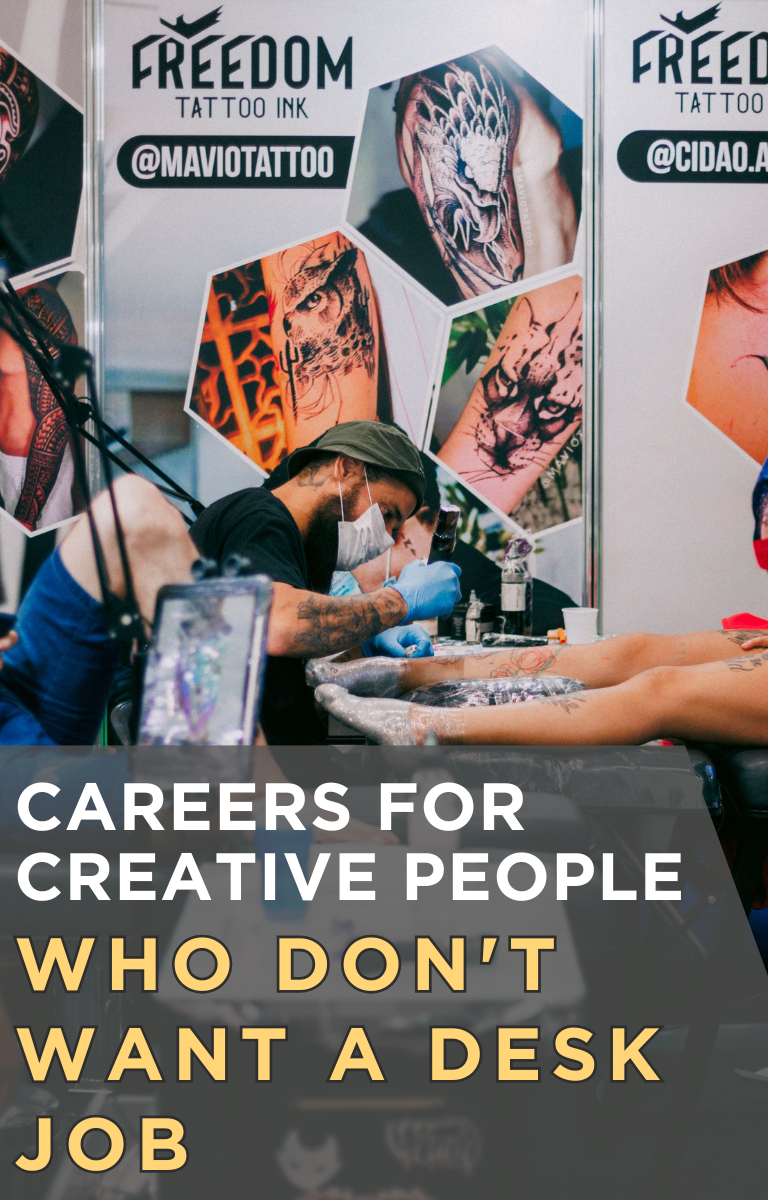
Careers for Creative People Who Don’t Want a Desk Job
November 27, 2026
In This Article
- Key Takeaways
- What counts as a unique job that pays well without a degree?
- Why are people walking away from the degree path?
- What are the best unique jobs that pay well without a degree?
- Why does becoming a Tattoo Artist top the list?
- How do you start a creative career without a degree?
- What does Ink Different’s Traditional Tattoo Apprenticeship offer?
- Who is the Master Mentorship for?
- Ready to build a career on your own terms?
- FAQ
Unique jobs that pay well without a degree include elevator installer, wind turbine technician, aircraft mechanic, commercial pilot and Tattoo Artist. These careers reward skill, certification and hands-on training rather than a four-year diploma. Several pay well above the national median of $49,500 for all occupations, according to the U.S. Bureau of Labor Statistics.
Some are also growing fast. The BLS projects employment of wind turbine technicians to grow 50% from 2024 to 2034, much faster than average. Below, we look at standout unique careers, what they pay and how a creative path like tattooing compares.
Key Takeaways
- Skill over diplomas: These jobs typically require training, certification or an apprenticeship rather than a bachelor’s degree.
- Top median earners: Elevator installers earned a median of $106,580 in May 2024, according to the BLS.
- Fast growth: Wind turbine technician jobs are projected to grow 50% from 2024 to 2034.
- Creative option: Tattooing pairs creative work with income that grows with skill and reputation.
- Training path: Ink Different’s Traditional Tattoo Apprenticeship takes 18 to 24 months across four phases.
What counts as a unique job that pays well without a degree?
It’s a skilled, often hands-on or creative career that values what you can do over academic credentials. You train for it through a certificate, an apprenticeship or on-the-job learning.
These aren’t the usual paths a guidance counselor suggests. They reward precision, problem-solving and craft. Many are learned the way trades always have been: by working alongside experienced professionals.
Why are people walking away from the degree path?
Many people are weighing the cost and time of college against faster, hands-on routes into well-paid work.
The cost difference is real. The College Board reports average published tuition and fees of $11,950 a year for in-state students at public four-year colleges in 2025-26. Meanwhile, many skilled careers train you in less time, sometimes while you earn.
There are plenty of jobs that pay well without a degree, and some of them clear $30 an hour without a degree. A few reach six figures, as this list of jobs that pay $100K a year without a degree shows.
Real Talk: Waiting for the perfect moment can cost you years. Research your options, then pick a path and start.

What are the best unique jobs that pay well without a degree?
Here are some standout careers where pay grows with skill rather than a transcript. Figures are BLS median pay for May 2024.
- Elevator and escalator installer: A median of $106,580, according to the BLS. Most learn through an apprenticeship.
- Commercial pilot: A median of $122,670 for commercial pilots, according to the BLS. It requires flight training and FAA certification, but not necessarily a degree.
- Aircraft mechanic: A median of $78,680, according to the BLS. Some train at FAA-approved schools, while others learn on the job or in the military.
- Wind turbine technician: A median of $62,580, with 50% projected growth from 2024 to 2034, per the BLS. Most train through a postsecondary certificate plus on-the-job training.
- Tattoo Artist: Learned through a tattoo apprenticeship, with income tied to skill, style and client base.
If a calmer workday matters to you, there are also low-stress jobs that pay well without a degree worth comparing. What these careers share is simple: employers and clients care about what you can do.
Why does becoming a Tattoo Artist top the list?
Tattooing combines creative freedom, strong earning potential and independence, and it’s learned through a tattoo apprenticeship rather than a degree.
Your work lives on someone who trusts you enough to wear it for life. It’s also person-to-person work that’s hard to automate, which is part of why Tattoo Artists stay essential.
The earning potential can be strong. ZipRecruiter puts the average Tattoo Artist salary at $106,858 a year, though income varies widely with skill, location and client base.
Some Tattoo Artists even turn down a traditional path to do it. Ink Different Master Mentor Jordi Pla gave up an aerospace scholarship to become a Tattoo Artist. Tattoo apprentices often juggle a lot, too. Joe Kendall balances two jobs and kids with his tattoo training.
How do you start a creative career without a degree?
Choose your craft, find structured training with a Mentor, learn the fundamentals and meet licensing requirements.
- Pick your craft. Commit to the skill that excites you.
- Find structured training. A Mentor can shorten your learning curve dramatically.
- Learn the fundamentals. For tattooing, that means drawing, linework, machine handling and safety, including the OSHA Bloodborne Pathogens Standard.
- Build your portfolio and brand. Your work becomes your resume, and the right platforms for building your brand help clients find it.
- Get licensed. Requirements vary by state, as this state-by-state tattoo licensing map shows.
Skipping fundamentals or rushing training are among the most common apprentice mistakes.
What does Ink Different’s Traditional Tattoo Apprenticeship offer?
Ink Different’s Traditional Tattoo Apprenticeship runs 18 to 24 months across four phases. It’s built for beginners, with in-person mentorship, licensing support and job-ready skills.
For 15 years, Ink Different has trained aspiring Tattoo Artists as a college alternative. In the Traditional Tattoo Apprenticeship, you train with a Mentor at one of 60+ tattoo studios nationwide.
- Phase 1, Art and Design Principles: Drawing, shading, digital design and building a portfolio.
- Phase 2, Machine Mastery and Practice Tattooing: Hand-control exercises, machine operation, lining, shading and color packing.
- Phase 3, Supervised Tattoos: Tattooing real skin under a Mentor’s direct supervision.
- Phase 4, Junior Artist Externship: Building client relationships and refining your skills while you start earning.
- Interest-free payment plans: Flexible payments make training more accessible.
You’ll finish with job-ready skills, licensing support and a guaranteed job offer at one of Ink Different’s own tattoo studios. Our “Good Humans” culture means you join a supportive, family-like community. Each Mentor takes just two tattoo apprentices per tattoo studio, so seats fill up quickly.
Who is the Master Mentorship for?
The one-year, in-person Master Mentorship is for beginners and experienced Tattoo Artists who want to master a specific style, grow their career or build their own tattoo studio.
You’ll train with celebrity and award-winning Master Mentors like Jordi Pla, with intensive, focused skill development.
We also offer Spanish-speaking locations in Denver, Orange County, NYC, Miami, San Antonio and San Diego.
Ready to build a career on your own terms?
You don’t need a degree to build a respected, well-paid career. You need the right training and the decision to start. For many people, a tattoo apprenticeship is a practical alternative to college, and it’s never too late. Army paratrooper Daniel Mercedes came back to tattooing seven years later to become a Tattoo Artist.
Ready to become a Tattoo Artist? Apply now to Ink Different’s Traditional Tattoo Apprenticeship and start building a creative career with licensing support along the way.
Frequently Asked Questions
What are some unique jobs that pay well without a degree?
Elevator installers, commercial pilots, aircraft mechanics, wind turbine technicians and Tattoo Artists are strong examples.
What’s the fastest-growing job without a degree?
Wind turbine technician is one of the fastest-growing occupations, with the BLS projecting 50% growth from 2024 to 2034.
How much do Tattoo Artists make?
ZipRecruiter reports an average of $106,858 a year, though income varies widely by skill, location and client base.
How long does it take to become a Tattoo Artist?
Most tattoo apprenticeships take one to three years. Ink Different’s Traditional Tattoo Apprenticeship takes 18 to 24 months across four phases.
Do I need art experience or a degree to start?
No. The Traditional Tattoo Apprenticeship is built for beginners and starts with art and design principles.
Will I get help becoming licensed?
Yes. The Traditional Tattoo Apprenticeship includes licensing support to help you meet your state’s requirements.
Sources (all checked November 25, 2026)
- U.S. Bureau of Labor Statistics: May 2024 national occupational employment and wages
- U.S. Bureau of Labor Statistics: Wind Turbine Technicians
- U.S. Bureau of Labor Statistics: Elevator and Escalator Installers and Repairers
- U.S. Bureau of Labor Statistics: Airline and Commercial Pilots
- U.S. Bureau of Labor Statistics: Aircraft and Avionics Equipment Mechanics and Technicians
- College Board: Trends in College Pricing highlights
- ZipRecruiter: Tattoo Artist Salary
- OSHA: Bloodborne Pathogens Standard