
Do Tattoo Artists Make Good Money? An Honest Answer
November 26, 2026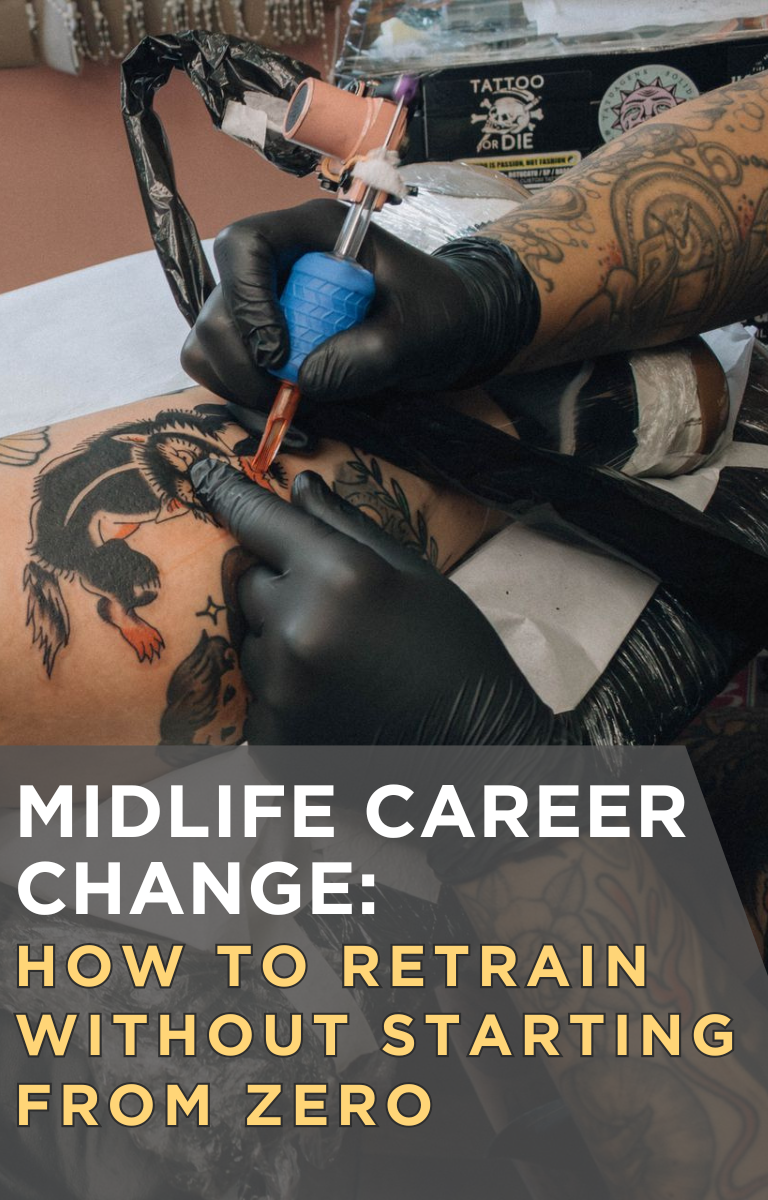
In This Article
- Key Takeaways
- What Is a Midlife Career Change (and Why It’s Not Starting Over)?
- Why Does a Midlife Career Change Feel So Terrifying?
- What Skills Can You Actually Bring With You?
- How Do You Retrain Without Going Back to College?
- What Are the Steps to Retrain as a Tattoo Artist?
- How Does Ink Different Support a Midlife Career Change?
- What If You Want to Go Further, Faster?
- Is Tattoo Training Available in Spanish?
- Ready to Retrain Without Starting From Zero?
- FAQ
A midlife career change means moving into new work in your 30s, 40s or 50s while building on the experience you already have. You don’t start from zero. Communication, reliability, problem-solving and handling pressure all carry over, and hands-on paths like a tattoo apprenticeship let you retrain without going back to college.
Changing jobs is more common than many people think. Americans born from 1957 to 1964 held an average of 12.7 jobs between ages 18 and 56, according to the U.S. Bureau of Labor Statistics. And with full retirement age at 67 for anyone born in 1960 or later, according to the Social Security Administration, a career change at 45 still leaves more than 20 years of working life. Below, we cover why midlife changes feel so hard, which skills transfer and how to retrain as a Tattoo Artist.
Key Takeaways
- Job changes are normal: The BLS reports an average of 12.7 jobs between ages 18 and 56 for later baby boomers.
- Time is on your side: Full retirement age is 67 for people born in 1960 or later, per the SSA.
- Your skills transfer: Client communication, precision and reliability are core tattooing skills.
- No college required: A tattoo apprenticeship is hands-on training in a working tattoo studio.
- Timeline: Ink Different’s Traditional Tattoo Apprenticeship takes 18 to 24 months across four phases.
What Is a Midlife Career Change (and Why It’s Not Starting Over)?
A midlife career change is a deliberate move into new work that uses the maturity and skills you’ve already built. You retrain on top of that foundation rather than starting from scratch.
Many people picture going back to a classroom full of 18-year-olds, broke and behind. That image keeps them stuck. In reality, retraining today can look very different, especially in hands-on trades.
The patience, communication and time management you’ve built over years of work don’t disappear when you change fields. They become the base for whatever you learn next.

Why Does a Midlife Career Change Feel So Terrifying?
It often comes down to sunk-cost thinking, fear of judgment and the belief that it’s “too late.”
Sunk-cost thinking sounds like: “I’ve invested too much to leave now.” But many people who leave do so for clear reasons. Among U.S. workers who quit a job in 2021, 63% said low pay was a reason, and 63% cited no opportunities for advancement, according to Pew Research Center.
If you’re in your 40s, a realistic plan for starting over can help you move forward without risking your stability. And if you’re a little older, it’s worth knowing that a hands-on career change at 50 is more realistic than many people assume.
You’re not too old. You’re experienced enough to make this decision with your eyes open.
What Skills Can You Actually Bring With You?
Most skills from a previous career transfer to tattooing, especially client communication, attention to detail, scheduling and the maturity to calm a nervous client.
Tattooing is a service built on trust, as well as an art. People who’ve spent years working with the public already know how to make clients feel safe and heard.
- Hospitality or retail: You know how to read people and manage expectations.
- Trades or manual work: You have steady hands and respect for precision.
- Healthcare: You understand hygiene and protocols like the OSHA Bloodborne Pathogens Standard.
- Office or corporate work: You know deadlines, scheduling and follow-through, the same habits that help people leaving a desk job for tattooing.
Ink Different apprentices prove it. Alex McLean spent 10 years in corporate and flooring work before his tattoo apprenticeship, and Ashley Pietkiewicz came from 10 years in medicine.
How Do You Retrain Without Going Back to College?
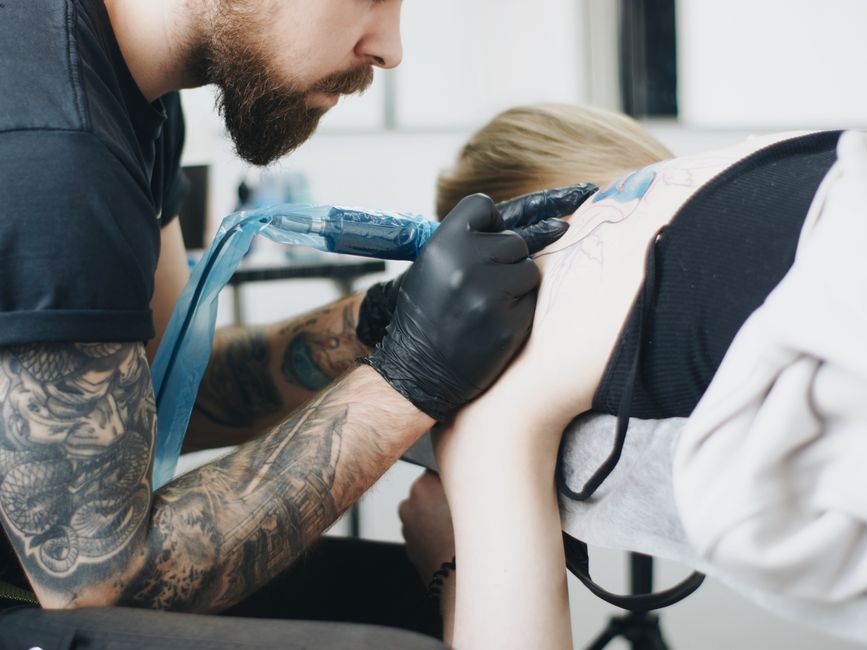
A structured tattoo apprenticeship lets you retrain hands-on, inside a working tattoo studio, with a Mentor guiding you.
A four-year degree is slow and expensive, and for many creative careers it isn’t the right fit. Tattooing has long been taught through mentorship, with one experienced Tattoo Artist guiding another. That makes it one of the most direct ways to retrain in midlife, and the same idea runs through this guide to changing careers at 40 without going back to college.
Even Tattoo Artists at the top of the field sometimes arrive by an unexpected route. Ink Different Master Mentor Liz Cook has talked on Tattoo Shop Tango about how she built a tattoo career she never planned.
Pro Tip: When comparing training options, look for in-person mentorship and real licensing support. Those two things separate serious training from empty promises.
What Are the Steps to Retrain as a Tattoo Artist?
Take stock of your skills, start drawing, join structured training, work through supervised phases and get licensed.
- Take honest inventory. List the skills from your current job that transfer, like patience, communication, precision and reliability. If it helps, follow a step-by-step career change plan.
- Start drawing again. You don’t need to be great yet. Fill a sketchbook to build the habit.
- Join a structured tattoo apprenticeship. Choose one with real Mentors, clear phases and licensing support. Rushing in without checking is one of the most common apprentice mistakes.
- Work through the phases. Build art fundamentals, then machine skills, then supervised tattooing on real skin.
- Get licensed. Requirements vary from state to state, as this state-by-state tattoo licensing map shows.

How Does Ink Different Support a Midlife Career Change?
Ink Different’s Traditional Tattoo Apprenticeship runs 18 to 24 months across four phases. It’s built for beginners and career changers, with in-person mentorship and licensing support.
For 15 years, Ink Different has trained aspiring Tattoo Artists. The people who do well aren’t always the youngest. They’re the ones who show up ready to learn. In the Traditional Tattoo Apprenticeship, you train with a Mentor at one of 60+ tattoo studios nationwide.
- Phase 1, Art and Design Principles: Drawing, shading, digital design and building a portfolio.
- Phase 2, Machine Mastery and Practice Tattooing: Hand-control exercises, machine operation, lining, shading and color packing.
- Phase 3, Supervised Tattoos: Tattooing real skin under a Mentor’s direct supervision.
- Phase 4, Junior Artist Externship: Building client relationships and refining your skills while you start earning.
- Interest-free payment plans: Flexible payments make training more accessible.
You’ll finish with job-ready skills, licensing support and a guaranteed job offer at one of Ink Different’s own tattoo studios. Once you’re established, income can grow with your skills and client base. ZipRecruiter puts the average Tattoo Artist salary at $106,858 a year, though pay varies widely by location and experience.
Our “Good Humans” culture means you join a community where questions are welcome and no one makes you feel late to the party. Edward Cuff, for example, went from Amazon deliveries to tattoo apprentice. Each Mentor takes just two tattoo apprentices per tattoo studio, so seats fill up quickly.
What If You Want to Go Further, Faster?
The Master Mentorship is a one-year, in-person program for beginners and experienced Tattoo Artists who want intensive skill development, a signature style or a path to business ownership.
In the Master Mentorship, you train with celebrity and award-winning Master Mentors like Liz Cook, with a focus on mastering a style, sharpening your business skills and building something of your own. If relocating is part of your plan, some states are easier for relocating Tattoo Artists than others, so check licensing rules before you move.
Is Tattoo Training Available in Spanish?
Yes. Ink Different offers Spanish-speaking locations in Denver, Orange County, New York City, Miami, San Antonio and San Diego.
The mentorship, standards and support are the same whether you train in English or Spanish.
Ready to Retrain Without Starting From Zero?
You already have a foundation of skills and experience. A midlife career change is about putting them to work somewhere that fits you better, with training that meets you where you are.
Ready to become a Tattoo Artist? Apply now to Ink Different’s Traditional Tattoo Apprenticeship and start building a career with licensing support along the way.
Frequently Asked Questions
Am I too old for a midlife career change into tattooing?
No. Many people start tattoo apprenticeships in their 30s, 40s and beyond, and maturity and people skills are real advantages.
How common is changing careers in midlife?
Very common. The BLS found that later baby boomers held an average of 12.7 jobs between ages 18 and 56.
How long does the Traditional Tattoo Apprenticeship take?
Ink Different’s Traditional Tattoo Apprenticeship takes 18 to 24 months across four phases, depending on your progress.
Do I need prior art experience to retrain as a Tattoo Artist?
No. The Traditional Tattoo Apprenticeship is built for beginners and starts with art and design principles.
Will my past work experience help?
Yes. Communication, hygiene awareness, precision and reliability all carry over into tattooing.
Is there Spanish-language support for a career change into tattooing?
Yes. Ink Different offers Spanish-speaking locations in Denver, Orange County, New York City, Miami, San Antonio and San Diego.
Sources (all checked November 23, 2026)