
Tattooing Over Scars: What Artists Need to Know
November 25, 2026
Midlife Career Change: How to Retrain Without Starting From Zero
November 26, 2026
In This Article
- Key Takeaways
- Do Tattoo Artists Make Good Money?
- How Much Do Tattoo Artists Actually Earn?
- What Affects a Tattoo Artist’s Income?
- How Can You Increase Your Income as a Tattoo Artist?
- How Fast Can You Start Earning?
- Is a Tattoo Career Worth the Investment?
- How Ink Different Helps You Build an Income
- Ready to Build a Career You Love?
- FAQ
Yes, many Tattoo Artists make good money, but income varies widely. ZipRecruiter puts the average Tattoo Artist salary in the United States at $106,858 a year, with most salaries falling between $43,500 and $80,000 and top earners at the 90th percentile making about $340,000. New Tattoo Artists usually start toward the lower end, while established Tattoo Artists with a strong reputation, a loyal client base and a sought-after style can earn far more.
That range reflects how tattoo income works. It’s tied to skill, location, booking volume and business sense, not a fixed salary. Below, we break down what Tattoo Artists earn, what moves income up or down and how earnings grow over a career.
Key Takeaways
- Average pay: ZipRecruiter reports an average of $106,858 a year, with a wide range.
- Typical range: Most salaries fall between $43,500 (25th percentile) and $80,000 (75th percentile), per ZipRecruiter.
- Income grows with experience: Pay usually rises as your skills, speed and client base grow.
- Location and specialty count: Where you work and what you’re known for both affect your rates.
- Training comes first: Strong fundamentals and licensing are the foundation of steady income.
Do Tattoo Artists Make Good Money?
Skilled, established Tattoo Artists can make good money, but income builds over time. Tattooing works like a trade, where earning power reflects skill, consistency and reputation.
Early in your career, you’re building clean linework, speed and repeat clients. Those are what eventually produce reliable income. The Tattoo Artists who struggle financially often rushed past the fundamentals. The ones who do well treat tattooing as a serious profession.
There’s strong demand, too. According to Pew Research Center, 32% of Americans have a tattoo, and 22% have more than one, which means many clients come back for more work.
How Much Do Tattoo Artists Actually Earn?
Earnings range widely, from modest starting income to six figures for in-demand Tattoo Artists.
Here’s how the numbers break down:
- ZipRecruiter average: $106,858 a year.
- ZipRecruiter middle range: Most salaries fall between $43,500 (25th percentile) and $80,000 (75th percentile).
- Top earners: About $340,000 a year at the 90th percentile, according to ZipRecruiter.
- Wider benchmark: The U.S. Bureau of Labor Statistics groups Tattoo Artists with craft and fine artists, who earned a median of $56,260 in May 2024.
Pay also varies a lot by region, which is clear when you compare what Tattoo Artists make by state. Schedules change the picture too. Some Tattoo Artists earn part-time income working weekends only while building their book.
Reality check: Tattoo income isn’t a fixed salary. It depends on your skill, how often you’re booked and how you treat your clients.
What Affects a Tattoo Artist’s Income?
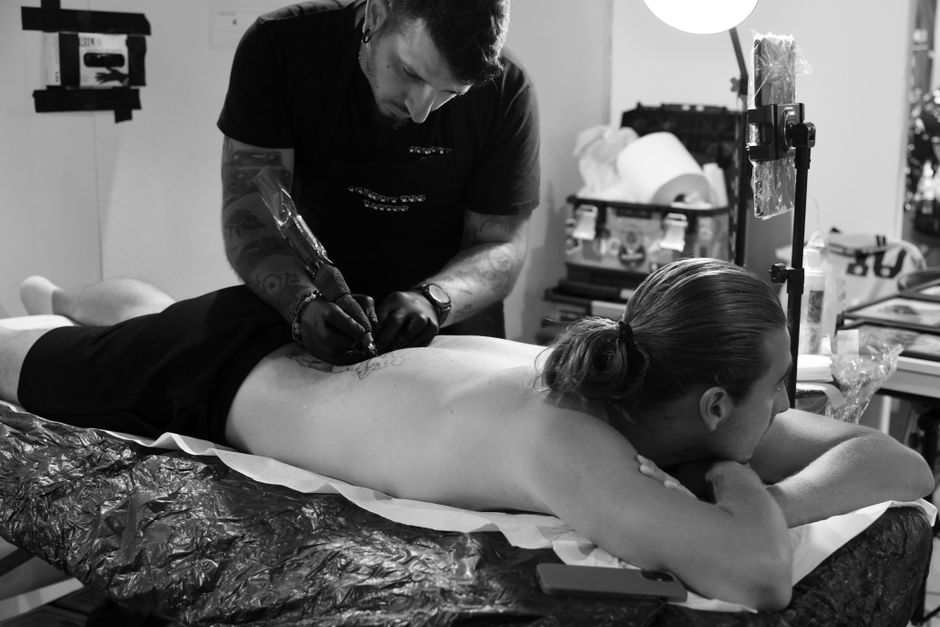
Skill level, location, tattoo studio reputation, specialty, booking consistency and business ability all shape what a Tattoo Artist earns.
- Skill and speed: Clean work done efficiently means more satisfied clients each week.
- Location: Busy markets can bring more walk-ins and higher rates, though costs may be higher too.
- Specialty: A sought-after style, like realism, fine line or Japanese, can support premium pricing.
- Reputation: Repeat clients and referrals keep your schedule full.
- Pay structure: Commission splits, booth rent and studio policies affect how much you take home.
- Business sense: Pricing, scheduling and marketing all make a difference.
Walk-in volume can make a big difference too. Ink Different Master Mentor BillyJack Gunter shared on Tattoo Shop Tango that he tattooed about 1,000 walk-ins since March and made more than ever.
How Can You Increase Your Income as a Tattoo Artist?
Sharpen your skills, specialize, build your brand, keep your license current and give every client a great experience.
- Master the fundamentals. Clean lines, smooth shading and good healing lead to repeat clients and referrals.
- Choose a specialty. A clear style attracts clients looking for exactly what you do.
- Build your portfolio and brand. A strong tattoo flash sheet shows your style, and the right platforms for building your brand help clients find you.
- Add income streams. Many Tattoo Artists earn extra by selling flash prints and merch.
- Keep your license current. Budgeting for license renewal fees by state prevents gaps in your ability to work.
- Create a great experience. Clients who feel cared for come back and send their friends.
Safe, clean work builds trust too. Professional tattoo studios follow the OSHA Bloodborne Pathogens Standard, and that trust helps keep your schedule full.
Some Tattoo Artists eventually move into ownership. Going from tattoo apprentice to tattoo studio owner adds income potential, along with more responsibility.
How Fast Can You Start Earning?
Many new Tattoo Artists start earning toward the end of a structured tattoo apprenticeship, then build income as their client base grows.
In Ink Different’s Traditional Tattoo Apprenticeship, apprentices start earning during Phase 4, the Junior Artist Externship. From there, income usually grows gradually and then picks up as your portfolio and reputation develop. Building a loyal client base takes time, but it’s what turns early bookings into steady income.
If you’re wondering what the work really demands before you commit, this breakdown of the skills, traits and training it takes to be a Tattoo Artist gives a realistic picture.
Is a Tattoo Career Worth the Investment?
For people who commit to mastering the craft, tattooing can be worth it. It offers creative work, income that rewards skill and a hands-on trade built on human connection.
Training costs and time are part of the equation. Many people compare a tattoo apprenticeship with college, where the College Board reports average published tuition and fees of $11,950 a year for in-state students at public four-year schools in 2025-26. For a creative, hands-on career, a tattoo apprenticeship can be a more direct route.
Some people take the leap later than they planned. Army paratrooper Daniel Mercedes came back to tattooing seven years later to become a Tattoo Artist.

How Ink Different Helps You Build an Income
Ink Different’s Traditional Tattoo Apprenticeship combines in-person mentorship, licensing support and job-ready skills. For 15 years, Ink Different has trained aspiring Tattoo Artists as a college alternative.
What You Can Expect from Our Traditional Tattoo Apprenticeship
The Traditional Tattoo Apprenticeship runs 18 to 24 months across four phases, with in-person training at one of 60+ tattoo studios nationwide. No prior art experience is needed.
- Phase 1, Art and Design Principles: Drawing, shading, digital design and building a portfolio.
- Phase 2, Machine Mastery and Practice Tattooing: Hand-control exercises, machine operation, lining, shading and color packing.
- Phase 3, Supervised Tattoos: Tattooing real skin under a Mentor’s direct supervision.
- Phase 4, Junior Artist Externship: Building client relationships and refining your skills while you start earning.
- Interest-free payment plans: Flexible payments make training more accessible.
A Career That Comes With Confidence
You’ll finish with job-ready skills, licensing support and a guaranteed job offer at one of Ink Different’s own tattoo studios, so you can start building income with a clear path forward.
Mentorship That Pushes Your Brand and Skills Further
The one-year, in-person Master Mentorship lets you train with celebrity and award-winning Master Mentors like BillyJack Gunter, with a focus on mastering a specific style, growing your career and learning the business side of running a tattoo studio.
Making Tattoo Training Accessible for Everyone
We offer Spanish-speaking locations in Denver, Orange County, New York City, Miami, San Antonio and San Diego. Our “Good Humans” culture means you join a supportive, family-like community.

Ready to Build a Career You Love?
Do Tattoo Artists make good money? Many do, especially once they’ve built strong skills, a loyal client base and good business habits. It takes time, but the earning potential is real. Each Mentor takes just two tattoo apprentices per tattoo studio, so seats fill up quickly.
Ready to become a Tattoo Artist? Apply now to Ink Different’s Traditional Tattoo Apprenticeship and start building a career with licensing support along the way.
Frequently Asked Questions
Do Tattoo Artists make good money?
Many do. ZipRecruiter reports an average of $106,858 a year, though most salaries fall between $43,500 and $80,000, depending on skill, location and client base.
How much do new Tattoo Artists make?
New Tattoo Artists usually earn less while building their portfolio and client base. Income tends to grow with experience and reputation.
What do top Tattoo Artists earn?
Top earners at the 90th percentile make about $340,000 a year, according to ZipRecruiter.
How long before a Tattoo Artist starts earning?
Often toward the end of training. In Ink Different’s Traditional Tattoo Apprenticeship, apprentices start earning during Phase 4, the Junior Artist Externship.
What affects how much a Tattoo Artist makes?
Skill, speed, location, specialty, reputation, pay structure and business habits.
Do I need prior art experience to start a tattoo apprenticeship?
No. The Traditional Tattoo Apprenticeship is built for beginners and starts with art and design principles.