Women Who Changed Tattooing: The Female Tattoo Artists Who Paved the Way
October 9, 2026
Areola and Nipple Tattooing After Breast Reconstruction: A Guide for Survivors
October 9, 2026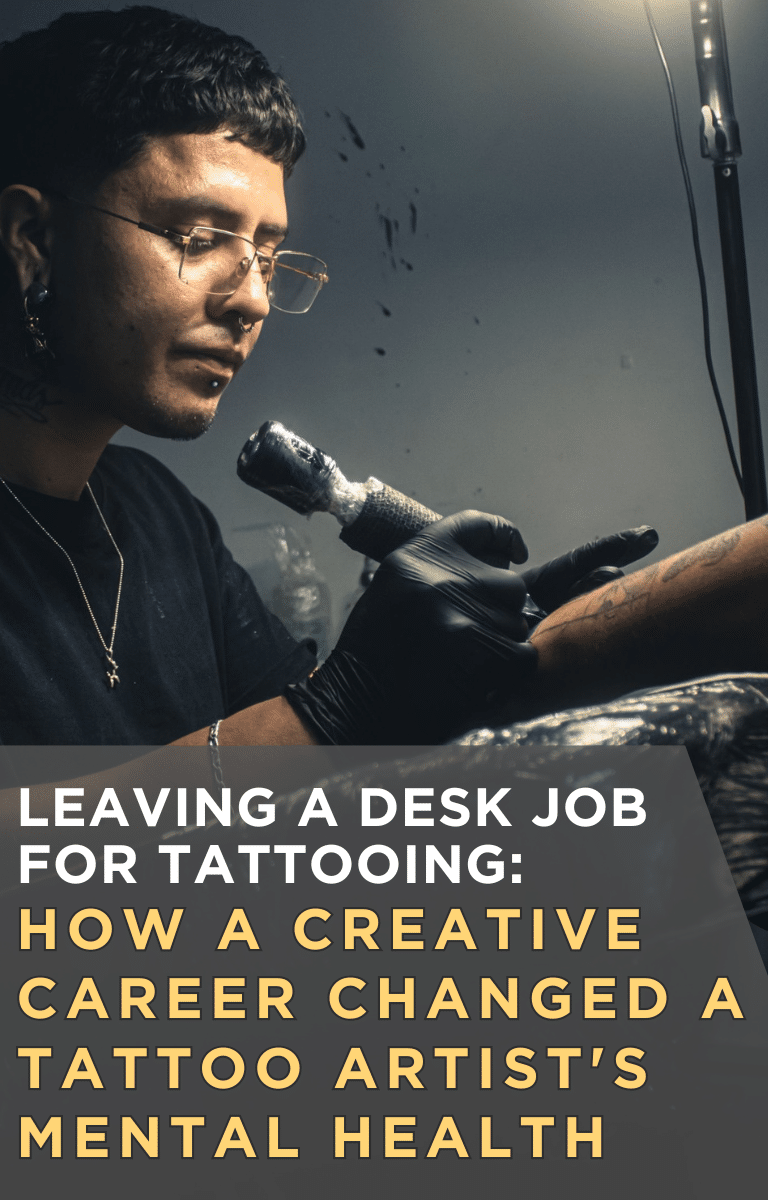
In This Article
- Key Takeaways
- What Happens to Your Mind in a Job That Drains You?
- Why Does Creative Work Improve Mental Health?
- How Does Tattooing Specifically Support Well-Being?
- What Are the Signs It’s Time to Leave Your Desk Job?
- How Do You Make the Leap From Desk Job to Tattooing?
- How Does Ink Different Guide Your Career Change?
- What Is the Traditional Tattoo Apprenticeship?
- What Is the Master Mentorship?
- Who Can Access Training, and Where?
- Ready to Trade the Cubicle for the Tattoo Machine?
- Frequently Asked Questions
Leaving a desk job for tattooing means trading chronic workplace stress and creative suppression for hands-on creative work built on human connection. Burnout is a state of chronic emotional, physical, and mental exhaustion caused by prolonged workplace stress. For many people, the fix is not a longer weekend. It is different work.
At Ink Different Tattoos, we’ve trained aspiring Tattoo Artists for 15 years, including many career changers. This guide covers why creative work can support your well-being and how to make the move.
Key Takeaways
- Desk-job burnout is real: Unfulfilling office work can erode mental health, feeding anxiety, creative suppression, and chronic dread.
- Creative work can reduce stress: Hands-on artistic work can lower stress and build a sense of focus, purpose, and presence.
- Tattooing is AI-proof and human: It is an automation-resistant craft built on meaningful connection and tangible skill.
- Training is structured and beginner-friendly: Ink Different’s Traditional Tattoo Apprenticeship runs 18 to 24 months, requires no prior art experience, and includes licensing support.
- Career change is a decision, not a fantasy: The first step is validating your passion and applying.
What Happens to Your Mind in a Job That Drains You?
A job that misaligns with who you are can wear down your mental health, feeding stress, anxiety, and a sense that your potential is going unused. You do not need a diagnosis to know something is wrong.
The symptoms are sneaky: irritability on Sunday nights, a creative itch you never get to scratch, and the feeling that your one life is passing by through a monitor.
You are not alone in this. According to Careershifters’ 2026 research, 73% of career changers say their work negatively affects their overall life satisfaction.
If work stress is affecting your health, a doctor or licensed therapist can help. A career change is one part of the picture, not a replacement for care.
Why Does Creative Work Improve Mental Health?
Creative work can support mental health by engaging your brain in focused flow, which can lower stress, quiet anxious thought patterns, and restore a sense of purpose and control.
When you make something with your hands, your attention narrows to the line, the shade, and the design in front of you. Some research suggests art-making can lower cortisol, the body’s primary stress hormone.
That kind of focus is hard to find in a day of emails and meetings. A creative career builds it into the work, so meaning becomes the default rather than the exception.

How Does Tattooing Specifically Support Well-Being?
Tattooing supports well-being by combining daily creative expression, meaningful human connection, tangible craftsmanship, and work that resists automation.
Tattooing is not just drawing. You sit with a person during one of the most personal moments of their life. You help them mark a memory, honor a loss, or celebrate a transformation. That human bond is deeply fulfilling, and no algorithm can replicate it.
There is also the pride of a craft. Every tattoo is proof of your growing skill. Unlike a report that disappears into a folder, your work walks out the door and lives on skin for decades. The Bureau of Labor Statistics tracks craft and fine artists as a field built on hands-on skill.
What Are the Signs It’s Time to Leave Your Desk Job?
The clearest signs it is time to leave are chronic dread on workdays, a suppressed creative drive, feeling undervalued, and sensing your real potential is going unused.
You do not need every box checked. One or two persistent signs are enough to pay attention. Here are the patterns we hear most from people who eventually made the leap:
- The Sunday scaries: Dread sets in before the work week even starts.
- Creative starvation: You daydream about making art but never have the energy after work.
- Autopilot living: Days blur together and you cannot remember the last time you felt genuinely excited.
- Envy, not inspiration: You scroll through working artists and feel a sting of what could have been.
Honest Truth: Staying in a job that drains you is not safe. It is slow. The real risk is reaching 60 and realizing you never bet on yourself.
How Do You Make the Leap From Desk Job to Tattooing?
You make the leap by planning your transition in deliberate steps: validating your passion, building fundamentals, finding real mentorship, completing a structured tattoo apprenticeship, and earning your license.
You do not have to quit on Monday with no plan. A smart career change is built in steps. According to Careershifters, 49% of career changers say their biggest obstacle is figuring out what else they want to do, and only 12% name money as their top obstacle. A defined path takes much of that guesswork out. Here is the path we guide people through:
- Step 1: Reconnect with your creativity. Start drawing again, even for 20 minutes a day. Prove to yourself the artist is still in there.
- Step 2: Learn the fundamentals. Study line work, shading, and design. Explore the tools every beginner tattoo artist should know.
- Step 3: Find a real Mentor. You cannot shortcut this craft. Live, in-person mentorship is how skill transfers. Avoid common traps by reading mistakes aspiring tattoo apprentices should avoid.
- Step 4: Enroll in a structured Tattoo Apprenticeship Program. This is where hobbyists become professionals through hands-on training.
- Step 5: Earn your license and build your brand. Complete your training, get licensing support, and start establishing yourself. See platforms to help tattoo artists build their brand.
Tattoo apprenticeships are increasingly recognized as a serious college alternative that leads to real, income-earning careers without the debt.

How Does Ink Different Guide Your Career Change?
Ink Different Tattoos guides your career change through live, in-person mentorship from award-winning Tattoo Artists, 15 years of experience since 2011, and a supportive “Good Humans” community.
We founded Ink Different in 2011 because talented people deserved a real path into this craft, not a guessing game. We are a college alternative built for aspiring professionals who pursue excellence, not shortcuts.
You get a map, the tools, and a family that has your back when the work gets hard. Nobody makes this change alone here.
What Is the Traditional Tattoo Apprenticeship?
The Traditional Tattoo Apprenticeship is an 18 to 24 month, four-phase tattoo apprenticeship that takes beginners from first sketch to job-ready professional with licensing support and hands-on mentorship.
You do not need prior art experience. It is built to meet you where you are and develop your skills step by step. Here is what you can expect:
- Personalized hands-on training: Direct, live instruction from experienced Mentors.
- Real studio training: Train in working tattoo studios under experienced Mentors.
- Beginner-friendly: No portfolio or formal background required to begin.
- Job-ready outcomes: Graduate with professional skills, licensing support, and a guaranteed job offer at one of our tattoo studios.
This is a career built on trust, skill, and human connection, not algorithms. Tattooing is an AI-proof craft rooted in hand skill and lasting impact. Part of your training includes safety fundamentals aligned with OSHA bloodborne pathogen standards, so you work cleanly and responsibly from day one.
What Is the Master Mentorship?
The Master Mentorship is a one-year, in-person intensive training for beginner and experienced artists who want to master a specific tattoo style, grow their career, and build a business under award-winning Tattoo Artists.
If you are ready to push your brand and skills further, this is your accelerator. You train directly with award-winning Tattoo Artists including Al Fliction, Liz Cook, Kyle Dunbar, Boneface, and Jordi Pla, who have shaped the modern tattoo industry.
It is intensive, focused skill development for people serious about standing out and owning their future. This is exclusive access you cannot get from an online course.
Who Can Access Training, and Where?
Ink Different operates nationwide, with the Traditional Tattoo Apprenticeship available in 60+ locations, including Spanish-speaking locations in Denver, Orange County, NYC, Miami, San Antonio, and San Diego.
Your language should never be a barrier to a creative career. Whether you are looking for Spanish-speaking training near Miami or English-language instruction in NYC, you get mentorship in the language you think and dream in. Seats in our hands-on training are limited by nature, since real mentorship cannot be mass-produced. If you are considering the leap, you can explore explore a career change tattoo apprenticeship starting today.
Ready to Trade the Cubicle for the Tattoo Machine?
If your current job leaves your creative side unused, a tattoo apprenticeship gives you a structured way out. The first step is deciding to apply.
Ready to become a Tattoo Artist? Apply now to Ink Different’s Traditional Tattoo Apprenticeship and start building an AI-proof career, with licensing support along the way. Not sure yet? Fill out our quick questionnaire to get personalized support and find out if our Traditional Tattoo Apprenticeship is right for you.
Frequently Asked Questions
Is it too late to leave my desk job and become a Tattoo Artist?
No. People transition into tattooing at many ages and life stages. What matters is your commitment to training and willingness to develop skill, not your current age or job title.
Do I need art experience to start a tattoo apprenticeship?
No. Ink Different’s Traditional Tattoo Apprenticeship is built for beginners and teaches drawing fundamentals, line work, and machine handling from day one.
How long does the Traditional Tattoo Apprenticeship take?
The Traditional Tattoo Apprenticeship takes 18 to 24 months across four phases, starting remote and finishing with hands-on training in real tattoo studios.
Can a creative career really improve my mental health?
Yes. Creative, hands-on work promotes flow state linked to reduced stress and greater purpose. Many former desk workers describe the change as life-altering.
What makes Ink Different different from other training?
Ink Different offers live mentorship from award-winning artists, 15 years of experience since 2011, licensing support, and a supportive community.
Where can I train if I prefer Spanish-speaking instruction?
Ink Different offers Spanish-language locations in Denver, Orange County, New York City, Miami, San Antonio, and San Diego for nationwide access.