Trade School Requirements: Do You Need a GED?
November 23, 2026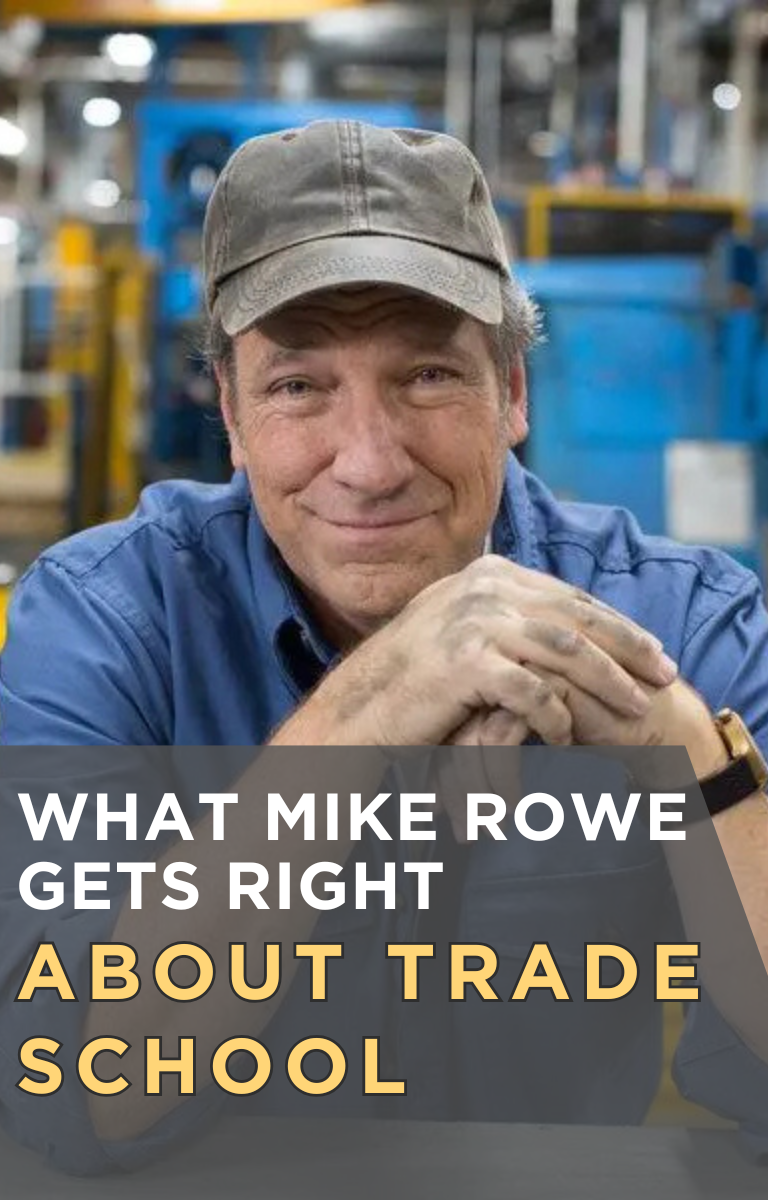
In This Article
- Key Takeaways
- Who Is Mike Rowe and Why Does His Trade School Message Matter?
- What Does Mike Rowe Actually Get Right About Trade School?
- Why Is There a Skills Gap in America Right Now?
- Is Tattooing a Trade Worth Learning?
- How Do You Start a Skilled Trade Like Tattooing?
- How Does Ink Different Tattoos Apply the Mike Rowe Philosophy?
- What Is the Master Mentorship Option?
- Frequently Asked Questions
Mike Rowe’s core argument about trade school is that skilled trades are valuable, in-demand careers that deserve the same respect as a four-year degree. He argues that schools and families spent decades steering students toward college, treating trades as a backup plan. The result, in his view, is a shortage of skilled workers and a generation weighed down by costly degrees. A lot of what he says holds up, and it applies to creative trades like tattooing too.
Rowe has been making this case for years. In 2017, he wrote on his website that Forbes had credited him with inspiring its first-ever ranking of trade schools. Below, we look at what he says, what the data shows and how it applies to tattooing.
Key Takeaways
- His message: Skilled trades are respected, in-demand careers, not a “consolation prize.”
- College costs: Rowe argues that a four-year degree has become one of the fastest-rising costs in American life.
- The skills gap: Industries from electrical work to shipbuilding report needing hundreds of thousands more workers.
- Tattooing fits: It’s a hands-on craft learned through apprenticeship, with licensing and strong earning potential.
- Training path: Ink Different’s Traditional Tattoo Apprenticeship takes 18 to 24 months and requires no prior art experience.
Who Is Mike Rowe and Why Does His Trade School Message Matter?
Mike Rowe is best known as the host of Dirty Jobs, which spotlighted essential, hands-on work across America. He’s also CEO of the mikeroweWORKS Foundation, which supports people training for skilled trades.
His message matters because it challenges a long-held assumption that college is the only respectable path. In a 2026 Fortune article, Rowe described how learning a trade came to be treated as a “vocational consolation prize,” a shift he traces back to schools removing shop classes in the 1970s and ’80s.
Interest in his message is growing. Rowe said applications to his foundation jumped tenfold over the past year, according to the same Fortune article.
Worth remembering: A good job isn’t defined by a diploma. It’s defined by whether the work pays, takes real skill and gives you something to be proud of.
What Does Mike Rowe Actually Get Right About Trade School?
Rowe gets three big things right: college costs have soared, skilled trades are in high demand and the way we define a “good education” needs to change.
College has become extremely expensive.
Speaking at a BlackRock infrastructure summit in 2026, Rowe argued that nothing in Western history has risen in price faster than a four-year degree, while noting that a degree can still be valuable, as Fortune reported. The data supports him: Fortune cites J.P. Morgan Asset Management analysis showing that college tuition outpaced every other household expense between 1983 and 2025.
Skilled trades pay.
Rowe described meeting three electricians under 30 at a data center in Plano, Texas, who earned between $240,000 and $280,000 a year with no college debt, according to Fortune. Those are standout examples, but many trades pay well above average. Electricians, plumbers, and other trade school jobs that pay well often earn more than the national median.
“Good education” needs a broader definition.
On his website, Rowe wrote, “We simply have to change the way we approach and define a ‘good education.’” He was reacting to Forbes treating trade schools and two-year colleges with the same respect as four-year universities.
Want to learn more in his own words? You can watch him discuss the immediate need for trade school training or his back-to-trade-school conversation with Fox News host Kennedy.
Why Is There a Skills Gap in America Right Now?
The skills gap grew as students were steered toward four-year degrees while trades lost visibility and prestige. Now many industries can’t find enough trained workers.
The numbers are striking. Fortune reports that an estimated 300,000 new electricians will be needed over the next decade, on top of replacing roughly 200,000 retirees. The U.S. Bureau of Labor Statistics projects electrician employment to grow 9% from 2024 to 2034, much faster than average. Rowe has also pointed to shipbuilders, welders and plumbers as fields needing large numbers of new workers.
For people willing to learn a trade, that demand means opportunity. Some of the highest-paying trade school jobs reach six figures, and many take far less time to train for than a bachelor’s degree.

Is Tattooing a Trade Worth Learning?
For creative, people-focused workers, yes. Tattooing is a skilled trade that takes technical mastery, safety training and, in most states, licensing. It’s also learned the way Rowe champions: hands-on, through apprenticeship.
It checks many of the same boxes as other trades. It’s hands-on, it requires real skill and it can’t be outsourced. Tattoo Artists follow strict safety practices, like the OSHA Bloodborne Pathogens Standard, and meet state or local licensing rules.
It also pays well once you’re established. ZipRecruiter puts the average Tattoo Artist salary at $106,858 a year as of November 2026, with income tied to skill, reputation and client base. Demand is strong: according to Pew Research Center, 32% of Americans have a tattoo, and 22% have more than one.
It can also be a real career change. Edward Cuff, for example, went from Amazon deliveries to tattoo apprentice.
How Do You Start a Skilled Trade Like Tattooing?
Find structured, hands-on training, learn the fundamentals under a Mentor, practice under supervision and meet your state’s licensing rules.
- Commit to the decision. Make a realistic plan for your time and finances during training.
- Find structured training. For most trades, that means getting into a trade school or apprenticeship. For tattooing, look for in-person mentorship with a clear plan.
- Learn the fundamentals. Drawing, linework, shading, machine handling and sanitation come before client work.
- Practice under supervision. Move from practice skin to real clients when your Mentor says you’re ready.
- Meet licensing requirements. Rules vary by state, from Texas to California to Colorado.
How Does Ink Different Tattoos Apply the Mike Rowe Philosophy?
Ink Different isn’t affiliated with Mike Rowe, but its approach reflects the same idea: skilled, hands-on careers can be learned through mentorship, without a four-year degree.
For 15 years, Ink Different has trained aspiring Tattoo Artists as a college alternative. The Traditional Tattoo Apprenticeship runs 18 to 24 months across four phases, with in-person training at one of 60+ tattoo studios nationwide. No prior art experience is required.
- Phase 1, Art and Design Principles: Drawing, shading, digital design and building a portfolio.
- Phase 2, Machine Mastery and Practice Tattooing: Hand-control exercises, machine operation, lining, shading and color packing.
- Phase 3, Supervised Tattoos: Tattooing real skin under a Mentor’s direct supervision.
- Phase 4, Junior Artist Externship: Building client relationships and refining your skills while you start earning.
You’ll finish with job-ready skills, licensing support and a guaranteed job offer at one of Ink Different’s own tattoo studios. Interest-free payment plans help make training more accessible, and our “Good Humans” culture means you join a supportive, family-like community. Each Mentor takes just two tattoo apprentices per tattoo studio, so seats fill up quickly.
What Is the Master Mentorship Option?
The Master Mentorship is one year of in-person training where beginners and experienced Tattoo Artists work directly with celebrity and award-winning Master Mentors to master a style, grow their career and build a business.
You’ll train with Master Mentors including Al Fliction, Liz Cook, Kyle Dunbar, Boneface, Jordi Pla and Marcel Oliveira.
We also offer Spanish-speaking locations in Denver, Orange County, NYC, Miami, San Antonio and San Diego.

Ready to Build a Career With Your Hands?
Mike Rowe has spent years making the case that skilled, hands-on work deserves more respect, and the labor market is backing him up. If a creative trade like tattooing appeals to you, there’s a clear path in.
Ready to become a Tattoo Artist? Apply now to Ink Different’s Traditional Tattoo Apprenticeship and start building a skilled-trade career with licensing support along the way.
Frequently Asked Questions
What does Mike Rowe say about trade school?
He argues that skilled trades are valuable careers that schools wrongly treated as a “consolation prize,” and that college has become extremely expensive while skilled workers are in short supply.
What is the mikeroweWORKS Foundation?
It’s Mike Rowe’s foundation, which supports people pursuing skilled trades. Rowe serves as its CEO.
Is tattooing considered a skilled trade?
It’s a hands-on craft that requires technical skill, safety training and, in most states, licensing, and it’s typically learned through apprenticeship.
How long does a tattoo apprenticeship take?
Most take one to three years. Ink Different’s Traditional Tattoo Apprenticeship takes 18 to 24 months across four phases.
Do I need art experience to start a tattoo apprenticeship?
No. Ink Different’s Traditional Tattoo Apprenticeship is built for beginners and starts with art and design principles.
Is a tattoo apprenticeship a real alternative to college?
For many people, yes. It teaches a skilled, in-demand craft through mentorship, usually with less time and debt than a four-year degree.