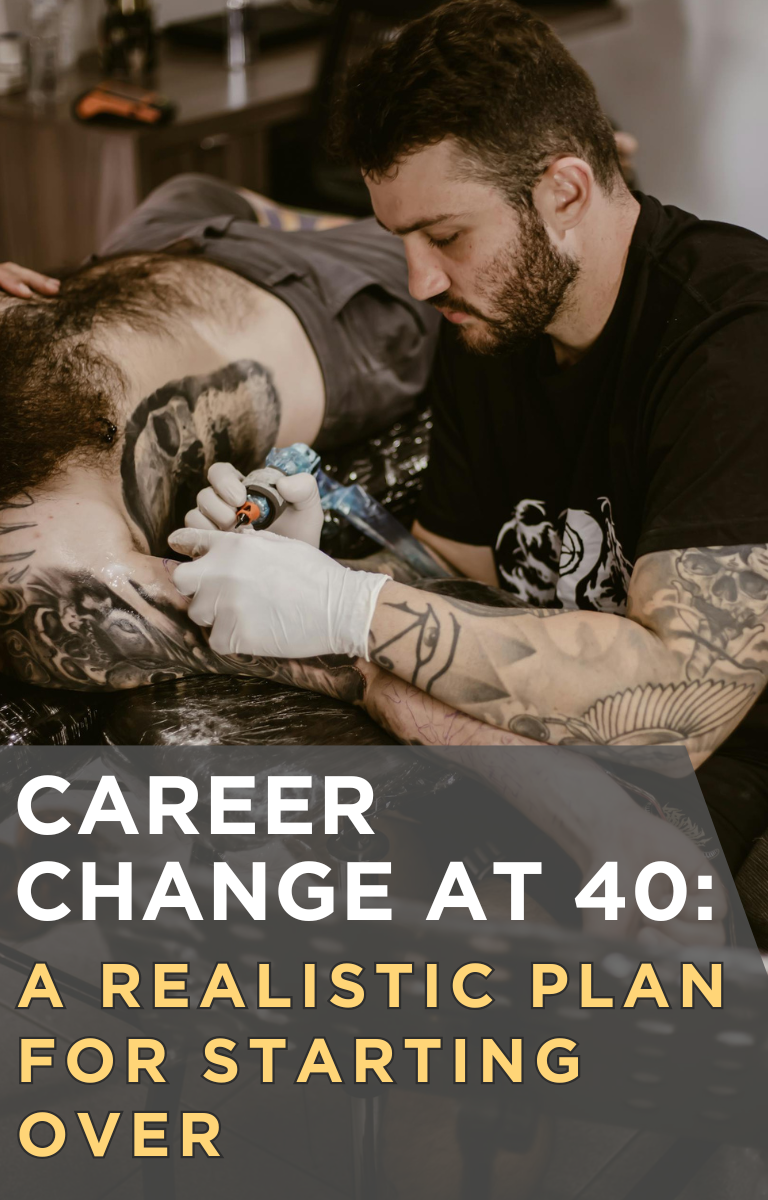
Career Change at 40: A Realistic Plan for Starting Over
November 11, 2026
In This Article
- Key Takeaways
- What is trade school and why does it matter?
- How do you get into trade school step by step?
- What do you need to get accepted?
- How much does trade school cost compared to college?
- How do you choose the right trade?
- Why is tattooing one of the smartest trades to learn?
- How does Ink Different’s apprenticeship work?
- Ready to take the first step?
- Frequently Asked Questions
Getting into trade school is usually simpler than getting into a four-year college. Most programs ask for a high school diploma or GED, an application and sometimes an interview, a placement test or a minimum age. There’s typically no SAT, no essay marathon and no years of prerequisites.
More people are taking this route. In spring 2025, public two-year colleges with a heavy vocational focus grew enrollment by 11.7%, according to the National Student Clearinghouse Research Center.
This guide walks you through how to get into trade school, step by step: what you need to apply, how to find and compare programs, how to pay for training and how to pick the right trade. We’ll also cover tattooing, a skilled trade with its own training path. At Ink Different Tattoos, we’ve spent 15 years training people for that path.
Key Takeaways
- Basic requirements: Most trade programs require a high school diploma or GED, an application and sometimes an interview or placement test.
- Finding programs: The U.S. Department of Labor’s free Local Training Finder lists schools and training programs near you.
- Cost: Average public two-year in-district tuition was $4,150 in 2025-26, compared with $11,950 at public four-year colleges.
- Paying for it: Federal aid, workforce funding, payment plans and paid apprenticeships can all help.
- Tattoo path: Most Tattoo Artists train through a structured tattoo apprenticeship rather than a traditional trade school.
What is trade school and why does it matter?
Trade school is focused training for a specific skilled profession. It gives you job-ready skills in far less time than a traditional four-year degree.
Instead of general education courses, you spend your time learning the skills your trade requires, like electrical work, HVAC, welding, cosmetology or plumbing. Many trades also combine classroom learning with paid on-the-job training. According to Apprenticeship.gov, 93% of apprentices keep their jobs after completing an apprenticeship, with an average starting salary of $86,000.
Hands-on trades also tend to be harder to automate, because they depend on physical skill and human judgment.
How do you get into trade school step by step?
Earn your diploma or GED, research programs, apply, complete any interview or testing, arrange financing and enroll.
Here’s the roadmap:
- Step 1: Earn your high school diploma or GED. Most trade programs require one of these before you apply.
- Step 2: Research trades and programs. Use the U.S. Department of Labor’s CareerOneStop Local Training Finder to search schools and training programs by trade and location.
- Step 3: Check accreditation and outcomes. Confirm the school is accredited, and ask about completion rates, job placement and licensing exam pass rates.
- Step 4: Prepare your application. Gather transcripts, ID, references and a portfolio if your trade calls for one.
- Step 5: Complete any interview or placement test. Many programs want to know your goals and confirm you’re ready.
- Step 6: Arrange financing. File the FAFSA through Federal Student Aid if your school is eligible, and compare payment plans and workforce funding.
- Step 7: Enroll and show up ready to work. Your effort from day one shapes how far you go.
There’s free help available, too. CareerOneStop’s Local Training Finder includes training programs from public and private schools and other providers that have been approved for WIOA funding. That WIOA designation indicates a program has been identified as high-quality preparation for employment in an in-demand career. careeronestop careeronestop
Pro Tip: Don’t pick a program on price alone. Hands-on hours, instructor experience and real-world preparation matter far more than a slightly lower sticker price.
What do you need to get accepted?
Most trade schools require a high school diploma or GED and a completed application. Depending on the trade, you may also need an interview, a placement test, a portfolio or a minimum age of 18.
The requirements are much less intimidating than a four-year university’s. You generally won’t need standardized test scores or a long list of prerequisites. Some trades add their own requirements, such as a valid driver’s license for commercial driving or a background check for certain healthcare roles.
For creative trades like tattooing, your willingness to learn often matters more than existing experience. Before you apply anywhere, read about the mistakes aspiring tattoo apprentices should avoid.
How much does trade school cost compared to college?
Trade school typically costs much less than a four-year degree and takes less time, so you can start earning sooner with less debt.
Here’s what the College Board reports for 2025-26:
- Public two-year colleges: Average in-district tuition and fees of $4,150, where many trade programs are offered. collegeboard
- Public four-year colleges: Average in-state tuition and fees of $11,950 a year. collegeboard
- Full student budgets: From $21,320 for public two-year in-district students to $65,470 for private nonprofit four-year students, including living costs. collegeboard
Private career schools can cost more than public colleges, so compare carefully. For a deeper look at why more people choose hands-on training, see why tattoo apprenticeships are gaining ground as a solid alternative to college.
How do you choose the right trade?
Match your strengths and interests with careers that are in demand, hard to automate and let you work with your hands.
Ask yourself three questions:
- What work would you enjoy even on a tough day?
- Which skills are hard for machines to replace?
- Which career lets you keep growing instead of plateauing?
Research pay and outlook before you commit. The BLS Occupational Outlook Handbook covers pay, training requirements and job outlook for hundreds of careers.
The trades that hold value long term tend to rely on human skill and judgment. A machine can stamp out identical parts, but it can’t listen to a client’s story and turn it into permanent art. Read more about why Tattoo Artists are still essential.
Why is tattooing one of the smartest trades to learn?
Tattooing combines creative work, real earning potential and a skill set that’s very hard to automate.
Every client brings a story, and a Tattoo Artist’s job is to turn it into permanent art on living skin. That takes technical skill, trust and judgment. The earning potential is real, too. According to ZipRecruiter, the average Tattoo Artist in the United States earns $106,858 a year as of November 2026.
Tattooing works a little differently from most trades. In most places, you won’t find it in a trade school catalog. Most Tattoo Artists learn through a structured tattoo apprenticeship under an experienced Mentor, plus whatever licensing or registration their state requires. Rules vary, so see how to get your tattoo license in Texas, tattoo license requirements in California or how long it takes to get a tattoo license in Colorado.
Quality training covers safety in line with the OSHA Bloodborne Pathogens Standard. It also covers client aftercare based on guidance like the American Academy of Dermatology’s tips for caring for tattooed skin.

How does Ink Different’s apprenticeship work?
Ink Different’s Traditional Tattoo Apprenticeship takes 18 to 24 months across four phases. It takes beginners to job-ready Tattoo Artists, with licensing support along the way.
What you can expect from our Traditional Tattoo Apprenticeship
- No experience needed: We teach drawing fundamentals, linework and machine handling from day one.
- In-person training: Learn with a Mentor at one of 60+ tattoo studios nationwide.
- Personalized, hands-on training: Real-time feedback from working Tattoo Artists, not videos you watch alone.
- Licensing support and a guaranteed job offer: You finish job-ready, with help meeting your state’s requirements and a guaranteed job offer at one of Ink Different’s own tattoo studios.
- Interest-free payment plans: Flexible payments make training more accessible.
A career that comes with confidence
By the time you finish all four phases, you’ve done the real work: supervised client tattoos, a portfolio you built yourself and the knowledge to run a session professionally.
Mentorship that pushes your brand and skills further
Want to master a specific style? Our one-year, in-person Master Mentorship lets you train alongside celebrity and award-winning Master Mentors, including Al Fliction, Liz Cook, Kyle Dunbar, Boneface, Jordi Pla and Marcel Oliveira. It’s built for beginners and experienced Tattoo Artists focused on career growth and business ownership.
Making tattoo training accessible for everyone
We offer Spanish-speaking locations in Denver, Orange County, NYC, Miami, San Antonio and San Diego. Our “Good Humans” culture means you join a supportive, family-like community.
Remember: Each Mentor takes just two tattoo apprentices per tattoo studio, so seats fill up quickly.

Ready to take the first step?
Getting into trade school comes down to a few clear steps: meet the basic requirements, find a quality program and plan how you’ll pay for it. If the trade that interests you is tattooing, a structured tattoo apprenticeship is the most direct way in.
If you’re switching careers, read why a tattoo apprenticeship is perfect for career changers starting over.
Ready to become a Tattoo Artist? Apply now to Ink Different’s Traditional Tattoo Apprenticeship and start building an AI-proof career with licensing support along the way.
Frequently Asked Questions
What do you need to get into trade school?
Most trade schools require a high school diploma or GED and a completed application. Some also require an interview, a placement test, a portfolio or a minimum age.
Do trade schools require the SAT or ACT?
Usually not. Most trade programs don’t require standardized test scores, though some use placement tests to check basic reading and math skills.
How do I find trade schools near me?
Use the U.S. Department of Labor’s free CareerOneStop Local Training Finder. You can search programs by trade and location and spot WIOA-approved options.
Can I get financial aid for trade school?
Many accredited trade schools are eligible for federal aid through the FAFSA. Workforce funding, scholarships, payment plans and paid apprenticeships can also help.
How long does a tattoo apprenticeship take?
Most take one to three years. Ink Different’s Traditional Tattoo Apprenticeship takes 18 to 24 months across four phases.
Do I need art experience to start a tattoo apprenticeship?
No. Ink Different’s Traditional Tattoo Apprenticeship teaches drawing fundamentals, linework and machine handling from day one.