
Trade Schools for Artists: Creative Trades Worth Training For
November 16, 2026
6-Month Trade School Programs: What You Can Learn Fast
November 16, 2026
In This Article
- Key Takeaways
- What are the highest paying trade school jobs?
- Why are trade careers worth considering over a four-year degree?
- What trade school jobs pay the most?
- How does becoming a Tattoo Artist compare to other trades?
- How do you start a high-income trade career?
- How Ink Different Trains the Next Generation of Tattoo Artists
- What is the Master Mentorship Program?
- How is Ink Different making training accessible?
- Ready to Build a High-Income Trade Career?
- Frequently Asked Questions
The highest paying trade school jobs include radiation therapists, elevator installers, dental hygienists and electrical power-line workers, all with median pay near or above $90,000 a year. Plumbers, electricians and HVAC technicians also pay above the national median. Tattoo Artists can earn strong incomes too, with pay tied to skill and reputation.
For context, the U.S. Bureau of Labor Statistics puts the median wage for all occupations at $49,500 in May 2024. Below, we rank the top trade school jobs by pay, show how each one is learned and look at how tattooing compares.
Key Takeaways
- Top earners: Radiation therapists ($101,990) and elevator installers ($106,580) lead the BLS medians on this list.
- Two training paths: Some trades are learned through apprenticeships, while healthcare technical roles usually need an associate degree from a community or technical college.
- Fast compared with college: Most of these paths take two to five years, often while earning.
- Tattoo Artists: ZipRecruiter reports an average of $106,858 a year, with a wide range depending on skill and reputation.
- Hard to automate: Hands-on, person-to-person work is difficult for software to replace.
What are the highest paying trade school jobs?
They’re skilled, hands-on careers learned through trade schools, technical colleges or apprenticeships rather than a four-year degree, and many pay well above the national median.
“Trade school jobs” usually fall into two groups:
- Skilled trades like elevator installation, line work, plumbing, electrical and HVAC, often learned through apprenticeships and certificate programs.
- Technical healthcare careers like radiation therapy and dental hygiene, usually learned through associate degree programs at community or technical colleges.
What they share is hands-on, job-specific training. You build marketable skills from the start.
Why are trade careers worth considering over a four-year degree?
Trade careers can get you earning sooner, usually with less debt, while building practical skills.
The cost difference is real. The College Board reports that average published tuition and fees for in-state students at public four-year colleges reached $11,950 in 2025-26, per year. Average in-district tuition and fees at public two-year colleges were $4,150.
Many trades also offer paid training. According to Apprenticeship.gov, 93% of apprentices keep their jobs after completing an apprenticeship, with an average starting salary of $86,000. That’s one reason tattoo apprenticeships are gaining ground as a solid alternative to college.
Pro Tip: Look for careers that require hands-on skill and personal judgment. They tend to be harder to outsource or automate.

What trade school jobs pay the most?
Here are some of the top-paying trade school jobs, using BLS median pay for May 2024. Tattoo Artist pay comes from ZipRecruiter, which reports an average.
1. Elevator and Escalator Installer
- Median pay: $106,580, per the BLS.
- Training: Nearly all learn through an apprenticeship, and most states require a license.
2. Radiation Therapist
- Median pay: $101,990, per the BLS.
- Training: Radiation therapists typically need an associate’s or bachelor’s degree in radiation therapy. Most states require radiation therapists to be licensed or certified, which often includes passing a national certification exam. bls
3. Dental Hygienist
- Median pay: $94,260, per the BLS.
- Training: Dental hygienists typically need an associate’s degree in dental hygiene. Programs usually take 3 years to complete. All states require dental hygienists to be licensed; requirements vary by state. bls
- Outlook: Employment of dental hygienists is projected to grow 7 percent from 2024 to 2034, much faster than the average for all occupations. bls
4. Electrical Power-Line Installer and Repairer
- Median pay: $92,560, per the BLS.
- Training: Usually a high school diploma plus long-term on-the-job training or an apprenticeship.
5. Plumber
- Median pay: $62,970, per the BLS.
- Training: Most learn through a four- or five-year apprenticeship, then pass a licensing exam.
6. Electrician
- Median pay: $62,350, per the BLS.
- Training: Usually an apprenticeship and a state license.
7. HVAC Technician
- Median pay: $59,810, per the BLS.
- Training: Typically a postsecondary nondegree award, such as a trade school certificate.
8. Tattoo Artist
- Average pay: $106,858 a year, according to ZipRecruiter as of November 2026. Most salaries fall between $43,500 (25th percentile) and $80,000 (75th percentile), with top earners (90th percentile) making $340,000.
- Training: Usually a structured tattoo apprenticeship, plus your state’s licensing or registration requirements.
Many trades require safety training. In tattooing and healthcare, that includes the OSHA Bloodborne Pathogens Standard.
How does becoming a Tattoo Artist compare to other trades?
Tattooing stands out because it combines creative freedom, independent income potential and a person-to-person skill set that’s hard to automate.
Many trades pay well, but few let you build your own brand, shape your own schedule and turn creativity into income. A Tattoo Artist is part craftsperson, part business owner.
The trade-off is that tattoo income varies more than in salaried trades. ZipRecruiter’s wide range reflects how much skill, reputation, location and client base affect pay. Read more about why Tattoo Artists are still essential.
How do you start a high-income trade career?
Choose a trade that fits your strengths, find quality training with real mentorship and commit fully to the process.
If tattooing is your path, here’s how to start:
- Step 1: Commit to the decision. Make a plan for your time and finances.
- Step 2: Choose your trade. For creative, people-focused work, tattooing is a strong fit.
- Step 3: Find a structured tattoo apprenticeship. Look for in-person mentorship, not online shortcuts.
- Step 4: Learn the fundamentals. Master drawing, linework, machine handling and sanitation. Start with the tools every beginner Tattoo Artist should know.
- Step 5: Build your brand. Share your work early using these platforms to help new and aspiring Tattoo Artists build their brand.
- Step 6: Get licensed and go professional. Meet your state’s requirements. See how to get your tattoo license in Texas, tattoo license requirements in California and how long it takes to get a tattoo license in Colorado.
Before you begin, read about the mistakes aspiring tattoo apprentices should avoid.

How Ink Different Trains the Next Generation of Tattoo Artists
Ink Different’s Traditional Tattoo Apprenticeship runs 18 to 24 months across four phases. It takes you from complete beginner to job-ready Tattoo Artist.
For 15 years, we’ve trained professional Tattoo Artists as a college alternative. You train in person with a Mentor at one of 60+ tattoo studios nationwide.
- Phase 1, Art and Design Principles: Drawing, shading, digital design and building a portfolio.
- Phase 2, Machine Mastery and Practice Tattooing: Hand-control exercises, machine operation, lining, shading and color packing.
- Phase 3, Supervised Tattoos: Tattooing real skin under a Mentor’s direct supervision.
- Phase 4, Junior Artist Externship: Building client relationships and refining your skills while you start earning.
No prior art experience is required. You’ll finish with job-ready skills, licensing support and a guaranteed job offer at one of Ink Different’s own tattoo studios. Interest-free payment plans help make training more accessible, and our “Good Humans” culture means you’re never doing it alone.
What is the Master Mentorship?
The Master Mentorship is one year of in-person training with celebrity and award-winning Master Mentors. It’s built to help you master a style, grow your career and build your own business.
It’s for beginners and experienced Tattoo Artists ready to level up. You’ll train with Master Mentors like Al Fliction, Liz Cook, Kyle Dunbar, Boneface, Jordi Pla and Marcel Oliveira.
How is Ink Different making training accessible?
Ink Different offers Spanish-speaking locations in Denver, Orange County, NYC, Miami, San Antonio and San Diego, so language is never a barrier.
Remember: Each Mentor takes just two tattoo apprentices per tattoo studio, because in-person mentorship can’t be mass-produced. Seats fill up quickly.
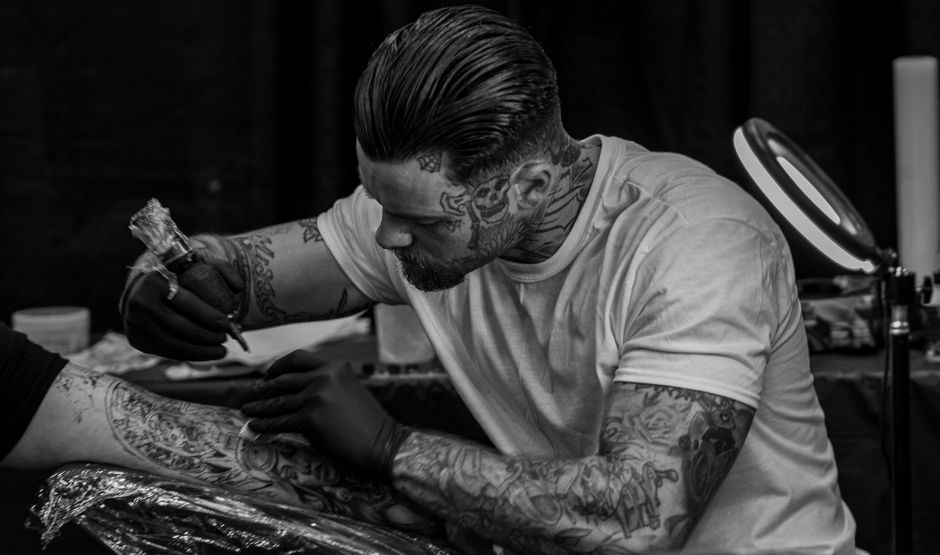
Ready to Build a High-Income Trade Career?
The highest-paying trade school jobs reward hands-on skill and focused training. If you want a trade that combines income potential with creative freedom, tattooing is worth a serious look.
Ready to become a Tattoo Artist? Apply now to Ink Different’s Traditional Tattoo Apprenticeship and start building an AI-proof career with licensing support along the way.
Frequently Asked Questions
What is the highest paying trade school job?
On this list, elevator installers ($106,580) and radiation therapists ($101,990) have the highest BLS medians. Tattoo Artists average $106,858, according to ZipRecruiter.
Which trade school jobs don’t require a degree?
Elevator installers, power-line workers, plumbers, electricians and HVAC technicians usually train through apprenticeships or certificates. Radiation therapists and dental hygienists typically need an associate degree.
How long does it take to become a professional Tattoo Artist?
Most tattoo apprenticeships take one to three years. Ink Different’s Traditional Tattoo Apprenticeship takes 18 to 24 months across four phases.
Do I need art experience to start a tattoo apprenticeship?
No. The Traditional Tattoo Apprenticeship starts with art and design principles, so beginners can start from scratch.
Are tattoo careers AI-proof?
Tattooing is hands-on and person-to-person, which makes it hard to automate. Your skill, reputation and style drive your income.
Where can I find a tattoo apprenticeship near me?
Ink Different offers the Traditional Tattoo Apprenticeship at 60+ tattoo studios nationwide, including Spanish-speaking locations in Denver, Orange County, NYC, Miami, San Antonio and San Diego.
Related Posts: career change tattoo apprenticeship, tools every beginner Tattoo Artist should know, start your tattoo apprenticeship, and why spring is the best time to become a tattoo artist.