
Famous Tattoo Artists Every Apprentice Should Know
November 20, 2026
Jobs That Pay $100K a Year Without a Degree
November 20, 2026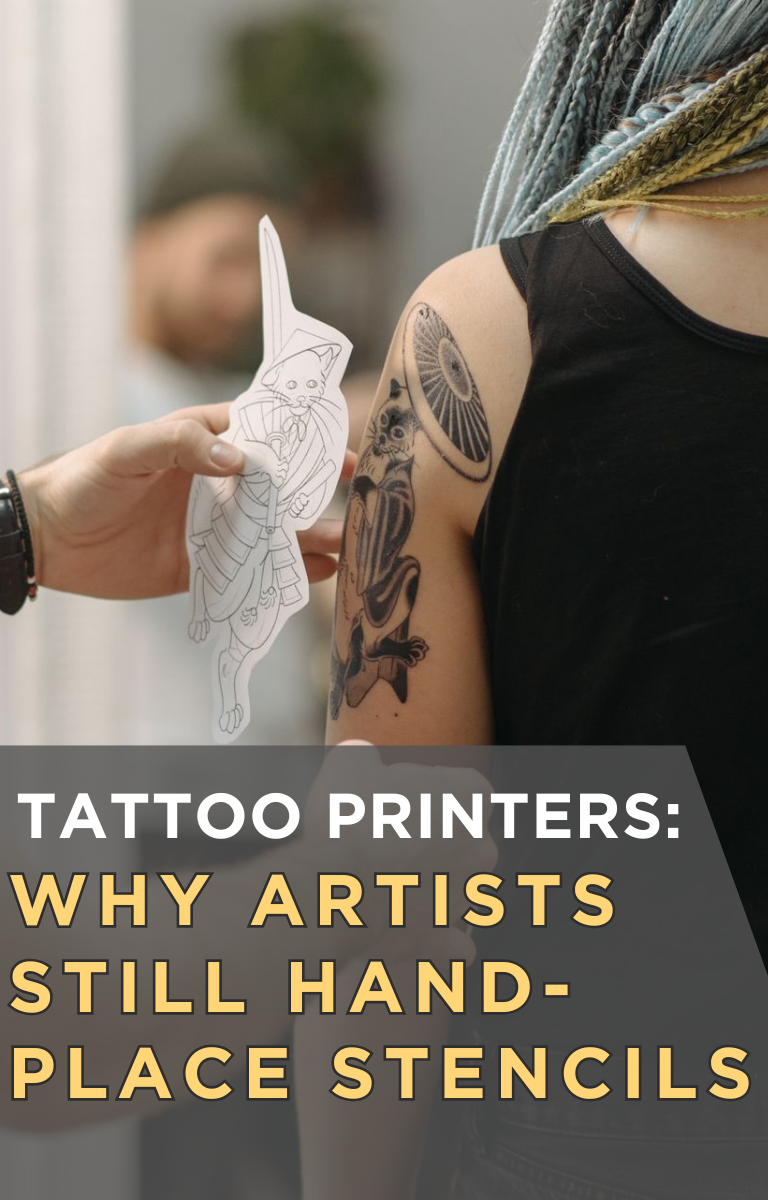
In This Article
- Key Takeaways
- What Is a Tattoo Printer?
- Why Do Artists Still Hand-Place Stencils?
- Why Does the Body Fight the Printer?
- How Do You Hand-Place a Stencil Correctly?
- When Does a Tattoo Printer Actually Help?
- Why Is Stencil Placement an AI-Proof Skill?
- Where Can You Learn to Place Stencils Like a Pro?
- Ready to Become a Tattoo Artist?
- FAQ
A tattoo printer is a thermal stencil printer that transfers a design onto stencil paper, creating the purple outline a Tattoo Artist uses as a guide. It saves time and produces clean, consistent lines. But a printer can only make a flat stencil. Placing that stencil on a curved, moving body still takes a Tattoo Artist’s eye and judgment.
That purple outline has a long history. Tattoo stencil paper works much like the old spirit duplicator masters, which, according to the Society of American Archivists, were introduced in the early 1920s and used a purple aniline dye ink. Below, we cover how tattoo printers work, where they help and why stencil placement is still a hands-on skill.
Key Takeaways
- What it does: A tattoo printer transfers a design onto stencil paper. It doesn’t place the stencil on skin.
- Why hand placement matters: Skin curves, stretches and moves, so Tattoo Artists adjust each stencil to the body.
- Where printers help: They save time on tracing, so Tattoo Artists can focus on design and placement.
- A lasting skill: Placement affects how a tattoo flows, how it looks when the body moves and how it ages.
- How to learn it: Hands-on mentorship is the most reliable way to master stencil placement.
What Is a Tattoo Printer?
A tattoo printer is a stencil printer that uses heat to transfer a line drawing onto specialized stencil paper, creating the purple outline a Tattoo Artist places on the skin.
Most tattoo printers are thermal printers. The design is printed onto multi-layer stencil paper, and heat transfers the purple dye layer onto the top sheet. Before thermal printers became common, many Tattoo Artists traced designs by hand using hectograph pencils and paper, a process invented in the 1870s, according to the Society of American Archivists.
The printer’s job ends when the stencil comes out. It creates a flat, two-dimensional outline, but the client is a three-dimensional, breathing, moving canvas.
Remember: The printer makes the stencil. The Tattoo Artist makes it fit. Those are two different skills.

Why Do Artists Still Hand-Place Stencils?
Because skin is curved, uneven and constantly moving. Where and how the stencil goes decides whether the tattoo flows with the body or fights it.
No printer can account for how a bicep flexes, how the rib cage expands with each breath or how a design needs to wrap around a forearm without looking distorted. Placement is a conversation between the Tattoo Artist’s eye and the client’s anatomy.
Placement also carries a lot of weight for the client. A memorial piece that sits a little too low, or lettering that curves the wrong way, is permanent. Clients trust their Tattoo Artist to get it right, and that takes skill a machine doesn’t have.
Why Does the Body Fight the Printer?
Paper is flat and still, while skin is rounded, stretchy and always moving. A design that looks balanced on paper can look warped once it’s on the body.
Every Tattoo Artist learns these realities quickly:
- Curvature: A straight line on a stencil can look bent once it wraps around a rounded arm.
- Stretch: Skin pulled taut during application relaxes afterward, which can shift proportions.
- Movement: Muscles, joints and posture all change how a tattoo reads.
- Individual anatomy: No two bodies have the same contours, even for the same design.
That’s why placement is part technique and part feel. Tattoo Artists learn to flow designs with muscle groups, line them up with natural body lines and picture how they’ll look when the client stands, moves and ages.
How Do You Hand-Place a Stencil Correctly?
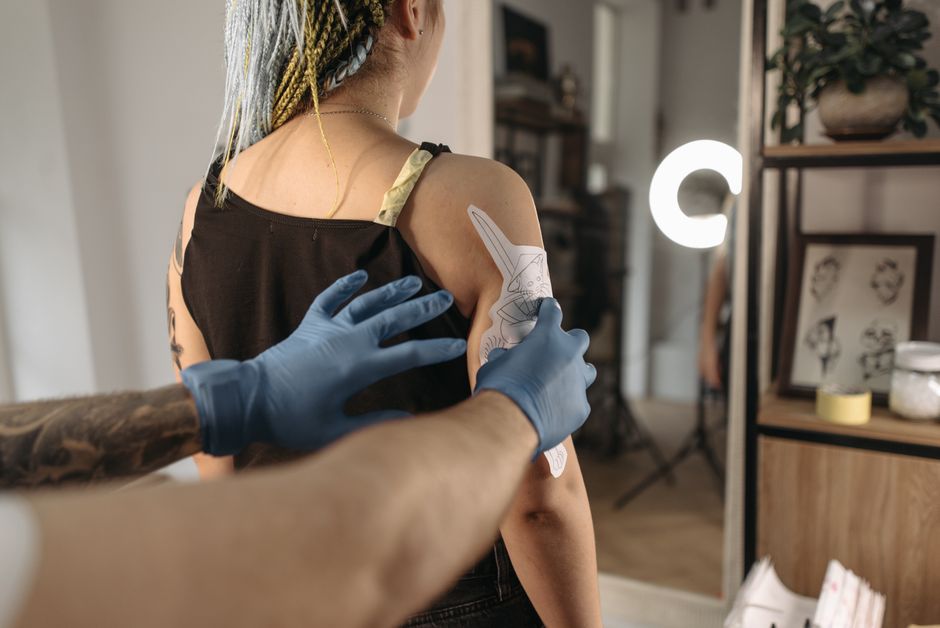
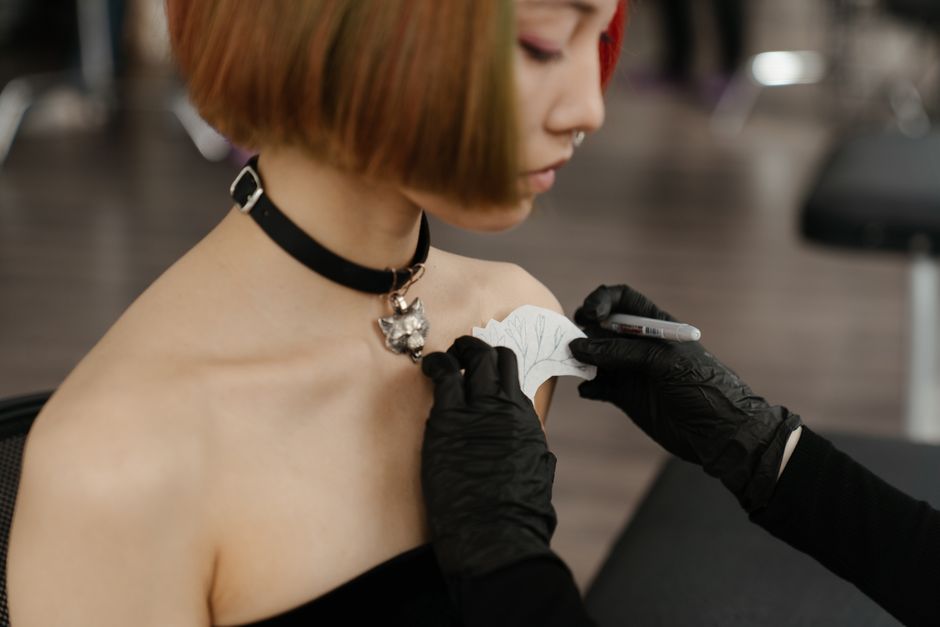
Prep the skin, apply transfer solution, line the design up with the body’s natural lines, press evenly and confirm placement with the client before tattooing.
- Prep the skin. Shave and clean the area, following strict hygiene practices like the OSHA Bloodborne Pathogens Standard.
- Apply transfer solution. A thin, even layer of stencil transfer solution helps the stencil stick without smearing.
- Read the anatomy. Study how the design should flow with muscle and bone before the stencil touches the skin.
- Position the stencil. Line it up with natural body lines and check symmetry from several angles.
- Press firmly and evenly. Hold without sliding, then peel slowly to reveal a clean transfer.
- Confirm with the client. Have them stand, move and check it in a mirror. Reposition if needed before tattooing.
Every step involves judgment calls a printer can’t make. Rushing placement is one of the most common beginner mistakes, and one of the easiest to avoid with patience.
When Does a Tattoo Printer Actually Help?
A tattoo printer saves time on the transfer step and produces clean, consistent outlines, so the Tattoo Artist can focus on design and placement.
Printers are a valuable part of a modern setup, alongside the machines, needles and inks every new Tattoo Artist learns to use. If you’re building your own kit, it helps to know which tools beginners actually need before spending money.
The printer handles the repetitive work of producing fast, accurate outlines. That frees the Tattoo Artist to adjust scale, customize designs and solve the placement puzzle on a real person.
The best Tattoo Artists treat the printer as an assistant, not a decision-maker. It speeds up the process, but the placement decisions are still theirs.
Why Is Stencil Placement an AI-Proof Skill?
Stencil placement depends on real-time judgment about a unique human body, which is something software and machines can’t do.
Software can generate a design, and a printer can transfer it. But neither can read a nervous client’s posture, feel how their skin responds or decide a design needs to shift slightly to flow with the shoulder. That kind of adaptive, hands-on skill is a big part of why human Tattoo Artists stay essential.
Demand for that skill is strong. According to Pew Research Center, 32% of Americans have a tattoo, and 22% have more than one. Every one of those tattoos started with a placement decision.
Where Can You Learn to Place Stencils Like a Pro?
Stencil placement is best learned through in-person mentorship in a working tattoo studio, where a Mentor can correct your hands in real time. That’s what Ink Different’s Traditional Tattoo Apprenticeship provides.
Placement is hard to learn from videos. You learn it by doing it over and over with an experienced Tattoo Artist watching and catching mistakes before they become permanent. For many people, this kind of hands-on training is a practical path into a creative career, and it’s part of why tattoo apprenticeships are gaining ground as an alternative to college.
What You Can Expect from Our Traditional Tattoo Apprenticeship
For 15 years, Ink Different has trained aspiring Tattoo Artists. The Traditional Tattoo Apprenticeship runs 18 to 24 months across four phases, with in-person training at one of 60+ tattoo studios nationwide.
- Built for beginners: No prior art experience is required.
- Hands-on training: In-person mentorship from experienced Tattoo Artists.
- A clear path: Art and design principles, then machine mastery and practice tattooing, then supervised tattoos and finally a Junior Artist Externship where you start earning.
- Licensing support: Help meeting your state’s requirements, whether that means getting licensed in Texas or elsewhere.
- Interest-free payment plans: Flexible payments make training more accessible.
A Career That Comes With Confidence
You’ll finish with job-ready skills, licensing support and a guaranteed job offer at one of Ink Different’s own tattoo studios. Our “Good Humans” culture means you learn in a supportive, family-like community.
Mentorship That Pushes Your Brand and Skills Further
Our one-year, in-person Master Mentorship is for beginners and experienced Tattoo Artists. You’ll train with celebrity and award-winning Master Mentors, including Al Fliction, Liz Cook, Kyle Dunbar, Boneface, Jordi Pla and Marcel Oliveira, with a focus on mastering a specific style, growing your career and building a business.
Making Tattoo Training Accessible for Everyone
We offer Spanish-speaking locations in Denver, Orange County, NYC, Miami, San Antonio and San Diego.
Ready to Become a Tattoo Artist?
A printer can make the stencil, but placing it well is a skill you build with practice and good guidance. If you want to learn the parts of tattooing no machine can do, there’s a clear path in. Each Mentor takes just two tattoo apprentices per tattoo studio, so seats fill up quickly.
Ready to become a Tattoo Artist? Apply now to Ink Different’s Traditional Tattoo Apprenticeship and start building an AI-proof career, with licensing support along the way.
Frequently Asked Questions
Do professional Tattoo Artists use printers?
Many do. Thermal stencil printers make it quick to transfer designs, but Tattoo Artists still place each stencil by hand.
How does a tattoo stencil printer work?
Most use heat to transfer a design from a printed or digital file onto multi-layer stencil paper, leaving a purple outline the Tattoo Artist applies to the skin.
Why can’t a printer place the stencil on skin?
A printer only makes a flat stencil. Skin is curved, stretchy and moving, so the Tattoo Artist has to adjust placement to the client’s body.
Why are tattoo stencils purple?
Tattoo stencil paper uses a purple transfer dye, similar to the purple aniline dye inks used in older spirit duplicators.
Do I need art experience to learn stencil placement?
No. Ink Different’s Traditional Tattoo Apprenticeship is built for beginners and teaches fundamentals through in-person mentorship.
How long does the Traditional Tattoo Apprenticeship take?
It takes 18 to 24 months across four phases.