Does FAFSA Cover Trade School?
November 20, 2026
Tattoo Printers: Why Artists Still Hand-Place Stencils
November 20, 2026
In This Article
- Key Takeaways
- Why should apprentices study famous Tattoo Artists?
- Who are the old-school legends who built the craft?
- Which modern icons are shaping tattooing today?
- What can you learn from each artist’s signature style?
- How do you actually study a famous Tattoo Artist’s work?
- Why is learning from a living Mentor better than a feed?
- What does Ink Different’s Tattoo Apprenticeship offer?
- Ready to follow in their footsteps?
- FAQ
Famous Tattoo Artists every apprentice should know include old-school legends like Sailor Jerry, Lyle Tuttle and Ed Hardy, plus modern icons like Horiyoshi III and Kat Von D. Each shaped tattooing in a different way, from bold American Traditional flash to Japanese full-body work to bringing tattooing onto TV screens. Studying them isn’t about copying their designs. It’s about understanding the roots of the craft so you can build your own style.
Their influence reaches well beyond tattoo studios. Ed Hardy, for example, became the subject of the first museum retrospective of his work, “Ed Hardy: Deeper than Skin,” at San Francisco’s de Young Museum in 2019, according to JSTOR Daily. Here’s who to know and what each one can teach you.
Key Takeaways
- Why it matters: Studying famous Tattoo Artists teaches technique, style history and how tattoo careers are built.
- The legends: Sailor Jerry, Lyle Tuttle and Ed Hardy helped shape modern Western tattooing.
- Modern icons: Horiyoshi III and Kat Von D shaped Japanese tattooing and the public image of the craft.
- Study smart: Look at linework, values and composition, not just finished photos.
- Learn in person: A Mentor turns what you admire into real skill faster than social media can.
Why should apprentices study famous Tattoo Artists?
Studying famous Tattoo Artists shows you what great linework, composition and career-building look like, so you can learn from decades of experience.
It’s like learning to cook by studying the chefs who defined a cuisine. You’re not copying their dishes. You’re learning the principles that make them work. When you break down why a classic American Traditional eagle reads clearly from across a room, you’re learning composition you’ll use for your whole career.
Skipping this kind of study is one of the more common mistakes new apprentices make, and one that’s easy to fix.
Who are the old-school legends who built the craft?
Sailor Jerry, Lyle Tuttle and Ed Hardy helped turn tattooing from a fringe trade into a respected craft.
Sailor Jerry (Norman Collins)
Norman “Sailor Jerry” Collins is one of the most influential names in American Traditional tattooing, known for bold outlines, limited color palettes and classic imagery like eagles, anchors and pin-ups. His World War II-era flash is held in the Lyle Tuttle Tattoo Art Collection alongside work by Bert Grimm and others, as highlighted by Smithsonian Magazine. He also influenced the next generation: JSTOR Daily notes that Collins was among the Tattoo Artists who guided Ed Hardy toward Japanese tattooing.
Lyle Tuttle
Lyle Tuttle helped bring tattooing into the mainstream. He’s famous for tattooing Janis Joplin and appearing on the cover of Rolling Stone, which opened tattooing up to a whole new generation, according to the San Francisco Chronicle.
Ed Hardy
Ed Hardy bridged fine art and tattooing. According to JSTOR Daily, he graduated from the San Francisco Art Institute in 1967, where he focused on printmaking, and in 1973 traveled to Gifu, Japan, to study with master tattooer Horihide. Hyperallergic notes that he was the first American to study tattooing with Horihide.
Pro Tip: Collect American Traditional flash and redraw the linework by hand. The old masters earned their clean lines through thousands of repetitions.
Which modern icons are shaping tattooing today?
Modern icons include Horiyoshi III, a master of traditional Japanese tattooing, and Kat Von D, who helped bring tattooing into millions of homes through television.
Horiyoshi III
Horiyoshi III is a master of irezumi, traditional Japanese full-body tattooing. He has been perfecting his work in Yokohama for five decades, according to Al Jazeera. He also founded the Yokohama Tattoo Museum, which The Japan Times describes as the only place in Japan dedicated to the history of body ink. If you want to understand large-scale composition and how one piece can flow across the whole body, his work is essential study.
Kat Von D
Kat Von D became one of the most recognizable Tattoo Artists in the world through reality TV. After starring on Miami Ink, she opened High Voltage Tattoo in West Hollywood in 2007, where TLC’s LA Ink was filmed from 2007 to 2011, according to CBS News and Business Insider. She closed the shop on December 1, 2021, after 14 years. Her career shows how visibility can shape a Tattoo Artist’s reach, and why building your brand matters today.
Ink Master names closer to home
Some of Ink Different’s own Master Mentors have also become well-known through television. Anwon “Boneface” Johnson competed on Ink Master Seasons 8 and 9, and James Vaughn reached the final three in Season 1. Both now teach through Ink Different’s Master Mentorship.
What can you learn from each artist’s signature style?
Each lineage teaches a different core skill.
- American Traditional (Sailor Jerry): Clean outlines, high contrast and designs that stay readable for decades.
- Fine art meets tattooing (Ed Hardy): How formal art training, printmaking and Japanese influences can shape tattoo design.
- Japanese irezumi (Horiyoshi III): Full-body composition, symbolism and visual flow.
- Black and gray portraiture (Kat Von D): Smooth shading and detailed portrait work.
- Showmanship and visibility (Lyle Tuttle, Kat Von D): How a Tattoo Artist’s public presence can grow the craft.
The skin sets the rules for all of these. Designs have to heal well and hold up over time, which is why it’s worth knowing how skin ages and fades. The American Academy of Dermatology notes, for example, that UV light can fade some tattoo inks.

How do you actually study a famous Tattoo Artist’s work?
Analyze linework, values and composition, then apply the principles to your own designs rather than copying finished pieces.
- Pick one Tattoo Artist at a time. Go deep on one style before moving to the next.
- Study the linework. Trace outlines on paper to feel how line weight changes across a design.
- Break down the values. Convert their work to grayscale and map the light, mid and dark areas.
- Analyze composition. Ask why the piece flows the way it does on the body.
- Apply the principle, not the piece. Design your own flash using what you learned.
Why is learning from a living Mentor better than a feed?
A Mentor can correct your hand in real time, teach you safety and guide your career in ways a social media feed can’t.
Instagram shows you finished tattoos. It doesn’t show the decisions behind them, like needle depth, pressure, machine setup and how the Tattoo Artist read that client’s skin. Those lessons happen in person.
A Mentor also teaches the foundations that keep clients safe, like the OSHA Bloodborne Pathogens Standard. That hands-on, person-to-person knowledge is a big part of why Tattoo Artists remain essential, even as technology changes other careers.
What does Ink Different’s Tattoo Apprenticeship offer?
Ink Different’s Traditional Tattoo Apprenticeship runs 18 to 24 months across four phases. It takes you from no experience to job-ready, with licensing support along the way.
For 15 years, Ink Different has trained aspiring Tattoo Artists as a college alternative. You train in person with a Mentor at one of 60+ tattoo studios nationwide.
- Phase 1, Art and Design Principles: Drawing, shading, digital design and building a portfolio, the same fundamentals the legends mastered.
- Phase 2, Machine Mastery and Practice Tattooing: Hand-control exercises, machine operation, lining, shading and color packing.
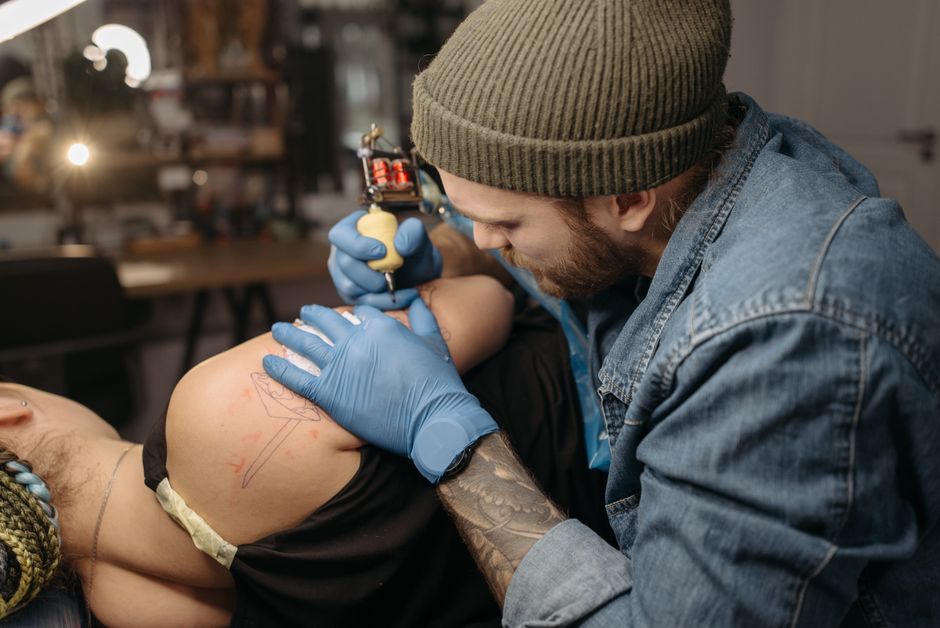
- Phase 3, Supervised Tattoos: Tattooing real skin under a Mentor’s direct supervision.
- Phase 4, Junior Artist Externship: Building client relationships and refining your skills while you start earning.
You’ll finish with job-ready skills, licensing support and a guaranteed job offer at one of Ink Different’s own tattoo studios. Interest-free payment plans help make training more accessible. Licensing rules vary, so it helps to know your state’s path, whether that’s getting licensed in Texas or elsewhere.
Want to go further? The one-year, in-person Master Mentorship lets you train directly with celebrity and award-winning Master Mentors, including Al Fliction, Liz Cook, Kyle Dunbar, Boneface, Jordi Pla and Marcel Oliveira. It’s built for mastering a specific style, growing your career and learning to run a business.
We also offer Spanish-speaking locations in Denver, Orange County, NYC, Miami, San Antonio and San Diego. Our “Good Humans” culture means you join a supportive, family-like community.
Ready to follow in their footsteps?
The Tattoo Artists on this list all reached a point where they stopped admiring the craft and committed to it. Studying their work is a great start, and learning hands-on with a Mentor is how you make those lessons your own. Each Mentor takes just two tattoo apprentices per tattoo studio, so seats fill up quickly.
Ready to become a Tattoo Artist? Apply now to Ink Different’s Traditional Tattoo Apprenticeship and start building an AI-proof career with licensing support along the way.
Frequently Asked Questions
Who are the most famous Tattoo Artists in history?
Names often mentioned include Sailor Jerry, Lyle Tuttle and Ed Hardy in American tattooing, and Horiyoshi III in Japanese tattooing. Kat Von D became one of the best-known modern Tattoo Artists through TV.
Who tattooed Janis Joplin?
Lyle Tuttle. Tattooing Janis Joplin and appearing on the cover of Rolling Stone helped make him one of the most famous Tattoo Artists of his era.
Who did Ed Hardy study with in Japan?
Ed Hardy studied with master tattooer Horihide in Gifu, Japan, starting in 1973.
Do I need to study famous Tattoo Artists to become one?
It’s not required, but it helps. Studying the greats teaches technique, style history and how successful careers are built.
Can I learn to tattoo just by following Tattoo Artists online?
No. Social media shows finished work, not technique, safety or machine handling. A Mentor corrects your hand in real time.
Do I need prior art experience to start a tattoo apprenticeship?
No. Ink Different’s Traditional Tattoo Apprenticeship is built for beginners and starts with art and design principles.