
Online Trade School: What You Can and Can’t Learn Remotely
November 19, 2026
How to Make a Tattoo Flash Sheet
November 19, 2026
In This Article
- Key Takeaways
- Why do tattoo terms matter for new artists?
- What are the essential tattoo equipment terms?
- What tattoo technique terms should you know?
- What safety and hygiene terms must every artist learn?
- What studio and business terms will you hear every day?
- What tattoo style terms define the craft?
- How do you actually learn the language of tattooing?
- Get Serious About Tattooing With Become A Tattoo Artist
- Frequently Asked Questions
Tattooing 101 starts with the language of the craft. Tattoo terminology covers the tools, techniques, safety practices, tattoo studio business and styles that Tattoo Artists talk about every day. Knowing these terms helps you follow your Mentor, talk confidently with clients and work safely from day one.
It’s a big and growing field. According to Pew Research Center, 32% of Americans have a tattoo, and 22% have more than one. This glossary covers the core terms every new Tattoo Artist should know, grouped into five categories.
Key Takeaways
- Five categories: Equipment, technique, safety, tattoo studio business and style terms make up the core vocabulary.
- Safety terms come first: Words like “cross-contamination” and “bloodborne pathogens” are tied to real safety rules.
- Know your tools: It’s a tattoo machine, not a “gun,” in a professional setting.
- Learn in context: Hearing terms used in a working tattoo studio is the fastest way to learn them.
- No experience needed: Ink Different’s Traditional Tattoo Apprenticeship teaches beginners from the ground up.
Why do tattoo terms matter for new artists?
Knowing tattoo terms helps you understand your Mentor, communicate with clients and work safely in a professional tattoo studio.
It’s like learning to drive. You need to know what the pedals and signals do before you hit the road. When your Mentor says, “Stretch the skin and run your liner at a steady pace,” you’ll want to know exactly what that means.
Using the right terms also builds trust. Clients feel more confident with a Tattoo Artist who can clearly explain placement, healing and aftercare.

What are the essential tattoo equipment terms?
These are the tools you’ll use and talk about every day.
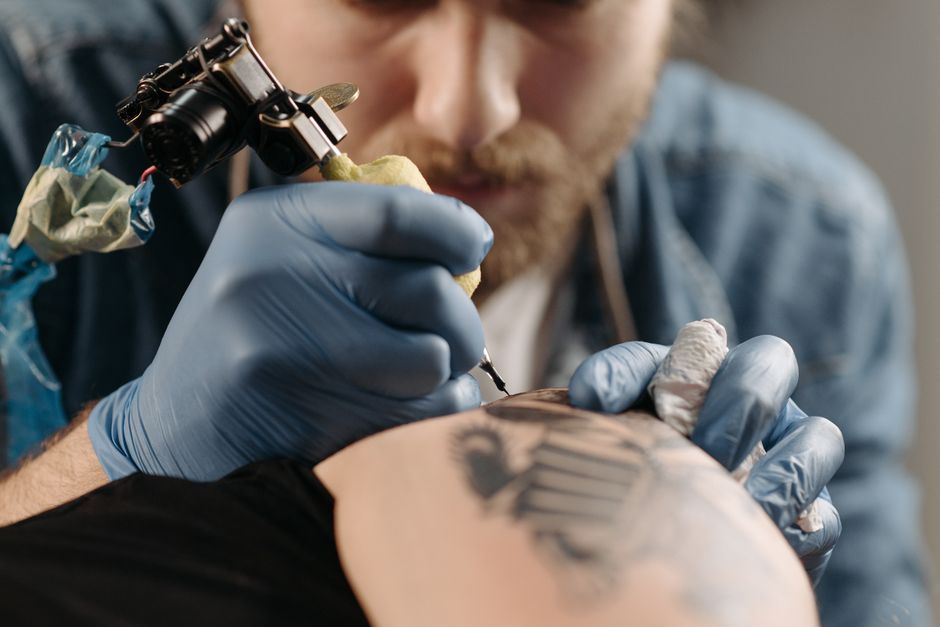
- Tattoo machine: The device that drives the needle into the skin. In a professional setting, it’s a tattoo machine, never a “gun.” The first electric tattoo machine was patented by Samuel O’Reilly in 1891, according to the history of the tattoo machine.
- Coil machine: A machine that uses electromagnetic coils to move an armature bar and needle, known for its buzzing sound.
- Rotary machine: A machine that uses a small motor for smooth, consistent needle movement.
- Pen machine: A pen-shaped rotary machine that uses needle cartridges.
- Needle cartridge: A self-contained, single-use needle unit that clicks into a pen or cartridge machine.
- Liner: A needle grouping used for outlines.
- Shader and magnum: Needle groupings used for shading and color fills.
- Tube and grip: The part the needle passes through and the part you hold.
- Power supply: The unit that controls the machine’s voltage and speed.
- Ink caps: Small, single-use cups that hold ink during a session.
- Stencil: A transferred outline of the design placed on the skin before tattooing.
- Transfer paper: Special paper used to create stencils, often purple.
For a closer look at the gear, read about the tools every beginner Tattoo Artist should know.
What tattoo technique terms should you know?
These terms describe what your hands and machine do on the skin.
- Lining: Creating clean, consistent outlines that form the structure of a tattoo.
- Shading: Adding depth and dimension with gradients of ink.
- Color packing: Filling an area with solid, even color so it heals smoothly.
- Whip shading: A flicking motion that creates soft, fading gradients.
- Saturation: How fully and evenly ink sits in the skin.
- Stretching: Holding the skin taut so lines go in smoothly and evenly.
- Blowout: Ink that spreads under the skin and blurs a line. A dermatology case report on PubMed Central explains that blowouts are thought to happen when ink goes too deep, into the fat below the skin, often from too much needle pressure.
- Touch-up: Follow-up work to fix patchy or faded areas after healing.
- Cover-up: A new tattoo designed to hide an older one.
Practice makes these feel natural, but beginners tend to make similar mistakes. Read about the mistakes aspiring tattoo apprentices should avoid.
What safety and hygiene terms must every Tattoo Artist learn?
These terms are tied to real health rules that protect you and your clients.
- Bloodborne pathogens: Disease-causing microorganisms in blood. Workplace safety is covered by the OSHA Bloodborne Pathogens Standard, which requires training at initial assignment and at least once a year.
- Cross-contamination: Spreading germs from one surface, tool or person to another.
- Barrier film: Plastic coverings placed over machines, cords and surfaces to prevent cross-contamination.
- Autoclave: A pressurized steam unit that sterilizes reusable equipment.
- Single-use: Items like needles and ink caps that are used once, then thrown away.
- Sharps container: A puncture-proof container for safely disposing of used needles.
- Hepatitis B vaccine: Under the OSHA standard, employers must make the vaccine available to workers with occupational exposure within 10 working days of their initial assignment.
- Second skin: A clear, breathable adhesive bandage some Tattoo Artists apply after a session.
- Aftercare: Instructions for caring for a healing tattoo, based on guidance like the American Academy of Dermatology’s tips for caring for tattooed skin.
Pro Tip: Many states require bloodborne pathogens training before you can tattoo. Florida, for example, requires license applicants to complete a Department-approved course, according to the Florida Department of Health.
What studio and business terms will you hear every day?
Tattooing is both a craft and a business, so you’ll hear these terms constantly.
- Flash: Pre-drawn designs clients can choose from, often displayed on tattoo studio walls or in binders.
- Custom work: Original designs created for a specific client.
- Walk-in: A client who comes in without an appointment.
- Consultation: A meeting to discuss a client’s idea, placement, size and price.
- Deposit: Money paid upfront to hold an appointment.
- Booth rent: A fee an independent Tattoo Artist pays a tattoo studio to use a station.
- Commission split: An arrangement where the Tattoo Artist and tattoo studio share income from each tattoo.
- Portfolio: Your collection of your best work, used to show your skills and attract clients.
- Guest spot: Working temporarily at another tattoo studio, often in a different city.
When you’re ready to grow your presence, explore these platforms to help new and aspiring Tattoo Artists build their brand.
What tattoo style terms define the craft?
Style terms describe the major genres of tattooing.
- American Traditional: Bold black lines, a limited color palette and classic imagery like eagles, roses and anchors. Norman “Sailor Jerry” Collins helped shape it.
- Neo-traditional: A modern take on American Traditional, with more detail, depth and a wider color range.
- Realism: Lifelike portraits and imagery that require precise shading.
- Black and gray: Work done in black ink and diluted gray washes, without color.
- Blackwork: Bold, black-heavy designs, often geometric or illustrative.
- Fine line: Delicate, thin-lined designs, popular for minimalist pieces and lettering.
- Japanese (Irezumi): A traditional Japanese style featuring koi, dragons, waves and other symbolic imagery.
- New school: Cartoon-like, exaggerated designs with bright color and bold outlines.
You don’t have to master every style, but knowing them helps you find your own direction. That human creativity is part of why Tattoo Artists are still essential.
How do you actually learn the language of tattooing?
You learn tattoo terminology fastest by hearing and using it in a working tattoo studio, with a Mentor explaining as you go.
- Build a base glossary. Study the terms above until you can explain each one in your own words.
- Watch Tattoo Artists work. See how the terms are used in real situations.
- Learn safety early. Study bloodborne pathogens standards and your state’s training requirements before working on anyone.
- Find a Mentor. An experienced Tattoo Artist can correct you and explain the “why” behind each step.
- Use the terms daily. Practice until the vocabulary feels natural.
Get Serious About Tattooing With Ink Different Tattoos
Ink Different’s Traditional Tattoo Apprenticeship trains complete beginners to become job-ready Tattoo Artists through structured, in-person mentorship. For 15 years, Ink Different has offered a college alternative built on a supportive, family-like “Good Humans” culture.
What You Can Expect from Our Traditional Tattoo Apprenticeship
The Traditional Tattoo Apprenticeship runs 18 to 24 months across four phases, with in-person training at one of 60+ tattoo studios nationwide. No prior art experience is required.
- Phase 1, Art and Design Principles: Drawing, shading, digital design and building a portfolio.
- Phase 2, Machine Mastery and Practice Tattooing: Hand-control exercises, machine operation, lining, shading and color packing.
- Phase 3, Supervised Tattoos: Tattooing real skin under a Mentor’s direct supervision.
- Phase 4, Junior Artist Externship: Building client relationships and refining your skills while you start earning.
A Career That Comes With Confidence and Licensing Support
You’ll finish with job-ready skills, licensing support and a guaranteed job offer at one of Ink Different’s own tattoo studios. Interest-free payment plans help make training more accessible. For licensing details, see how to get your tattoo license in Texas, tattoo license requirements in California and how long it takes to get a tattoo license in Colorado.
Mentorship That Pushes Your Brand and Skills Further
Our one-year, in-person Master Mentorship connects you with celebrity and award-winning Master Mentors, including Al Fliction, Liz Cook, Kyle Dunbar, Boneface, Jordi Pla and Marcel Oliveira. It’s built for mastering a specific style, growing your career and owning your own business.
Making Tattoo Training Accessible for Everyone
We offer Spanish-speaking locations in Denver, Orange County, NYC, Miami, San Antonio and San Diego.
Ready to Become a Tattoo Artist?
Now you know the core vocabulary of tattooing. The next step is learning to use it in a real tattoo studio, with a Mentor guiding you. Each Mentor takes just two tattoo apprentices per tattoo studio, so seats fill up quickly.
Ready to become a Tattoo Artist? Apply now to Ink Different’s Traditional Tattoo Apprenticeship and start building an AI-proof career with licensing support along the way.
Frequently Asked Questions
Do I need to memorize every tattoo term before starting a tattoo apprenticeship?
No. You’ll learn most terms in context as you train. A basic glossary helps you follow along from the start.
Why shouldn’t you call a tattoo machine a “gun”?
“Tattoo machine” is the professional term. Using it shows respect for the craft and the people who practice it.
What’s the difference between lining and shading?
Lining creates the outlines that give a tattoo structure. Shading adds depth and dimension with gradients of ink.
What is a blowout in tattooing?
A blowout is ink that spreads under the skin and blurs a line, usually because the needle went too deep.
What safety training do Tattoo Artists need?
Many states require bloodborne pathogens training, and the OSHA standard requires workplace training at the start and at least once a year after.
How long does the Traditional Tattoo Apprenticeship take?
It takes 18 to 24 months across four phases, with in-person training at a working tattoo studio.
Related Posts: Plant the Seed: Start Your Tattoo Apprenticeship This Spring, 9 Tools Every Beginner Tattoo Artist Should Know, and Tattoo Apprenticeships as a College Alternative.