How to Make a Tattoo Flash Sheet
November 19, 2026
Apprentice Spotlight: From Art School and the Military to Tattooing, Why Ashley Breaux Said “Now or Never”
November 19, 2026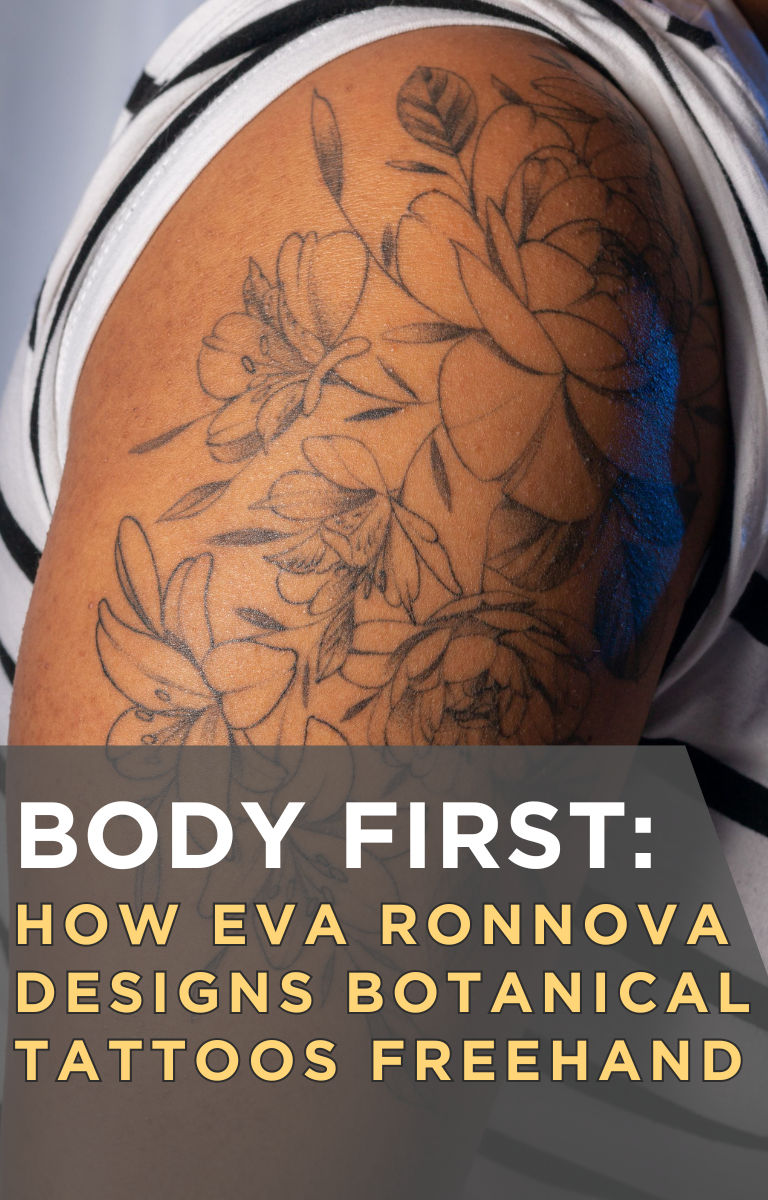
In This Article
- Key Takeaways
- What is freehand botanical tattooing?
- Who is Eva Ronnova and why does body-first matter?
- Why design botanical tattoos to the body instead of on paper?
- How do you design a botanical tattoo freehand?
- What skills do you need to tattoo freehand?
- Where can you learn freehand tattooing the right way?
- What does Ink Different’s Traditional Tattoo Apprenticeship teach?
- How does Master Mentorship push your skills further?
- Ready to become a Tattoo Artist?
- Frequently Asked Questions
For Tattoo Artist Eva Ronnova, the shape of a shoulder can change a whole design. She creates large-scale botanical tattoos in delicate fine line, and she builds each one around the person wearing it. The body decides where a flower grows, where a stem turns, and where skin stays open.
As InkedMag recently reported, Ronnova sketches her larger pieces freehand, directly on the client’s skin. At Ink Different Tattoos, we love this story because it shows what makes tattooing such a human craft. Here’s how her body-first approach works and what it takes to learn skills like hers.
Key Takeaways
- Body first: Eva Ronnova designs around each client’s anatomy instead of fitting a flat drawing onto the body.
- Freehand since 2023: She sketches her larger compositions directly on the skin, so she can react to the body in real time.
- More than thin lines: For Ronnova, fine line is also about movement, negative space, and how the design relates to the body.
- Human skill: She warns that AI-generated tattoo references can ignore anatomy, line weight, and placement.
- Your path: Ink Different’s Traditional Tattoo Apprenticeship takes 18 to 24 months and welcomes complete beginners.
What is freehand botanical tattooing?
Freehand botanical tattooing means drawing a floral or plant design directly on the client’s skin, then tattooing it. The design is built on the body instead of being transferred from a flat stencil.
Ronnova works at a big scale: half sleeves, chest pieces, and full arms. Freehand drawing lets her shape those large compositions around real curves. A stem can follow the line of a shoulder. A flower can grow or shrink to match someone’s proportions.
That’s why freehand botanical work can look so natural. The design responds to the body instead of fighting it.

Who is Eva Ronnova and why does body-first design matter?
Eva Ronnova is a Tattoo Artist known for delicate botanical fine line work designed around each client’s anatomy.
Art has been part of her life since she was young. She founded her own art school and worked as a graphic designer before tattooing. Then she went looking for her own ideal tattoo: something delicate, elegant, and designed for her body. When she couldn’t find a Tattoo Artist to bring that vision to life, she decided to become one. She started tattooing in 2021.
She wanted to create thoughtful, personal tattoos for women. Early on, she focused on illustrative work. She’d create a design first and then find a place for it on the body. That quickly flipped. Today, she says the body comes first.
Remember: A tattoo that belongs on the body starts with how the design is planned.
Why design botanical tattoos to the body instead of on paper?
A body isn’t flat. Designing on the skin lets the tattoo fit real curves and movement instead of bending a flat drawing into a three-dimensional shape.
That’s exactly why Ronnova moved into freehand work. Drawing on the skin lets her react to anatomy as she goes. She thinks about more than placement:
- Flow: Stems can turn to follow the curve of a shoulder or the direction of an arm.
- Scale: A flower’s size might change once she sees it against the client’s proportions.
- Negative space: She decides where to leave skin open instead of filling every inch.
- Movement: She considers how the tattoo will look when the person moves.
Large-scale fine line also gives her room to set focal points and let delicate details stretch across a whole arm or chest. She loves the idea of taking something visually light and making it big.
How do you design a botanical tattoo freehand?
Ronnova starts with a clear idea, then lets the body shape the details during the appointment.
Here’s how her process comes together:
- Gather the ingredients: Clients bring what matters to them, like favorite flowers, reference images, or a mood they want.
- Set the main idea: She usually has the main concept figured out before the appointment, but not every detail.
- Leave room on the day: She asks clients for room to decide the composition, scale, and flow on the body itself.
- Sketch on the skin: She draws the composition directly on the client, adjusting flower sizes and stem directions to fit their anatomy.
- Balance weight and open skin: She decides where the design needs weight and where skin should stay open.
- Tattoo with control: With the design mapped out, she focuses on precise, controlled lines.
Her setup stays simple so she can focus on the work. She relies on a Bishop Power Wand and Allegory Black ink, and she mostly uses 3RL and 5RL cartridges. She tests different cartridge brands instead of sticking to one. What matters most to her is knowing how her tools behave.
Simple to describe, hard to master. That’s why hands-on practice under a Mentor matters. Our guide to the mistakes aspiring tattoo apprentices should avoid covers a few common slip-ups.
What skills do you need to tattoo freehand?
You need strong drawing skills, an eye for anatomy, steady machine control, and strong safety habits. You also need to connect with your clients.
Each of these takes time to build:
- Drawing fundamentals: Line weight, composition, and balance on curved surfaces.
- Anatomy awareness: Understanding how skin and muscle shape the space you’re working with.
- Machine control: Pulling clean, controlled lines consistently.
- Hygiene: Following the OSHA bloodborne pathogens standard to keep every client safe.
- Client connection: Listening to what a tattoo means to someone before you design it.
That last skill shows up in one of Ronnova’s most meaningful projects. She covered scars for a breast cancer survivor who had gone through several surgeries. She had tattooed the client before, so trust was already there. Scar tissue required extra care and patience.
The scars were tied to a very hard time in the client’s life, and she wanted to see that part of her body differently. Ronnova never saw the tattoo as erasing what happened. It was about helping her turn that area into something she chose for herself.
Ronnova also raises a concern about AI-generated tattoo references. An image can look convincing on a screen but ignore anatomy, line weight, placement, and what actually works on skin. She’d rather clients connect with a Tattoo Artist’s real work and build the design together. It’s one more reason tattooing is an AI-proof career.

Where can you learn freehand tattooing the right way?
The most reliable path is a structured, in-person tattoo apprenticeship. A Mentor watches your work, corrects your technique, and guides you from fundamentals to supervised client work.
Freehand drawing builds on a strong foundation. Before you sketch on skin, you need confident drawing skills, an understanding of composition, and real practice with a tattoo machine. Getting live feedback along the way helps you improve faster and avoid bad habits.
A structured tattoo apprenticeship is also gaining ground as a solid alternative to college for people who want a creative career without piling up college debt.
What does Ink Different’s Traditional Tattoo Apprenticeship teach?
Ink Different’s Traditional Tattoo Apprenticeship takes you from drawing fundamentals to supervised client work in 18 to 24 months, across four phases.
We’ve been training professional Tattoo Artists for 15 years, since 2011. The Traditional Tattoo Apprenticeship is available at 60+ tattoo studios nationwide, and it’s built for beginners and career changers alike. You don’t need an art degree. You need the drive to show up and keep improving.
Here’s what to expect:
- Art and design foundations: Phase One focuses on drawing, design principles, and building your portfolio.
- Machine mastery: You practice tattooing and learn how your tools behave, a skill Ronnova calls a top priority.
- Supervised tattoos: You work on real clients in a tattoo studio under your Mentor’s guidance.
- Licensing support: We help you understand the requirements where you plan to work, like how to get your tattoo license in Texas.
- Interest-free payment plans: Flexible options to make training more affordable.
You finish with job-ready skills, licensing support, and a guaranteed job offer at one of Ink Different’s own tattoo studios. Each Mentor takes on only two tattoo apprentices per tattoo studio, so you get real one-on-one attention. Our “Good Humans” culture means you’re never doing this alone.
How does Master Mentorship push your skills further?
Master Mentorship is a one-year, in-person experience where beginners and experienced Tattoo Artists train with award-winning Master Mentors. It’s built to help you master a style, grow your brand, and work toward owning a tattoo studio.
If a specific style like fine line or botanical work pulls at you, this is where you can go deep. You learn from Master Mentors Al Fliction, Liz Cook, Kyle Dunbar, Boneface, Jordi Pla, and Marcel Oliveira.

Ready to become a Tattoo Artist?
Ronnova hopes her tattoos become such a natural part of her clients that they can’t imagine their bodies without them. That’s the kind of work that comes from skill, patience, and real connection with the people you tattoo.
Seats are limited because real mentorship can’t be mass-produced. We also offer Spanish-speaking locations in Denver, Orange County, NYC, Miami, San Antonio, and San Diego.
Ready to become a Tattoo Artist? Apply now to Ink Different’s Traditional Tattoo Apprenticeship. You’ll get hands-on training at one of 60+ tattoo studios nationwide, licensing support, and a guaranteed job offer at one of Ink Different’s own tattoo studios.
Frequently Asked Questions
Do I need art experience to learn freehand botanical tattooing?
No. Ink Different’s Traditional Tattoo Apprenticeship is built for beginners and starts with drawing and design fundamentals.
How long does it take to become a Tattoo Artist?
Ink Different’s Traditional Tattoo Apprenticeship takes 18 to 24 months across four phases, moving you from fundamentals to supervised client work.
Is freehand tattooing harder than using stencils?
Freehand takes strong drawing and anatomy skills because you design directly on the body. With practice and a Mentor’s guidance, those skills build over time.
What makes Ink Different different from other tattoo training?
You get live, in-person mentorship, licensing support, and interest-free payment plans. You also finish with a guaranteed job offer at one of Ink Different’s own tattoo studios.
Will AI replace human Tattoo Artists?
No. AI images can ignore anatomy, line weight, and placement. Reading a client’s body and designing on living skin takes human skill.
Where can I do a tattoo apprenticeship near me?
Ink Different’s Traditional Tattoo Apprenticeship is available at 60+ tattoo studios nationwide, including Spanish-speaking locations in Denver, Orange County, NYC, Miami, San Antonio, and San Diego.