Apprentice Spotlight: Why Army Veteran Chris Fairburn Didn’t Hesitate Once He Found a Real Tattoo Apprenticeship
November 25, 2026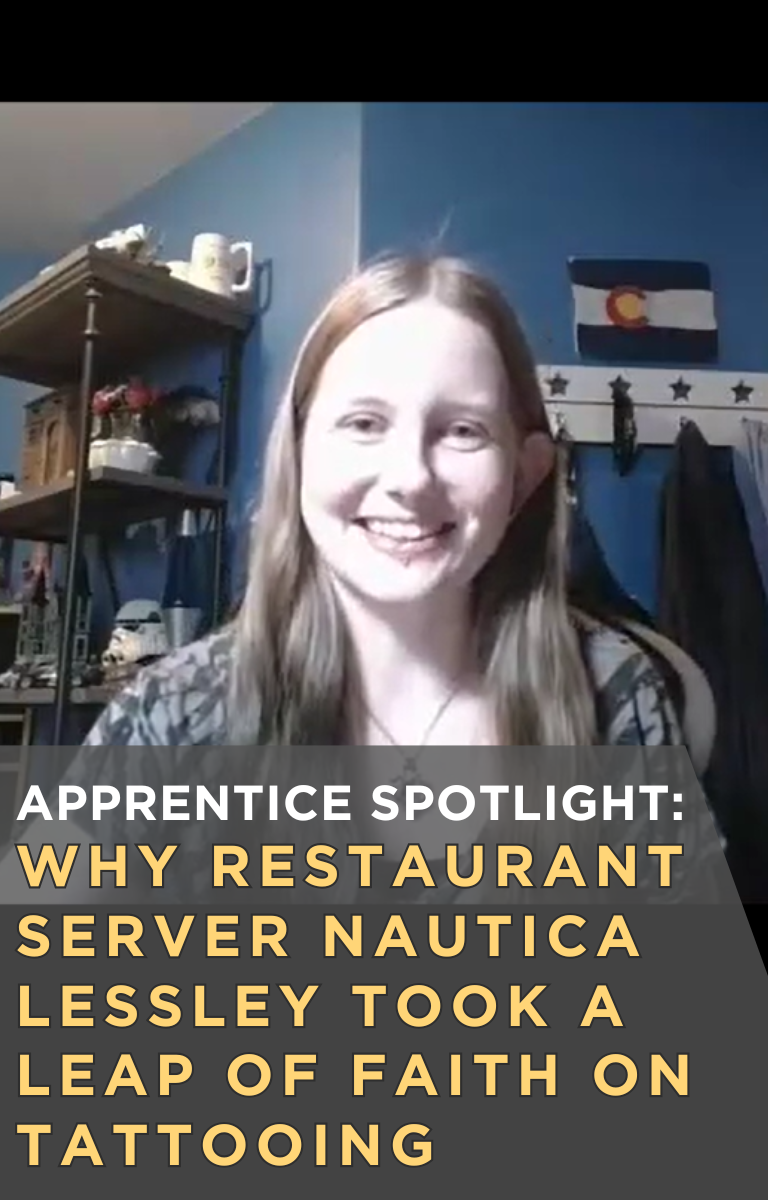
In This Article
- Key Takeaways
- Who Is Nautica Lessley?
- Why Would Someone Leave a Steady Serving Job?
- What Does a Leap of Faith Really Look Like?
- How Do Restaurant Skills Translate to Tattooing?
- How Can You Make the Same Leap?
- What Is the Traditional Tattoo Apprenticeship?
- What Is the Master Mentorship Program?
- Ready to Take Your Leap?
- FAQ
Nautica Lessley knows she can be hard on herself. So when it came time to submit her artwork to Ink Different, she treated it as something bigger than an application. “I really felt like I was taking a leap of confidence and faith in myself by submitting my artwork,” she says. “Overcoming that anxiety is taking that step into the unknown.” Nautica works full-time as a restaurant server in Colorado. She’s now finishing Phase One of Ink Different’s Traditional Tattoo Apprenticeship. In her Apprentice Spotlight interview, she shared what that leap looked like.
Key Takeaways
- Her job: She works full-time as a restaurant server and trains around her schedule.
- Her search: About six months of visiting local tattoo shops that weren’t taking apprentices.
- Her leap: Submitting her proudest pieces despite the “I’m not good enough” voice.
- Her mantra: “It’s not just going to be okay. It’s going to be better than okay.”
- Her reason: Tattooing is personal, connecting, and “life-changing.”
Who Is Nautica Lessley?
Nautica Lessley is an Ink Different apprentice in Colorado.
She’s been artistic her whole life. Her parents and grandparents were painters, and her grandma guided her. She’s worked in drawing, painting, and mixed media, and she took art classes at Front Range Community College during her last year of high school.
After graduating, she moved out of her mom’s house and started working in the service industry. She now works full-time as a restaurant server.
What drew her to tattooing was connection. “I grew up always being very artistic, but I found the best way to express that is by connecting with the human experience,” she says, “and how deep tattooing can be in bringing back memories.”
Why Would Someone Train While Keeping a Steady Serving Job?
Because the old route wasn’t working, and a new one let her keep her income.
For about six months, Nautica went from tattoo shop to tattoo shop, bringing her sketchbook and meeting people, while working full-time. “I spent so many months going from shop to shop, trying to find my footing and get my hands on the needle, so to speak,” she says. “It wasn’t working out.”
The tattoo shops were kind about it. “They were like, ‘We wish we could,'” she says. Many had just hired, or it was the off-season. Some gave her feedback on her art.
So she researched other options and found Ink Different, where she could train while keeping her serving job. “I always tell the teachers I wish I could just quit my job and do this full-time,” she says. “But I’m glad I’m able to do this in the first place.”
Reality check: You don’t have to quit your job to start training. Nautica didn’t.
What Does a Leap of Faith Really Look Like?
For Nautica, it looked like opening her sketchbook and choosing what to send.
“It did take a little bit of getting over that nervousness and anxiety of ‘I’m not good enough,'” she says. She finished a couple of pieces, then decided: “Okay, these are my proudest ones at the moment. I’m going to send these in.”
She kept repeating a mantra to herself. “It’s not just going to be okay. It’s going to be better than okay. That’s what I tell myself.”
Once she applied, she asked a lot of questions, and the admissions team made her feel supported. “Everyone was so communicative that I never felt like I was in the dark or waiting on anything,” she says. “I was like, ‘I can’t believe I’m really doing this.'”
Other apprentices describe similar turning points, like Ashley Breaux, who decided it was “now or never” after art school and the military.
How Does Restaurant Work Fit Alongside Tattooing?
Balancing both wasn’t easy at first. “It was definitely a struggle for me at first, because I had a lot going on in my personal life and I switched jobs,” she says.
The flexibility made the difference:
- Many class times: “There were so many different times to pick from,” she says.
- Understanding teachers: “If the traffic is really bad one day and I show up late to class, my teachers are always so nice and respectful about it, and they don’t make me feel bad.”
- Reasonable support: “Even with the hiccups in my schedule, everyone’s been so reasonable and nice about it, so I can’t complain at all.”
Her favorite instructors so far are Matt and Martin. “Sometimes it feels like they spoil me with compliments,” she says. “Even when they’re critiquing me, they’re really giving me credit for what they see me doing.”
How Can You Make the Same Leap?
Nautica’s path offers a few clear steps:
- Start where you are. She first tried local tattoo shops, bringing her sketchbook and meeting people.
- Keep working on your art. During her six-month search, she kept practicing while working full-time.
- Research structured options. When tattoo shops weren’t taking apprentices, she looked online.
- Send your proudest work. She finished a couple of pieces and sent the ones she was proudest of.
- Ask questions. She checked in with admissions every couple of days, and they always answered.
- Resist shortcuts. She had tried a handheld machine on synthetic skin before, but stopped. “I already knew I needed to learn the right way before I started messing around,” she says. “I don’t want to pick up any bad habits.”
If you want to build skills before you apply, here’s how to practice tattooing the right way before a tattoo apprenticeship. Many apprentices also find that simple linework flash teaches the most early on.
What Is the Traditional Tattoo Apprenticeship?
Ink Different’s Traditional Tattoo Apprenticeship is an 18 to 24 month, four-phase tattoo apprenticeship built for beginners. Ink Different has trained Tattoo Artists for 15 years. No prior art experience is required.
- Phase One: Art and design, online. Nautica is on her last few assignments.
- Phase Two: Machine practice on synthetic skin, online.
- Phase Three: Supervised tattoos on real clients in a tattoo studio.
- Phase Four: Building independence and preparing for licensing.
In Phase One, Nautica has learned to bend the rules within each style. For her American traditional jack-in-the-box skull, she asked Martin how much she could change the design. “I really wanted to show off, not just do a skull, and test my limits with the digital art,” she says.
Safety is part of the training, including the OSHA bloodborne pathogens standard. Colorado regulates tattooing at the county and city level, so it helps to understand how becoming a Tattoo Artist works in Colorado and Colorado’s tattoo license timeline.
You’ll finish with job-ready skills, licensing support, and a guaranteed job offer at one of Ink Different’s own tattoo studios. The Traditional Tattoo Apprenticeship is available at 60+ tattoo studios nationwide.
Good to know: Seats are limited, with only two apprentices per tattoo studio per Mentor.
What Is the Master Mentorship?
Once you’ve built your foundation, Ink Different’s Master Mentorship offers advanced training with Master Mentors like Liz Cook, known for color realism.
Nautica already has big goals. “I’m so excited to push the limits on so many different styles, like glitter tattoos or bubbles, being able to convey that imagery on the skin with the technology and equipment we have now,” she says.
Ready to Take Your Leap?
Nautica Lessley took her leap while keeping her job, and she’s almost through Phase One. Her friends and family are already lining up to be her first tattoos. “It’s been a great journey so far,” she says.
Ink Different also offers Spanish-speaking locations in Denver, Orange County, New York City, Miami, San Antonio, and San Diego.
Ready to become a Tattoo Artist? Apply now to Ink Different’s Traditional Tattoo Apprenticeship.
Frequently Asked Questions
Did Nautica quit her serving job?
No. She works full-time as a restaurant server and trains around her schedule.
Do I need art experience to become a tattoo apprentice?
No. Nautica grew up drawing and painting, but the Traditional Tattoo Apprenticeship teaches design fundamentals from day one.
How long does the Traditional Tattoo Apprenticeship take?
Ink Different’s Traditional Tattoo Apprenticeship takes 18 to 24 months across four phases, with licensing support and a guaranteed job offer at one of Ink Different’s own tattoo studios.
What did Nautica do before applying?
She spent about six months visiting local tattoo shops, which were kind but weren’t taking apprentices.
Should I practice on a machine before starting?
Nautica tried a handheld machine once, then stopped to avoid picking up bad habits before learning the right way.
Is tattoo training available in Spanish?
Yes. Ink Different offers Spanish-speaking locations in Denver, Orange County, New York City, Miami, San Antonio, and San Diego.