Apprentice Spotlight: After Years of Drawing, Animation Grad Carlton Washington Finally Took the Plunge Into Tattooing
November 25, 2026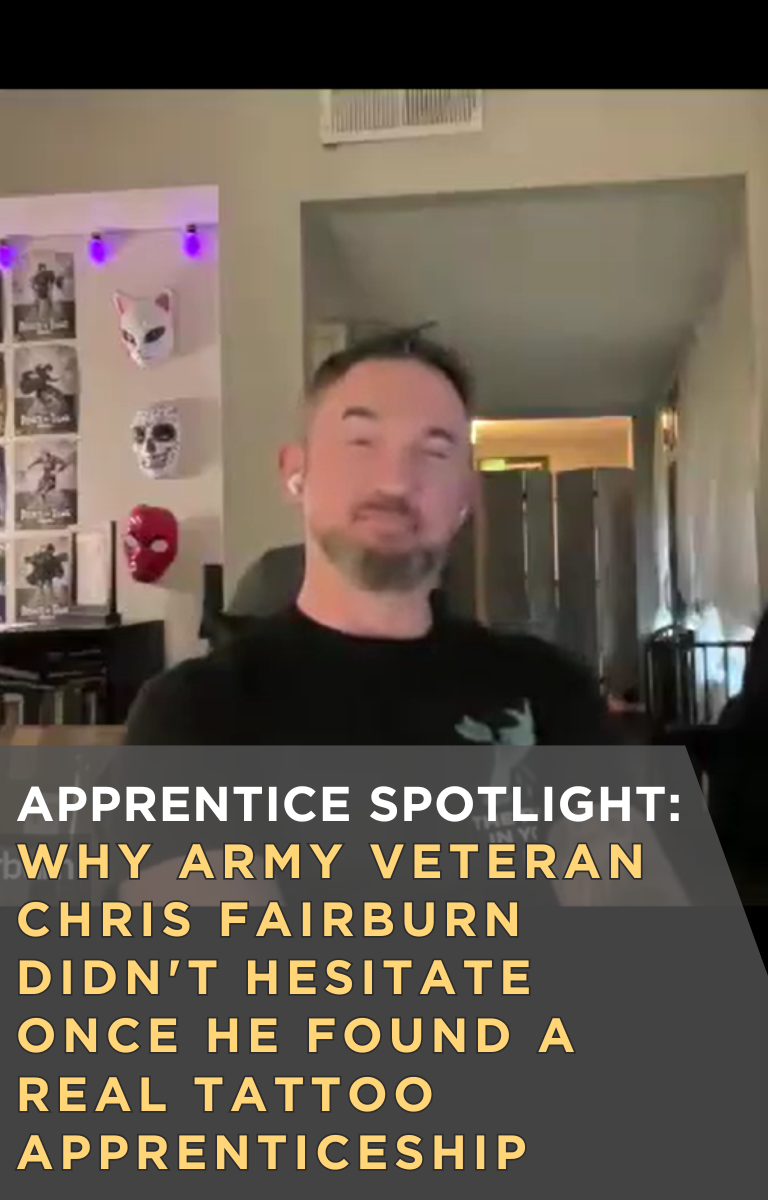
In This Article
- Key Takeaways
- Who Is Chris Fairburn and Why Did He Start Over?
- Why Do So Many Veterans Thrive in Tattooing?
- What Makes a “Real” Tattoo Apprenticeship Different?
- Why Didn’t Chris Hesitate Once He Found the Right Path?
- How Can You Follow the Same Path as Chris?
- What You Can Expect From Our Traditional Tattoo Apprenticeship
- How Does Master Mentorship Push You Further?
- Is Tattoo Training Accessible for Everyone?
- Ready to Become a Tattoo Artist?
- Frequently Asked Questions
“When I realized this was an actual program, there was no hesitation,” says Chris Fairburn, “because this is something I’ve always wanted to do.” Chris spent three years in Iraq and two in Afghanistan, taught at Ranger School, and was medically retired from the Army. He then earned a BFA and a master’s degree. Tattooing had been on his mind since he was a kid, but the path in never made sense, until he found Ink Different’s Traditional Tattoo Apprenticeship. Today, he’s in Phase Two in San Antonio. In his Apprentice Spotlight interview, he explained why he jumped in without a second thought.
Key Takeaways
- Who: Chris Fairburn is an Army veteran, a husband, and a dad in San Antonio.
- The old barrier: After the military, paying someone for years to “sweep their shop” just wasn’t realistic.
- The difference: A reputable, structured path with instructors who actually help.
- His mindset: “You only live once, and this is a reputable program. So put your feet down, get in here.”
- His work ethic: Three to four hours of practice a night, most nights.
Who Is Chris Fairburn?
Chris Fairburn is an Ink Different apprentice in San Antonio, Texas. He was born in Germany to an Army family and moved to San Antonio at about 15, when his dad retired there.
After 9/11, he enlisted. He left for basic training the day the U.S. invaded Iraq. He went on to serve three years in Iraq and two in Afghanistan, graduated from and taught at Ranger School at Fort Benning, and served as a platoon sergeant at Fort Hood. After surgeries on his neck and back, he was medically retired.
He then earned a BFA from the Art Institute of San Antonio and a master’s in communications from the University of the Incarnate Word. Today, he works as a contractor on Lackland Air Force Base, doing presentation design.
Tattooing was always there in the background. Growing up in the San Antonio metal scene, he was captivated by musicians with full arms of tattoos. “I’ve always been fascinated with the industry,” he says.
Why Do So Many Veterans Thrive in Tattooing?
Chris has seen how much artistic talent is in the military. “I knew a lot of guys in the military who are just phenomenal artists,” he says.
He’s also seen how hard it can be to turn that talent into a career after service. Some veterans are medically retired, as he was. Others finish 20 years and don’t want to keep working as contractors. Chris hopes more of them get a real shot at tattooing. “If the VA is ever able to help them with the GI Bill once they get out, that would be a great thing,” he says. “A program like this definitely lends a lot more credibility to that happening.”
His own service shaped his relationship with tattoos, too. As a leader, he held off on getting much ink. “When you’re a leader, you don’t want to get a bunch of ink and then tell your guys, ‘Do as I say, not as I do,'” he says.
If you’re planning your own transition, here’s a look at career changes after the military and stories from veterans in tattooing.
What Makes a “Real” Tattoo Apprenticeship Different?
For Chris, the traditional route never added up. “Getting out of the military, it’s just not economically feasible to say, ‘I want to get an apprenticeship, and I’m going to pay somebody for a couple of years to sweep their shop and hopefully I picked a good one,'” he says.
What he found at Ink Different was different:
- Reputable structure: A clear curriculum built around 18 to 24 months of real training.
- Personal instruction: “I definitely enjoy the personal side of the Tattoo Artists, because you’re actually talking to them,” he says.
- Real feedback: Critiques that push you to grow. “You’re not going to grow in a vacuum,” he says. “The only way you grow is through some sort of adversity.”
- Safety training: Standards like the OSHA bloodborne pathogens standard are part of the training.
He compares Ink Different’s instructors favorably to some of his college professors. “Some college professors are a little aloof and not really there to help you,” he says. “The staff here at Ink Different is phenomenal compared to some of the professors I’ve had.”
Pro Tip: Chris’s question for any tattoo apprenticeship is simple: is it reputable, and will the people teaching you actually help you?
Why Didn’t Chris Hesitate Once He Found the Right Path?
Because he’d wanted this for most of his life.
As a kid, he had no way in. “There was nothing out by my neighborhood,” he says. He lived out in the sticks, didn’t have a car, and his parents didn’t have money to help.
So when he found a real path, he took it. “You only live once, and this is a reputable program,” he says. “So put your feet down, get in here and just knock it out to the best of your ability.”
He’s honest about starting later in life. “I’m an older guy, but that’s okay,” he says. “I accept that this is something I’m going to learn how to do, and I’m going to learn how to do it well. It’s something I’m going to enjoy for the latter part of my life.”
Other veterans have made similar leaps, like Ashley Breaux, who went from art school and the military to tattooing.
How Can You Follow the Same Path as Chris?
Chris’s path offers a few clear steps:
- Know what you’ve always wanted. For Chris, tattooing had been on his mind since childhood.
- Look for a reputable, structured path. He didn’t want to pay someone to sweep a shop and hope he’d picked a good one.
- Commit fully. “Put your feet down, get in here,” he says.
- Put in the hours. In Phase Two, he practices three to four hours a night on “stacks and stacks of pads.”
- Take the feedback. Growth comes through challenge.
- Learn the foundations. He gained a new respect for American traditional, especially its line weight, and many apprentices find simple linework flash teaches the most.
If you’re changing careers like Chris, here’s why a tattoo apprenticeship works for people starting over.
What You Can Expect From Our Traditional Tattoo Apprenticeship
Ink Different’s Traditional Tattoo Apprenticeship is an 18 to 24 month, four-phase tattoo apprenticeship built for beginners. Ink Different has trained Tattoo Artists for 15 years. No prior art experience is required.
- Phase One: Art and design, online.
- Phase Two: Machine practice on synthetic skin, online. This is where Chris is now.
- Phase Three: Supervised tattoos on real clients in a tattoo studio.
- Phase Four: Building independence and preparing for licensing.
In San Antonio, Ink Different’s location is at Dynasty Tattoo Studio, owned by David Lamb, known for bold, photorealistic color work and fine line. Here’s more on training to become a Tattoo Artist in San Antonio, plus Texas’s tattoo licensing steps.
You’ll finish with job-ready skills, licensing support, and a guaranteed job offer at one of Ink Different’s own tattoo studios. The Traditional Tattoo Apprenticeship is available at 60+ tattoo studios nationwide.
“This program is groundbreaking to me,” Chris says. “It didn’t exist when I was a kid, and I’m glad it exists now, so I get to do it in my lifetime.”
How Does Master Mentorship Push You Further?
Once you’ve built your foundation, Ink Different’s Master Mentorship offers advanced training with Master Mentors like Liz Cook, known for detailed color work.
For Chris, color has been one of the most exciting parts of training so far. “When we started learning how to mix the black with the actual color, it was mind-blowing to be able to do it,” he says.
Is Tattoo Training Accessible for Everyone?
Ink Different’s online early phases let apprentices train around their lives. Chris trains while working full-time and raising a family. Ink Different also offers Spanish-speaking locations in Denver, Orange County, New York City, Miami, San Antonio, and San Diego.
For veterans specifically, here’s more on tattoo apprenticeships for veterans.
Seats are limited, with only two apprentices per tattoo studio per Mentor.
Ready to Become a Tattoo Artist?
Chris Fairburn waited most of his life for a real path into tattooing. When he found one, he didn’t hesitate. Now he’s spending his nights on practice pads and looking forward to the tattoo studio.
He knows why it’s worth it. “Every time I’ve walked out of a shop with a fresh piece, I’m happy,” he says. “It just makes people happy, because they get to express themselves.”
Ready to become a Tattoo Artist? Apply now to Ink Different’s Traditional Tattoo Apprenticeship.
Frequently Asked Questions
Why didn’t Chris Fairburn hesitate to apply?
He’d wanted to tattoo since he was a kid. Once he found a reputable, structured path, he committed right away.
Why didn’t Chris pursue a traditional shop apprenticeship?
After the military, he says, paying someone for years to sweep their shop and hoping you picked a good one just wasn’t economically realistic.
Do I need prior art experience to start?
No. Chris has a BFA, but the Traditional Tattoo Apprenticeship is built for beginners.
How long does the Traditional Tattoo Apprenticeship take?
Ink Different’s Traditional Tattoo Apprenticeship takes 18 to 24 months across four phases, with licensing support and a guaranteed job offer at one of Ink Different’s own tattoo studios.
Where does Chris train?
In San Antonio, where Ink Different’s location is at Dynasty Tattoo Studio.
Are there Spanish-speaking tattoo apprenticeship locations?
Yes. Ink Different offers Spanish-speaking locations in Denver, Orange County, New York City, Miami, San Antonio, and San Diego.