
Get a Head Start on 2027: Begin Your Tattoo Apprenticeship This November
November 24, 2026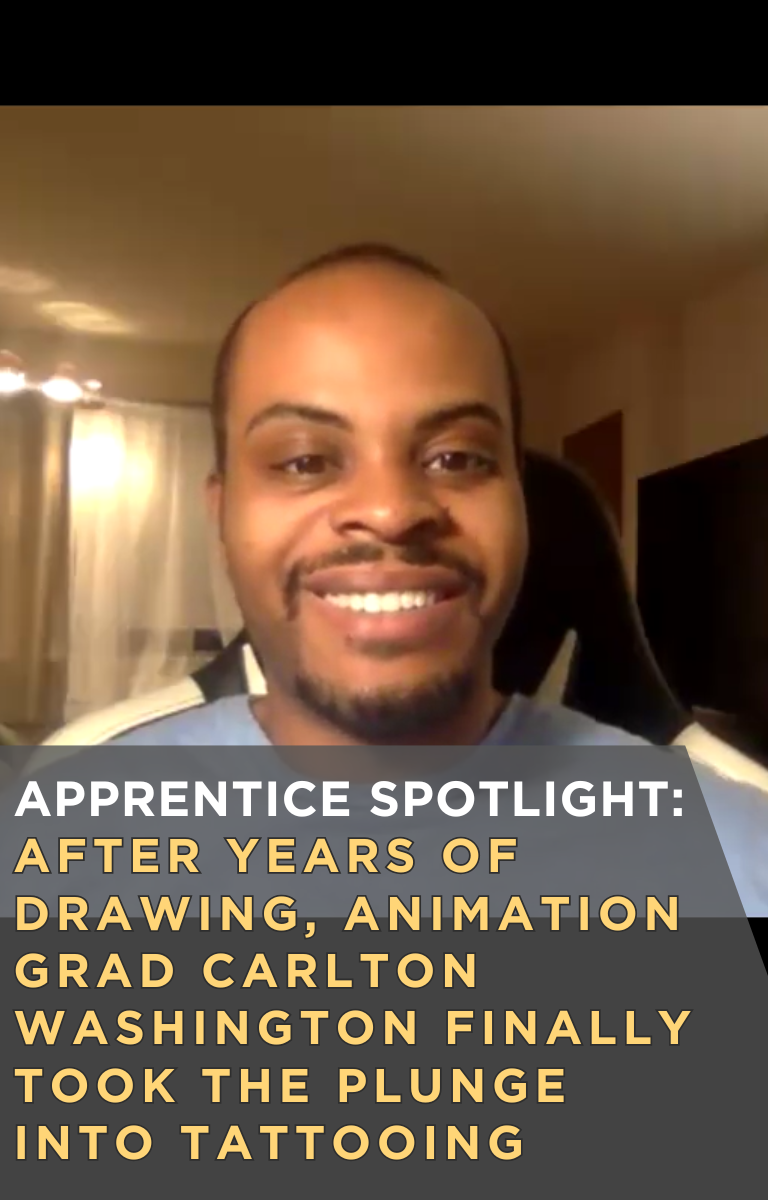
In This Article
- Key Takeaways
- Who is Carlton Washington?
- Why did it take years to take the plunge?
- How does an animation background translate to tattooing?
- What holds most aspiring artists back?
- How do you finally take the plunge into tattooing?
- What does the Traditional Tattoo Apprenticeship offer?
- What is Master Mentorship?
- How does Ink Different make training accessible?
- Ready to take your own plunge?
- Frequently Asked Questions
Carlton Washington first thought about tattooing in 2011, watching Black Ink Crew. He spent the years after that drawing, studying, and developing as an artist. He wanted to be ready. “I just took my time, continued to develop my art, and got ready to make the plunge,” he says. “I’m glad I decided to do it.” Today, Carlton is nearly finished with Phase One of Ink Different’s Traditional Tattoo Apprenticeship. He’ll train with Master Mentor Joey Tattoo in North Jersey. In his Apprentice Spotlight interview, he explained what finally made him jump.
Key Takeaways
- His start: Watching Black Ink Crew in 2011 made him want to tattoo.
- His preparation: He made sure he could move from traditional art to digital before committing.
- What he wanted: Training that felt like a class, with “real instruction, real positivity, and real encouragement.”
- What convinced him: Ink Different’s apprentice interview videos.
- His advice: “You have to step out of your comfort zone, but it’s rewarding.”
Who is Carlton Washington?
Carlton Washington is an Ink Different apprentice in Essex County, North Jersey. He works two jobs and takes evening classes twice a week.
He’s drawn his whole life. Carlton started out copying cartoons, then moved into realism, color, and ink, with some watercolor and acrylics along the way. He took art in high school and never went to formal art school, but he studied fine arts in college, focusing on animation and illustration.
He still hopes to pursue animation full-time while also tattooing.
Why Did It Take Years to Take the Plunge?
For Carlton, the years weren’t wasted. They were preparation.
He’s had a “huge respect for the craft” since watching Black Ink Crew, the Chicago and New York versions. “I was just blown away by how you can take a moving needle on skin and make something so real, like you do on paper,” he says.
Rather than rush in, he kept building his skills. He started with traditional art and wanted to be sure he could make the switch to digital before committing to tattooing. Once he could, “it was the right time for me,” he says.
Reality check: Carlton’s path shows that preparing first can make the leap feel more like the next step than a gamble.
How Does an Animation Background Translate to Tattooing?
Carlton came into Phase One confident in his skills. “I came in thinking I had a pretty solid drawing foundation,” he says. “I thought my line work was solid.”
Tattoo design asked for more. After taking class with his instructor Julian, he learned how precise tattoo work has to be. Julian taught him to zoom in a thousand percent and check for anything he’d overlooked. “I take my time now,” he says. “It’s almost like being a surgeon.”
His animation and cartoon background shows up in his new school work, which leans on caricature and expression. His new school cats include a Halloween cat with bats, an Egyptian-inspired hairless cat, and one modeled on his own brown cat, with a king theme.
Other artists with formal training have made the same switch, like David Johnston, who chose tattooing over graphic design after art school.
What Holds Most Aspiring Tattoo Artists Back?
For Carlton, the hardest parts were finding the right kind of training and getting past his nerves.
Inconsistent training
When he researched tattoo shops in his area, he found that most tattoo apprenticeships happen in-shop. Some tattoo shops may want to take you on, he says, but the training isn’t always consistent.
Nerves about applying
“I was a little bit nervous,” he says. “It’s something brand new, and I’d never tattooed before.” He also knew acceptance was competitive. “That part was going through the back of my mind.”
What helped was knowing the training would be structured like a class, with people ready to help. “Once my work got accepted,” he says, “the excitement went up from there.”
Getting stuck in fear is one of the most common mistakes aspiring tattoo apprentices make.
How Do You Finally Take the Plunge Into Tattooing?
Carlton’s path offers a clear set of steps:
- Keep developing your art. Carlton practiced for years and made sure he was comfortable with digital tools.
- Know what kind of training you want. He wanted structure, with “real instruction, real positivity, and real encouragement.”
- Research your options. He looked at local tattoo shops first, then found Ink Different in his search.
- Hear from real apprentices. “You guys are great with the interview videos,” he says. “Everybody just seemed at ease. They were excited to be here and enthusiastic about their success. Something sat right with me, and I said, ‘I think this is the place.'”
- Apply, even if you’re nervous. “You have to step out of your comfort zone, but it’s rewarding,” he says. “I’m glad I made the move.”
Like many people who start over with a tattoo apprenticeship, Carlton is building his new path while still working. He also likes that it reminds him of college. Learning how to get into a trade school or tattoo apprenticeship often starts with the same step he took: researching what fits your life.
What Does the Traditional Tattoo Apprenticeship Offer?
Ink Different’s Traditional Tattoo Apprenticeship is an 18 to 24 month, four-phase tattoo apprenticeship built for beginners. Ink Different has trained Tattoo Artists for 15 years. No prior art experience is required.
- Phase One: Art and design, online. Carlton is on his last assignments.
- Phase Two: Machine practice on synthetic skin, online.
- Phase Three: Supervised tattoos on real clients in a tattoo studio.
- Phase Four: Building independence and preparing for licensing.
Carlton says it compares well to college. “This has actually been some of the best instruction I’ve had, period,” he says. “I like the way everything’s structured. It’s consistent.”
Safety is part of the training, including the OSHA bloodborne pathogens standard. In New Jersey, tattooing falls under the state Department of Health’s Body Art Project, and it’s worth knowing what shops and states typically ask for before you apply.
You’ll finish with job-ready skills, licensing support, and a guaranteed job offer at one of Ink Different’s own tattoo studios. The Traditional Tattoo Apprenticeship is available at 60+ tattoo studios nationwide.
What is Master Mentorship?
Once you’ve built your foundation, Ink Different’s Master Mentorship offers advanced training with Master Mentors.
Carlton will train with one of them, Master Mentor Joey Tattoo, whose Ink Different apprentices train at his Main Street Tattoo and Park Ave Tattoo studios in North Jersey. Joey starred in Spike TV’s Tattoo Rescue. According to Ink Different’s Paul-Anthony Surdi, Joey has trained nearly every Tattoo Artist at his tattoo shops himself.
How Does Ink Different Make Training Accessible?
Ink Different’s online early phases let apprentices like Carlton train around work. He takes evening classes between 6 and 8 p.m., sometimes at 10 p.m., and says it saves him a commute. “When you’re dedicated and you really want something, at least it’s available,” he says.
Ink Different also offers Spanish-speaking locations in Denver, Orange County, NYC, Miami, San Antonio, and San Diego. If you’re near Carlton’s area, here’s more on becoming a Tattoo Artist in Newark.
Remember: Seats are limited, with only two apprentices per tattoo studio per Mentor.
Ready to Take Your Own Plunge?
Carlton Washington took his time, and when he was ready, he jumped. Now he’s taking it one assignment at a time. “I believe every successful Tattoo Artist has gone through their own process,” he says. “So I’m keeping that perspective: one assignment at a time.”
Ready to become a Tattoo Artist? Apply to Ink Different’s Traditional Tattoo Apprenticeship.
Frequently Asked Questions
Do I need an art degree to become a Tattoo Artist?
No. Carlton studied animation and illustration, but the Traditional Tattoo Apprenticeship teaches design and technique from the foundations.
What made Carlton finally apply?
He wanted class-style training, and Ink Different’s apprentice interview videos made him feel it was the right place.
How long does the Traditional Tattoo Apprenticeship take?
Ink Different’s Traditional Tattoo Apprenticeship takes 18 to 24 months across four phases, with licensing support and a guaranteed job offer at one of Ink Different’s own tattoo studios.
Who is Carlton’s Mentor?
Master Mentor Joey Tattoo, whose apprentices train at his Main Street Tattoo and Park Ave Tattoo studios in North Jersey.
Can I keep my job while training?
Yes. Carlton works two jobs and takes evening classes, sometimes as late as 10 p.m.
Can I train in Spanish?
Yes. Ink Different offers Spanish-speaking locations in Denver, Orange County, NYC, Miami, San Antonio, and San Diego.