
Apprentice Spotlight: Why Former Business Major Alex McLean Chose a Tattoo Apprenticeship
November 5, 2026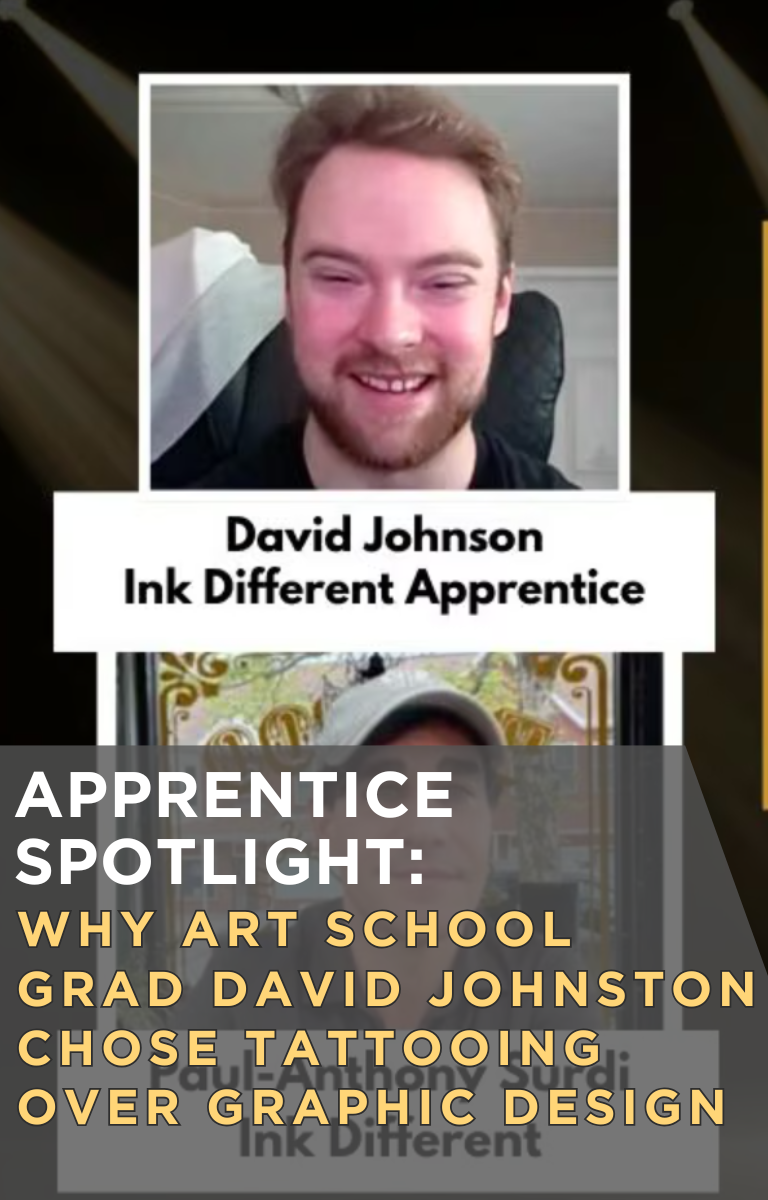
In This Article
- Key Takeaways
- Who is David Johnston and why does his story matter?
- Why did an art school grad walk away from graphic design?
- What design skills actually transfer to tattooing?
- Why is tattooing more AI-proof than graphic design?
- How did David start his tattoo apprenticeship?
- What does the Traditional Tattoo Apprenticeship include?
- What is the Master Mentorship program?
- Ready to trade the screen for skin?
- FAQ
“Why don’t you get into tattoos?” That’s what David Johnston’s dad asked him after art school, when the job hunt wasn’t going anywhere. David had looked at graphic design jobs, but making infographics and website images bored him. His dad’s question stuck, especially with AI changing so many careers. As David puts it, tattooing is “probably one of the very few fields that AI is going to have nothing to do with.”
Today, he’s working through Phase Two of Ink Different’s Traditional Tattoo Apprenticeship in Colorado. In our Apprentice Spotlight interview, David explained why he chose skin over screens.
Key Takeaways
- Why not graphic design: David found typical design work, like infographics, boring. He wants to draw cool things people will wear for life.
- Why tattooing: His dad suggested it, and David saw it as a field AI won’t replace.
- What transferred: Phase One felt a lot like his college illustration classes, including Procreate and Photoshop.
- What didn’t: The tattoo machine. In Phase Two, he had to relearn how to build an image, line by line.
- His mindset: Teachers “can lead you to the water,” but you have to be the one to drink it.
Who is David Johnston and why does his story matter?
David Johnston is an Ink Different apprentice in Colorado with a fine arts degree.
His interest in tattooing started early. He got his first tattoos at 16 and still remembers how welcoming the tattoo shop felt. In high school, he drew constantly to pass the time. He wanted to design video games, so he started college as a computer science major before switching to fine arts. He spent about five years in school.
His story matters because many art school grads hit the same wall: you have the skills, but the jobs don’t match what you want to make. David found a path that does.
Why did an art school grad walk away from graphic design?
David never built a graphic design career. He looked at those jobs and realized they weren’t for him.
After college, the economy was tough. He sent 30 to 40 job applications in a single week, then got stuck playing the waiting game. Some of the jobs he looked at were in graphic design, and the work, like infographics, just didn’t excite him.
What does excite him is making art that means something to someone. “If I can draw something really, really cool for a client that’s going to be on their body for their entire lives,” he says, “and they’re going to go to the beach and show it off, to me, that means the world.”
So when his dad suggested tattooing, David researched tattoo apprenticeships, found Ink Different, and applied.
What design skills actually transfer to tattooing?
Some of David’s art school skills transferred right away. Others didn’t.
What transferred
David says Phase One closely mirrored his college illustration courses. He already knew Procreate and Photoshop, and the self-directed style of learning felt familiar. He moved through Phase One quickly, learning American traditional, neo-traditional, new school, and his favorite, Japanese traditional.
What didn’t
Phase Two was a different story. Once he picked up a tattoo machine, he hit a wall. “Wow, tattooing is kind of hard,” he remembers thinking. Suddenly he had to manage machine stability, voltage, and needle depth all at once. He compares it to “learning how to walk again.”
He also had to rethink how he builds an image. With a pencil, he might draw a flower starting with the stem. With a tattoo machine, he has to work from right to left so his hand doesn’t smudge the stencil. “I need to not think of the pencil as like an image,” he says. “I need to think of it as lines that come together instead.”
Tiny, intricate designs like florals were especially challenging.
Why is tattooing more AI-proof than graphic design?
For David, the AI question was a big part of the decision.
“Especially with AI coming out and taking jobs away from people,” he says, “tattooing is probably one of the very few fields that AI is going to have nothing to do with and won’t touch at all.”
Tattooing is physical. It happens on real skin, with a real person in the chair, and that’s something software can’t replicate. Read more on why Tattoo Artists are still essential.
Worth remembering: David chose a career where his hands, his judgment, and his relationship with clients are the job.
How did David start his tattoo apprenticeship?
David started by researching tattoo apprenticeships after his dad’s suggestion, then applying to Ink Different.
Step 1: He took the suggestion seriously. His dad’s question pushed him to look into tattooing as a real career.
Step 2: He did his research. He looked into tattoo apprenticeships and found Ink Different.
Step 3: He used his art skills in Phase One. His illustration background helped him move quickly.
Step 4: He pushed through the Phase Two wall. He completed 30 double-sided practice pads.
Step 5: He leaned on blunt feedback. His Mentors, including Martin, Ruby, and Julian, gave him honest, helpful critiques.
Step 6: He owned his progress. “They can lead you to the water,” he says, “but you got to be the one to drink it.”
If you’re considering a similar move, read why a tattoo apprenticeship is perfect for career changers.
What does the Traditional Tattoo Apprenticeship include?
Ink Different’s Traditional Tattoo Apprenticeship is an 18 to 24 month, four-phase tattoo apprenticeship built for beginners. Ink Different has trained Tattoo Artists for 15 years.
- Phase One: Art and design, online, including Procreate and Photoshop.
- Phase Two: Machine practice on synthetic skin, online.
- Phase Three: Supervised work in a tattoo studio. David is looking forward to shadowing experienced Tattoo Artists, learning the business and financial side, and building a professional portfolio.
- Phase Four: Building independence and preparing for licensing.
- A guaranteed job offer: You’ll receive a guaranteed job offer at one of Ink Different’s own tattoo studios.
This is a career that comes with confidence. You’ll finish with job-ready skills, licensing support, and a guaranteed job offer at one of Ink Different’s own tattoo studios. The Traditional Tattoo Apprenticeship is available at 60+ tattoo studios nationwide.
Safety is part of the training, including the OSHA bloodborne pathogens standard. Licensing requirements vary by state. See how long a tattoo license takes in Colorado or how to get your tattoo license in Texas.
What is the Master Mentorship program?
Once you’ve built your foundation, Ink Different’s Master Mentorship connects you with Master Mentors, including Al Fliction, Liz Cook, Kyle Dunbar, Boneface, Jordi Pla, Marcel Oliveira, and Kara Gutierrez.
David already knows where he wants to go. Long-term, he hopes to specialize in neo-traditional and Japanese styles, inspired by medieval dark fantasy and pop culture. Master Mentorship is one way Tattoo Artists develop a signature style like that.
Ink Different also offers Spanish-speaking locations in Denver, Orange County, NYC, Miami, San Antonio, and San Diego.
Ready to trade the screen for skin?
David Johnston had the art degree. What he needed was work that felt meaningful. He found it in tattooing, and he’s ready for the challenge.
His mindset is simple. In college, he struggled with comparing his art to others. Now he only compares himself to who he was yesterday. “As long as you’re 1% better tomorrow than you are yesterday, that’s all that counts,” he says. To him, starting from zero and working your way up is an art form in itself.
Seats are limited, with only two apprentices per tattoo studio per Mentor.
Ready to become a Tattoo Artist? Apply now to Ink Different’s Traditional Tattoo Apprenticeship and start building an AI-proof career with licensing support and a guaranteed job offer at one of Ink Different’s own tattoo studios. Not sure yet? Fill out our quick questionnaire for personalized support.
Frequently Asked Questions
Why did David Johnston choose tattooing over graphic design?
He found typical graphic design work, like infographics, boring. His dad suggested tattooing, and David saw it as meaningful work AI can’t replace.
Do I need an art degree to become a Tattoo Artist?
No. David has one, and it helped in Phase One, but the Traditional Tattoo Apprenticeship is built for beginners.
Which art skills transfer to tattooing?
For David, Procreate, Photoshop, and the self-directed learning of his illustration classes transferred well. Using a tattoo machine was an entirely new skill.
What’s the hardest part of Phase Two?
For David, it was managing machine stability, voltage, and needle depth, and learning to tattoo from right to left so he doesn’t smudge the stencil.
How long does the Traditional Tattoo Apprenticeship take?
Ink Different’s Traditional Tattoo Apprenticeship takes 18 to 24 months across four phases, with licensing support and a guaranteed job offer at one of Ink Different’s own tattoo studios.
Where can I find a tattoo apprenticeship near me?
The Traditional Tattoo Apprenticeship is available at 60+ tattoo studios nationwide, including Spanish-speaking locations in Denver, Orange County, NYC, Miami, San Antonio, and San Diego.