Apprentice Spotlight: How Joe Kendall Balances Two Jobs, Kids, and a Tattoo Career Path
November 5, 2026
Apprentice Spotlight: Why Art School Grad David Johnston Chose Tattooing Over Graphic Design
November 5, 2026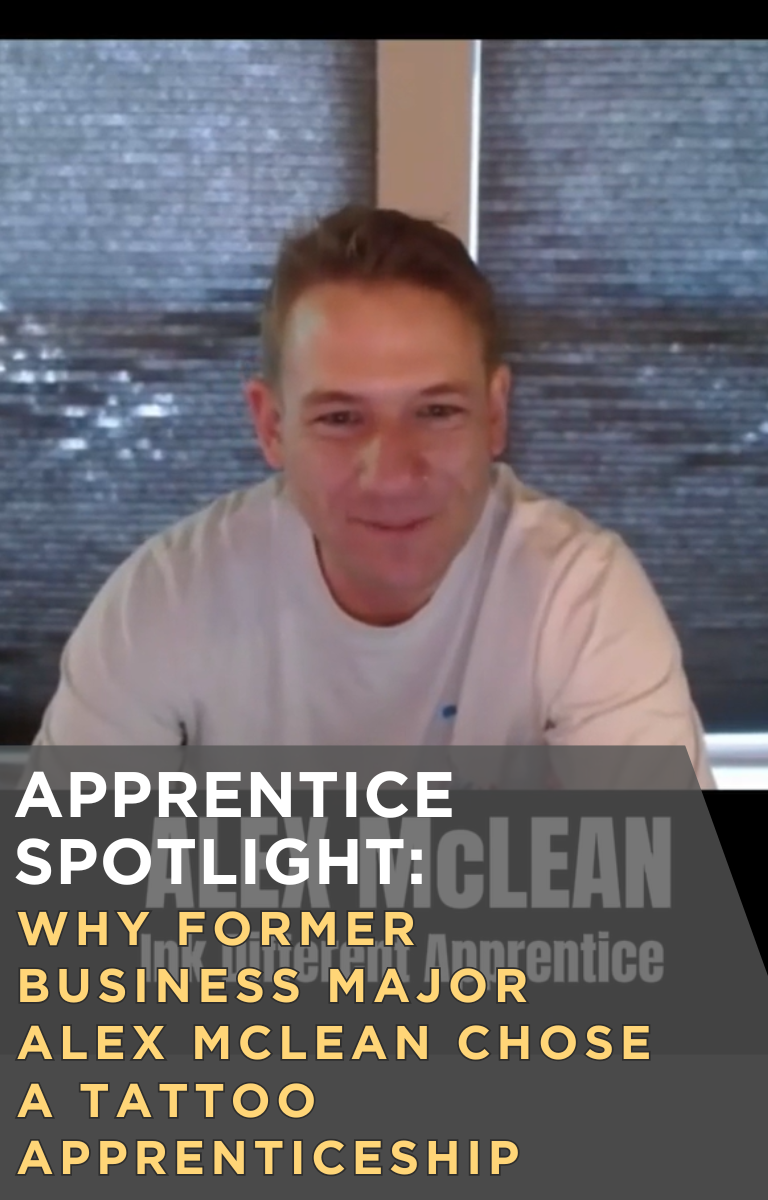
In This Article
- Key Takeaways
- Who Is Alex McLean?
- Why Did a Business Major Walk Away From the Corporate Track?
- What Made Tattooing Feel Different From a Degree?
- How Did Alex Start a Tattoo Apprenticeship With No Art Background?
- What Steps Can You Take to Follow Alex’s Path?
- Why Did Alex Choose Ink Different Tattoos?
- What Does the Traditional Tattoo Apprenticeship Offer?
- Ready to Write Your Own Spotlight Story?
- FAQ
When Alex McLean decided he wanted to tattoo professionally, he did what most people do first. He asked working Tattoo Artists how they got started. The answer he kept hearing wasn’t encouraging: you’ll have to hang around a tattoo shop for years, doing menial tasks, before anyone teaches you. So the former business major went looking for a better option.
He found it online in Ink Different’s Traditional Tattoo Apprenticeship, and its step-by-step structure won him over. Now he’s rounding out Phase One. We talked with Alex about why he chose this path.
Key Takeaways
- The usual advice: Tattoo Artists told Alex he’d spend years hanging around tattoo shops before getting a real chance.
- What he wanted instead: A structured, educational, professional path, step by step.
- What surprised him: Every instructor is a working Tattoo Artist, and he’s building a network with future colleagues.
- His biggest fear: The permanence of tattoos. Training turned that fear into confidence.
- His dream: A chair in a tattoo shop, and he keeps that picture in mind through every assignment.
Who Is Alex McLean?
Alex McLean is an Ink Different apprentice finishing Phase One of the Traditional Tattoo Apprenticeship.
He grew up making art. He took private lessons as a kid and was an art teacher’s assistant in high school. But he went to a liberal arts college to study business. His college art teachers noticed his sketches and asked him why he was a business major.
After college, Alex spent about 10 years away from art. He worked in the corporate world and tried running his own flooring business.
Why Did a Business Major Walk Away From the Corporate Track?
Alex found his way back to art during one of the hardest times of his life.
About a year and a half before our interview, he lost good friends and family members. He needed an outlet. So he went back to his roots. He started painting, and then he tried tattooing on synthetic skin.
“I was just trying to create something, you know, something different, something cool,” he says, “and really just fell in love with the tattoo aspect.”
That love kept growing. Tattooing felt like it was calling his name.
Reality Check: Sometimes a career change starts with a personal low point. For Alex, art became both an outlet and a new direction.
If you’re considering your own change, read why a tattoo apprenticeship is perfect for career changers.
What Made Tattooing Feel Different From a Degree?
For Alex, the difference was the stakes, and the skills it takes to meet them.
He’d always loved getting tattooed and thought it would be an awesome career. But the permanence held him back. “I would think it’s just such a high risk,” he says. “If you mess up, then that’s on that person forever.”
What changed was training. Through his tattoo apprenticeship, that fear turned into confidence. It got to a point, he says, where he realized, “I could do this.”
Tattooing also asks you to think differently than other kinds of art. Alex calls it “rethinking how you draw.” As a sketch artist, he drew freely. Now he has to think a few steps ahead about how a design will look as a tattoo.
How Did Alex Start a Tattoo Apprenticeship With No Art Background?
Alex actually had an art background. What he didn’t have was experience designing tattoos, and that was a whole new skill set.
Learning tattoo boundaries
American traditional was his biggest adjustment. The line weights have to be consistent, and the figures are basic, but “they have to be strong,” he says. “You can’t do it crappily.” That’s when his mindset switched from art to tattoo art.
He also enjoyed learning the differences between traditional, neo-traditional, and new school. His instructors’ critiques kept his designs from blurring the lines between styles.
Learning new tools
Alex had never used Procreate. It was a little frustrating at first, but it quickly became fun. Now it makes his design process efficient, and he can draw anywhere.
Staying humble
Alex believes attitude matters as much as skill. “If people think going in that they are the best at something, then they’re probably not going to work out at it,” he says. “But if you go with the open mindset, absolutely.”
Before you start, read about the mistakes aspiring tattoo apprentices should avoid. Safety is part of the training, too, including the OSHA bloodborne pathogens standard.
What Steps Can You Take to Follow Alex’s Path?
Step 1: Find your way back to art. For Alex, painting and practicing on synthetic skin reignited his passion.
Step 2: Ask how others got started. Talking to Tattoo Artists showed Alex what the traditional route looks like.
Step 3: Look for structure. When years of menial tasks didn’t appeal to him, he searched for a step-by-step path.
Step 4: Send in your portfolio. Alex submitted his work, and he was accepted quickly.
Step 5: Draw every day. It’s his most valuable lesson. “Keeping things tight,” he says. Tight lines rely on small muscles, and daily practice keeps them sharp.
Step 6: Keep the dream in view. “This is the dream,” he says. “Just stay focused and keep going and it’ll become second nature.” He keeps picturing the final piece: being at the tattoo shop, tattooing.
For gear, see the tools every beginner Tattoo Artist should know.
Why Did Alex Choose Ink Different Tattoos?
Alex chose Ink Different because it offered the structure he was looking for. It felt educational, professional, and organized, with clear steps.
Once he started, two things surprised him:
- Every instructor is a working Tattoo Artist. He’s learning from people who tattoo for a living.
- He’s building a network. His classmates and instructors are future colleagues.
He also appreciates the supportive community. Ink Different’s “Good Humans” culture means you’re not learning alone. Ink Different has trained Tattoo Artists for 15 years.
It’s also a college alternative. Read why tattoo apprenticeships are gaining ground as a solid alternative to college.
What Does the Traditional Tattoo Apprenticeship Offer?
Ink Different’s Traditional Tattoo Apprenticeship is an 18 to 24 month, four-phase tattoo apprenticeship built for beginners.
- Online foundations: Phases One and Two happen online. Alex designed in Procreate and on paper in Phase One. In Phase Two, he’ll start using a tattoo machine on practice pads.
- In-studio training: Phases Three and Four take place in a tattoo studio under a Mentor’s supervision.
- Beginner-friendly: No prior experience required.
- Licensing support: Guidance through your state’s requirements, like how to get your tattoo license in Texas.
- A guaranteed job offer: You’ll receive a guaranteed job offer at one of Ink Different’s own tattoo studios.
This is a career that comes with confidence. You’ll finish with job-ready skills, licensing support, and a guaranteed job offer at one of Ink Different’s own tattoo studios. The Traditional Tattoo Apprenticeship is available at 60+ tattoo studios nationwide.
Good to Know: Seats are limited, with only two apprentices per tattoo studio per Mentor.
What if you want to go even further?
Once you’ve built your foundation, Ink Different’s Master Mentorship connects you with Master Mentors, including Al Fliction, Liz Cook, Kyle Dunbar, Boneface, Jordi Pla, Marcel Oliveira, and Kara Gutierrez.
When you’re ready to build your name, see these platforms to help Tattoo Artists build their brand.
Where can you train, and is Spanish-language support available?
Ink Different offers Spanish-speaking locations in Denver, Orange County, New York City, Miami, San Antonio, and San Diego.
Ready to Write Your Own Spotlight Story?
Alex McLean was told the only way in was years of hanging around tattoo shops. He found another way, and now he’s moving into Phase Two with a clear goal: a chair in a tattoo shop of his own.
His advice is to draw every day, stay open to critique, and keep picturing where you want to end up.
Ready to become a Tattoo Artist? Apply now to Ink Different’s Traditional Tattoo Apprenticeship and start building an AI-proof career with licensing support and a guaranteed job offer at one of Ink Different’s own tattoo studios. Or fill out our quick questionnaire to get personalized guidance.
Frequently Asked Questions
Why did Alex McLean choose a structured tattoo apprenticeship?
Tattoo Artists told him he’d have to hang around tattoo shops for years doing menial tasks. He wanted a structured, step-by-step path instead.
Did Alex have art experience?
Yes. He took private art lessons and was an art teacher’s assistant in high school. Designing for tattoos was still a new skill for him.
What is Alex’s most valuable lesson so far?
Draw every day to keep your fine motor skills sharp.
How did Alex get over his fear of tattooing?
Training. He worried about the permanence of tattoos, but his tattoo apprenticeship turned that fear into confidence.
How long does the Traditional Tattoo Apprenticeship take?
Ink Different’s Traditional Tattoo Apprenticeship takes 18 to 24 months across four phases, with licensing support and a guaranteed job offer at one of Ink Different’s own tattoo studios.
Will I get a job after finishing?
Yes. You’ll receive a guaranteed job offer at one of Ink Different’s own tattoo studios.