How Long Does It Take to Master Shading Before Going Solo?
September 28, 2026
In This Article
- Key Takeaways
- What Makes Tattooing an AI-Proof Career?
- Can Robots Really Tattoo People?
- Why Does the Human Touch Matter So Much?
- What Can a Robot Never Replace in a Tattoo Studio?
- How Do You Future-Proof Your Own Career?
- What You Can Expect from Our Traditional Tattoo Apprenticeship
- How Does Master Mentorship Push You Further?
- Making Tattoo Training Accessible for Everyone
- Ready to Become a Tattoo Artist?
- Frequently Asked Questions
On September 17, 2026, Figure gave that fear a real number. Its Helix 2.5 humanoid was tested in 30 Bay Area homes it had never operated in before, tasked with making beds, folding towels, and tidying living rooms. Out of 420 trials, it succeeded 237 times, a 56% completion rate under grading that allowed zero partial credit. Maybe you are stuck in a cubicle watching software swallow tasks that used to be yours. You can’t shake the feeling that your creative potential is going to waste.
An AI-proof career is a skilled trade rooted in human touch, trust, and craftsmanship. Even a $3.5 billion robot still can’t reliably replicate it on a comforter, let alone at scale. Tattooing is exactly that kind of career, and at Ink Different Tattoos we have spent over a decade training people just like you to build one.
Robots may be learning to make beds. They are not learning to transform a stranger’s story into permanent art. A Tattoo Artist works skin to skin with a real human being who wants to be seen, heard, and marked for life. Let’s talk about why Tattoo Artists will still be here long after the robots in your living room get their software updated.
Key Takeaways
- <b>AI-proof: Figure’s Helix 2.5 completed household chores at a 56% success rate across 30 unseen homes; tattooing requires 100%, on human skin, with no do-overs.
- <b>Craft over code: Every tattoo is a live, one-of-a-kind collaboration between artist and client, unlike a robot executing a fixed checkpoint across identical chores.
- Training length: Ink Different’s Traditional Tattoo Apprenticeship runs 18 to 24 months across four phases.
- Beginner friendly: No prior art experience is required to start your Tattoo Artist training.
- Real path: You start online and finish in studios with licensing support and job-ready skills.
What Makes Tattooing an AI-Proof Career?
><b>Tattooing is AI-proof because it combines physical skill, real-time judgment, and human trust in a way no algorithm, not even one trained on 16 million videos, can automate. A tattoo lives on a moving, breathing person, and every square inch demands a decision only a trained human can make.
The U.S. Bureau of Labor Statistics tracks craft and fine artists as a distinct, skilled occupation, precisely because hands-on creative work resists mass automation. Machines are getting better at prediction. Figure’s own Helix 2.5 still failed 44% of its trials on tasks as simple as folding a towel or making a bed. They remain terrible at reading the nervous first-timer in your chair who needs reassurance more than they need a perfect line.
When you become a Tattoo Artist, you plant a seed in ground that automation cannot pave over. Your value grows with every client relationship, every healed piece, every referral, while a robot’s “learning” still tops out at a fixed checkpoint applied identically across every home it enters.
Can Robots Really Tattoo People?
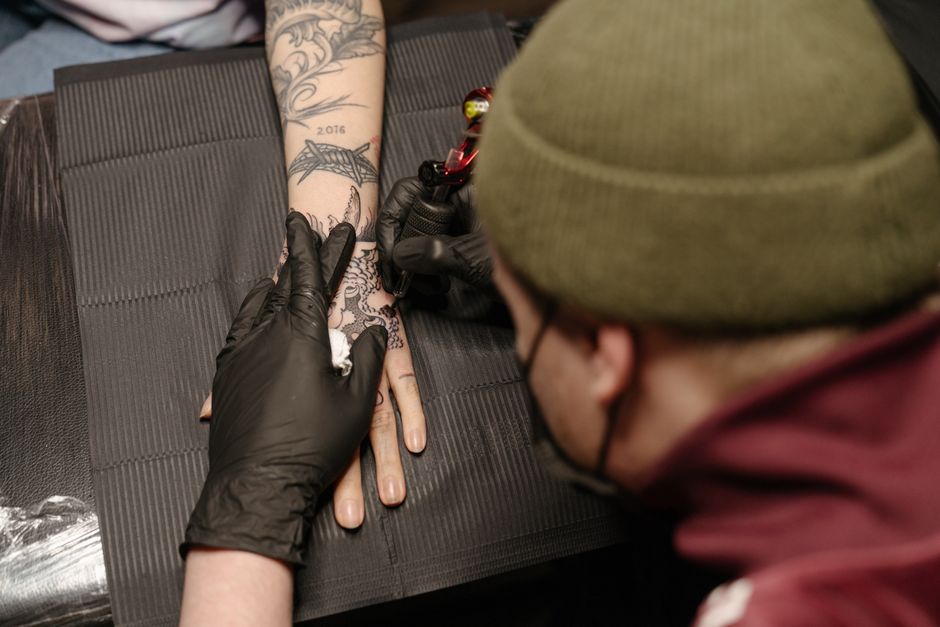
<b>Robots can technically press ink into skin in controlled demos, but the same generation of machines still fails 44% of the time on far simpler soft-fabric tasks, so they cannot handle the countless variables of a real human client safely or consistently. Skin stretches, bleeds, and reacts differently on every body.
A tattoo machine in a robot’s grip has no feel. Figure’s Helix 2.5, its most advanced system to date, needed 30 unseen homes and a fixed set of pre-trained chores just to hit 56% success on bed-making, and its idea of “self-correction” is stepping back to reposition a comforter or walk around a bed to fix a fold. It cannot sense when skin is drum-tight or loose, when a client flinches, or when a design needs to shift because a body isn’t shaped like a flat drawing. Those adjustments happen a thousand times per session, all guided by trained instinct that no amount of Index pretraining has come close to touching.
Why Does the Human Touch Matter So Much?
<b>The human touch matters because a tattoo is emotional first and visual second, and clients pay for the connection as much as the ink. People walk in carrying grief, pride, love, and rebellion, none of which shows up in a training dataset built from folded laundry.
Think about the last meaningful tattoo you saw. It marked something: a lost parent, a milestone, a new chapter. A person needs to translate that raw emotion into a permanent design, and that translation is a conversation, not a download. Figure’s Index dataset generates roughly 35 minutes of new human experience every second, and none of it teaches a machine how to sit with someone who’s nervous about a permanent decision.
A robot can copy a reference image. It cannot sit with a shaking client, calm them down, and adjust the story in real time. That warmth is why your future clients will keep choosing you.
What Can a Robot Never Replace in a Tattoo Studio?
A robot can never replace trust, style, adaptability, or the community that turns a tattoo studio into a place people return to for life. These are the pillars of a lasting career, and none of them show up on Figure’s scoreboard.
Here is what automation cannot touch:
- Trust: Clients hand you their skin permanently, and they choose humans they believe in.
- Signature style: Your artistic voice becomes a brand a machine cannot imitate.
- Real-time adaptation: Every session requires hundreds of on-the-fly decisions.
- Community: Shops run on relationships, reputation, and referrals.
Your style is your moat. Once you develop it, no software can flood the market with your voice.
How Do You Future-Proof Your Own Career?
You future-proof your career by trading a replaceable desk job for a hands-on skilled trade that automation cannot outsource, then training under experienced mentors. Here is a simple path to follow.

- Step 1: Name the pain. Get honest about the dead-end job draining your time and your creative potential. Nothing changes until you admit it.
- Step 2: Choose a trade that needs a human. Tattooing requires touch, trust, and judgment that no robot can copy.
- Step 3: Find a real mentor. Live, in-person guidance beats any online shortcut. Avoid the common traps in this guide to mistakes aspiring tattoo apprentices should avoid.
- Step 4: Learn your tools and safety. Master the fundamentals covered in tools every beginner tattoo artist should know.
- Step 5: Commit and start. Seats in quality tattoo apprenticeships are limited by nature, so decisive action wins.
Wise-Guide Tip: The best time to plant a tree was 20 years ago. The second-best time is today. The same is true for starting your tattoo apprenticeship.
What You Can Expect from Our Traditional Tattoo Apprenticeship
Ink Different’s Traditional Tattoo Apprenticeship is an 18- to 24-month, four-phase tattoo artist training program that takes you from beginner to job-ready professional with licensing support. It is our college alternative built for people who pursue excellence.
You get personalized, hands-on training. You start online to build your foundations, then finish in real tattoo studios working alongside experienced mentors. No prior art experience is required, because we teach the fundamentals from day one.
Here is what the four-phase tattoo apprenticeship builds:
- Phase 1: Foundations in drawing, line work, and machine handling.
- Phase 2: Supervised practice on practice skin to sharpen technique.
- Phase 3: Live, mentored work as your confidence and portfolio grow.
- Phase 4: Building your independent client base plus licensing preparation.
This is a career that comes with confidence: job-ready skills and licensing support so you can work professionally. Wondering about state rules? See how licensing works in specific states, from how to get your tattoo license in Texas to how long a tattoo license takes in Colorado</a>.
How Does Master Mentorship Push You Further?
Master Mentorship is a one-year, in-person program where you train with celebrity and award-winning mentors to master a specific style, explode your career, or launch your own business. It fits beginners and experienced artists alike.
Imagine learning directly from names like Al Fliction, Liz Cook, Kyle Dunbar, Boneface, and Jordi Pla. That is not a YouTube tutorial, and it’s not a fixed checkpoint applied the same way in every home. That is live, over-the-shoulder mentorship that compresses years of trial and error into focused, intensive skill development.
If you already have some experience and want to level up, this is your path to a signature voice that no robot and no competitor can copy.
Making Tattoo Training Accessible for Everyone
Ink Different offers Spanish-speaking locations so language never blocks your path to becoming a Tattoo Artist. Our Good Humans culture means you join a supportive, family-like community from your first day.
You can find Spanish-speaking tattoo artist training in Denver, in Orange County, near New York City, in Miami, in San Antonio, and in San Diego. Wherever you start, you are never alone on this journey.
Ready to Become a Tattoo Artist?
The robots are living in real homes now, making beds and folding towels with a 56% success rate. They are not coming for the trusted human who transforms a stranger’s story into permanent art, not this year, and not with the numbers Figure has published so far. While others watch their careers erode to automation, you can build one that grows stronger every single year, on ground no robot has even been tested on.
Ready to become a tattoo artist? Apply now to Ink Different’s Traditional Tattoo Apprenticeship and start building an AI-proof career with licensing support along the way. Not sure yet? Fill out our quick questionnaire to get personalized support and find out if our tattoo apprenticeship is right for you.
Frequently Asked Questions
Will AI or robots replace tattoo artists?
<p>No. Tattooing requires human trust, real-time judgment, and hands-on skill on living skin that automation cannot safely or consistently replicate, making it a genuine AI-proof career.
Do I need art experience to start a tattoo apprenticeship?
No prior art experience is required. Ink Different’s Traditional Tattoo Apprenticeship teaches drawing, line work, and machine handling from day one.
How long does the Traditional Tattoo Apprenticeship take?
<p>Ink Different’s Traditional Tattoo Apprenticeship takes 18 to 24 months across four phases: remote foundations, supervised practice, live mentored work, and independent client building with licensing prep.
What makes Ink Different different from a tattoo school?
<p>Ink Different offers live, in-person mentorship, over 15 years of experience, award-winning mentors, and a supportive Good Humans community, a college alternative focused on excellence.
Is there a Spanish-speaking tattoo apprenticeship near me?
Yes. Ink Different offers Spanish-speaking tattoo artist training in Denver, Orange County, near New York City, Miami, San Antonio, and San Diego.
Does the apprenticeship include help getting licensed?
Yes. The Traditional Tattoo Apprenticeship includes licensing support and job-ready skills, preparing you to work professionally under state requirements upon completion.