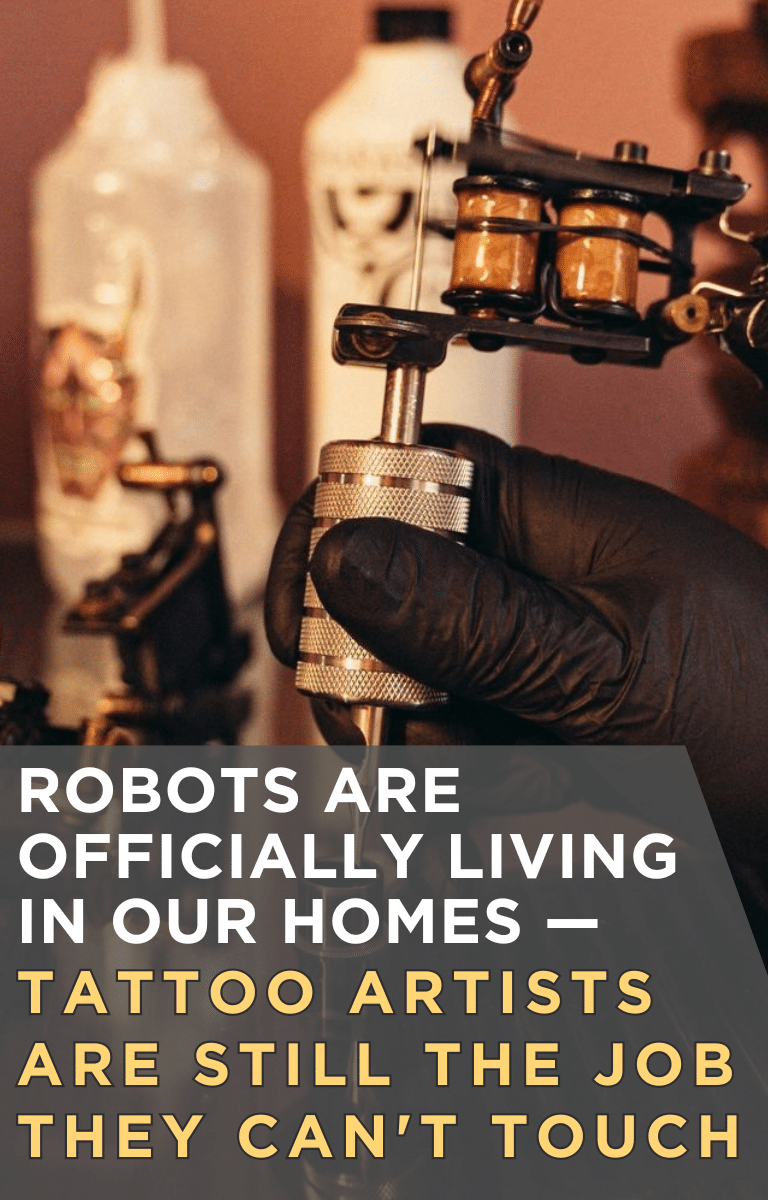
Robots Are Officially Living in Our Homes — Tattoo Artists Are Still the Job They Can’t Touch
September 24, 2026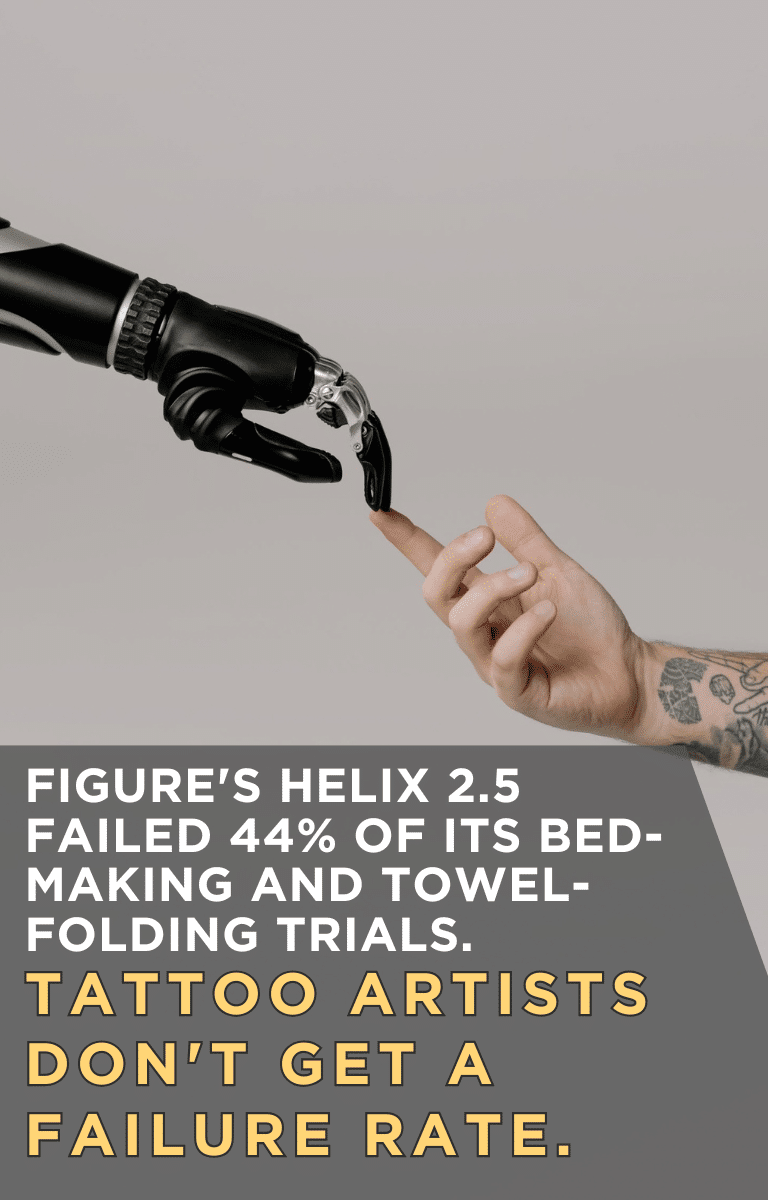
In This Article
- Key Takeaways
- What Actually Happened With Figure’s Helix 2.5?
- Why Can’t a Million-Dollar Robot Fold a Towel?
- Why Do Tattoo Artists Not Get a “Failure Rate”?
- What Makes Tattooing an AI-Proof Career?
- How Do You Start a Career Robots Can’t Touch?
- What Is the Traditional Tattoo Apprenticeship?
- Who Is the Master Mentorship For?
- Where Can You Train in Spanish?
- Ready to Build Something a Robot Never Will?
- FAQ
You’ve probably seen the headlines: humanoid robots are coming for every job, and creative work is next on the chopping block. Then, on September 17, 2026, Figure released real performance data on its Helix 2.5 model, tested zero-shot across 30 Bay Area homes it had never operated in before, and the story got a lot more complicated.
Out of 420 trials covering bed-making, towel-folding, and living room tidying, the robot completed only 237 successfully, a 44% failure rate under Figure’s own all-or-nothing grading. These are tasks a toddler figures out on a rainy afternoon. Here’s the thing worth sitting with: an AI-proof tattoo career is one where human hands, a steady eye, and trust between two people cannot reduce to a failure-rate percentage, because what a Tattoo Artist does is fundamentally irreplaceable.
A tattoo artist is a skilled craftsperson who creates permanent, custom body art through hands-on technique, artistic judgment, and one-on-one trust with clients, work that requires presence, adaptability, and permanent accountability. Ink Different Tattoos has spent 15 years training people for exactly that kind of work: the kind machines keep failing at.
Key Takeaways
- The data: Figure’s Helix 2.5 humanoid completed 237 of 420 trials, a 56% success rate and 44% failure rate on bed-making and towel-folding, with no partial credit given.
- The gap: Robots still struggle with soft, unpredictable, human-touch tasks, and tattooing is far harder than folding a towel.
- The point: A skilled Tattoo Artist works with living skin and real trust, which no failure-rate metric can automate.
- The path: Ink Different’s Traditional Tattoo Apprenticeship (18 to 24 months) builds job-ready skills with licensing support.
- The advantage: Live, in-person mentorship with award-winning artists makes this a serious college alternative.
What Actually Happened With Figure’s Helix 2.5?
Figure’s Helix 2.5 humanoid robot failed 44% of its 420 household trials, including bed-making, towel-folding, and living room tidying, revealing how far automation still is from mastering soft, unpredictable physical tasks, even after $3.5 billion in training compute.
Figure is one of the most hyped humanoid robotics companies on the planet, promising machines that will handle chores, warehouses, and eventually skilled labor. Helix 2.5 was trained on the company’s Index dataset, built from 16 million videos and 264,000 app downloads across 108 countries. That’s genuinely serious engineering. But when the trial numbers came in, on toy tidying specifically, success dropped to just 40%, reality punched back.
Folding a towel sounds trivial. A robot has to grip fabric that bends, bunches, and shifts, then reason about where the edges are as everything moves, all while being graded on whether all four corners land within one inch of each other. Now imagine asking that same machine to press a needle into living, moving human skin at exactly the right depth. You start to see the canyon between hype and reality.
Why Can’t a Million-Dollar Robot Fold a Towel?
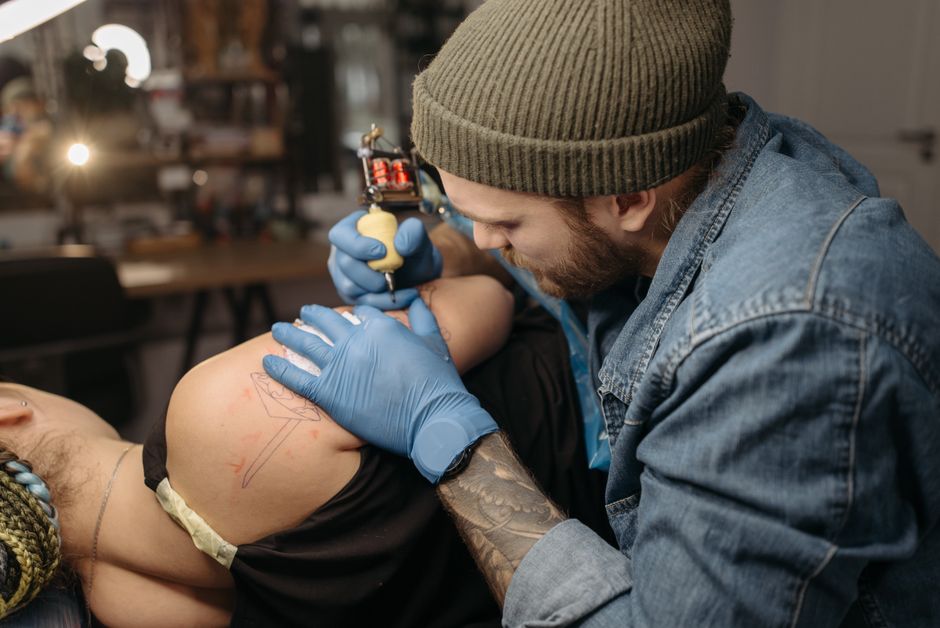
Robots fail at soft, variable tasks like folding towels because these jobs demand real-time judgment, adaptive touch, and constant micro-adjustments that automation cannot reliably replicate yet, even with $3.5 billion in training investment behind it.
Engineers call this the “dexterity problem.” A car assembly line is repetitive and predictable, so robots dominate there. But a towel never lands the same way twice. Neither does a customer’s arm, their nervous flinch, or the way their skin holds ink. Figure itself admits general humanoid robotics “is not solved,” and its own comparison test proves the point: a version of Helix 2.5 trained from scratch, without the Index pretraining, succeeded on only 9% of trials. Even with that pretraining boost to 56%, nearly half of all attempts still failed outright.
The U.S. Bureau of Labor Statistics on craft and fine artists groups craft and fine artists among careers built on hands-on originality, the exact quality automation struggles to reproduce. If a machine can’t reliably square a bedsheet 56% of the time, it isn’t shading a portrait on someone’s ribcage anytime soon.
Reality check: The tasks robots fail hardest at are the tasks that require a human to read the moment. Tattooing is that, times a thousand.
Why Do Tattoo Artists Not Get a “Failure Rate”?
Tattoo Artists don’t operate on a published failure rate because their work is a trained, one-on-one human craft where preparation, judgment, and accountability replace the trial-and-error metrics that measure machines like Helix 2.5.
When a robot fails 44% of its towel trials, nothing is lost but time and a reset. When you tattoo a person, there’s no “reset the trial” button, no do-over on a design that’s already under the skin. That permanence is exactly why the training matters, and why a real apprenticeship drills you until the work is dependable.
A working artist has already put in the reps on drawing, line work, machine handling, and safety, far more repetition than Figure’s robot got on any single chore (no single evaluation task, per Figure’s own report, made up more than 1.90% of its training data). By the time a client sits in your chair, the failure rate has been trained out of you. That’s not luck. That’s mentorship, and it’s the opposite of a machine guessing its way through a task.
If you’re just starting to explore this world, it helps to know the pitfalls early. Read our guide on the mistakes aspiring tattoo apprentices should avoid before you take your first step.
What Makes Tattooing an AI-Proof Career?
Tattooing is AI-proof because it combines physical dexterity, artistic originality, human trust, and permanent stakes, a combination no current robot, not even one backed by $3.5 billion in compute, can replicate on living skin.
Automation eats jobs that are repetitive, predictable, and screen-based. Tattooing is none of those. Every client, body, design, and healing process is different, which is exactly the kind of variation that dropped Helix 2.5’s success rate to 40% on its hardest task. You’re not just executing a task; you’re collaborating with a nervous human who is trusting you with their body forever.
We break this argument down further in why tattoo artists are still essential. The short version: the future belongs to skilled trades that require presence, and this is one of the best of them.
- Physical craft: Steady hands and depth control that machines can’t reliably match.
- Human trust: Clients hire a person, not a printer.
- Creative originality: Custom work that adapts to real anatomy.
- Safety judgment: Following standards like OSHA’s bloodborne pathogen guidelines in real time.
While you’re stuck in a job that a spreadsheet could do, your creative potential is sitting on a shelf collecting dust. That’s the real cost of waiting.
How Do You Start a Career Robots Can’t Touch?
You start an AI-proof tattoo career by enrolling in a structured tattoo apprenticeship that teaches fundamentals first, then progresses to supervised live work and licensing support.
Here’s the honest path, step by step. No shortcuts, no gimmicks, just the sequence that actually turns a beginner into a working professional.
- Step 1: Commit to the decision. Decide you’re done wasting years in work that drains you. Momentum starts with one choice.
- Step 2: Learn the fundamentals. Drawing, line work, machine handling, and safety come before you ever touch skin.
- Step 3: Practice under supervision. Move from fake skin to supervised live clients with a Mentor watching every move.
- Step 4: Build your portfolio and get licensed. Develop a body of work and complete your state licensing with real support.
If you’re weighing this against a degree, see how tattoo apprenticeships gain ground as a solid alternative to college.
What Is the Traditional Tattoo Apprenticeship?
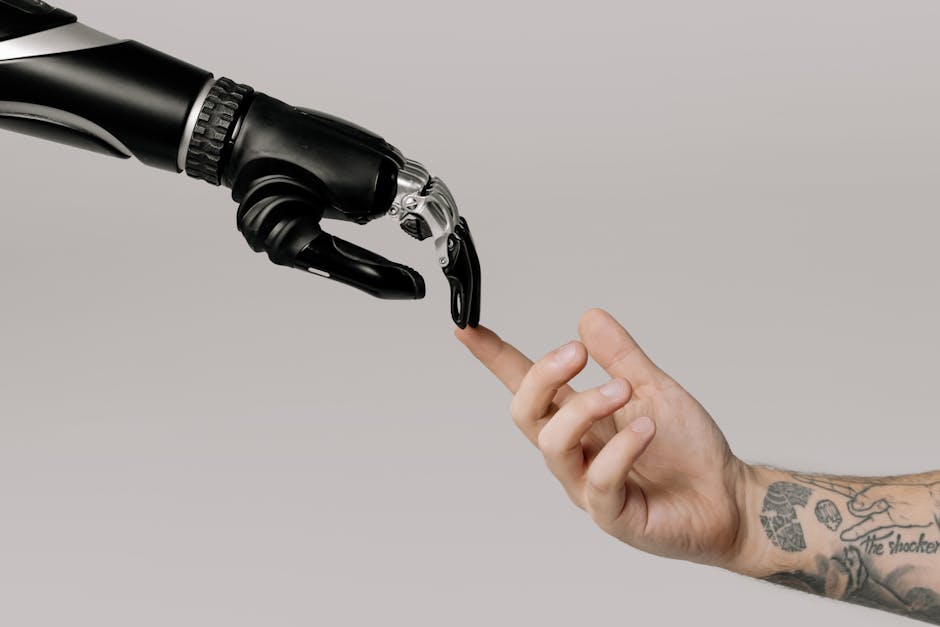
The Traditional Tattoo Apprenticeship at Ink Different Tattoos is an 18-to-24-month, four-phase training program that takes beginners from zero experience to job-ready professionals with licensing support.
This is our core path, and it’s built for people who have never picked up a Tattoo Machine. You start online to build your foundations, then finish hands-on inside working tattoo studios where the real learning happens.
- Length: 18 to 24 months across four progressive phases.
- Who it’s for: Beginners with no prior art experience needed.
- Format: Start remote, finish in professional Tattoo Studios.
- Outcome: Job-ready skills and licensing support so you can work professionally.
We’ve been doing this since 2011, which means 15 years of refining how we turn aspiring artists into confident professionals. That’s not theory. That’s a track record.
A career like this comes with something a robot’s 56% success rate never will: confidence. You’ll know your craft in your bones, and you’ll be able to build an income doing work that actually means something.
Who Is the Master Mentorship For?
The Master Mentorship is a one-year, in-person program for beginner and experienced artists who want intensive skill development, style mastery, and business ownership guidance from award-winning Mentors.
If you want to push harder and faster, this is your accelerator. You train alongside award-winning Mentors including Al Fliction, Liz Cook, Kyle Dunbar, Boneface, and Jordi Pla, artists who have built the exact careers you’re chasing.
This track is ideal for mastering a specific style, exploding your career, or learning to run your own tattoo studio.
Where Can You Train in Spanish?
Ink Different Tattoos offers Spanish-speaking training locations in Denver, Orange County, New York City, Miami, San Antonio, and San Diego, making professional tattoo training accessible to more aspiring artists.
Language should never be the wall between you and a career you were built for. If Spanish is your first language, you can train near you in any of these cities and get the same hands-on mentorship in a language you’re comfortable in.
This is part of our “Good Humans” culture: a supportive, family-like community where nobody gets left behind. You’re not just enrolling in a Tattoo Apprenticeship Program; you’re joining people who genuinely want you to win.
Ready to Build Something a Robot Never Will?
The robots keep failing at soft, human tasks, 44% of the time on tasks far simpler than tattooing, which means the smartest career move today is a skilled craft built on hands, trust, and presence, exactly what Ink Different trains you to do.
Seats in our live, in-person mentorship are limited by nature, because real training can’t be mass-produced. If you’ve been waiting for a sign to change your life, this is it.
Ready to become a Tattoo Artist? Apply now to Ink Different’s Traditional Tattoo Apprenticeship and start building an AI-proof career with licensing support along the way. Or fill out our quick questionnaire to get personalized support and find out if our Traditional Tattoo Apprenticeship is right for you.
Frequently Asked Questions
Will robots replace tattoo artists?
No. Humanoid robots like Figure’s Helix 2.5 still fail 44% of simple soft tasks such as folding towels and making beds, even after $3.5 billion in training investment. Tattooing requires human judgment, dexterity, and trust that automation cannot replicate on living skin.
How long does the Traditional Tattoo Apprenticeship take?
Ink Different’s Traditional Tattoo Apprenticeship takes 18 to 24 months across four progressive phases, starting online and finishing hands-on inside professional tattoo studios.
Do I need art experience to become a tattoo artist?
No prior experience is required. The Traditional Tattoo Apprenticeship teaches drawing, line work, machine handling, and safety from the very first phase for complete beginners.
What makes Ink Different different from a tattoo school?
Ink Different is a nationwide apprenticeship program, not a tattoo school, offering live in-person mentorship with award-winning artists, 15 years of experience, and a supportive community culture.
Can I train as a tattoo apprentice in Spanish?
Yes. Ink Different offers Spanish-speaking training in Denver, Orange County, NYC, Miami, San Antonio, and San Diego so more aspiring artists can access professional training.
Is tattooing really an AI-proof career?
Tattooing is highly AI-resistant, combining physical dexterity, creative originality, human trust, and permanent stakes on living skin, a mix current robots and software cannot replicate reliably.