Over 300 Artists Descend on Syracuse for the World’s Largest Traveling Tattoo Festival
September 29, 2026
Why Tattoo Styles From the 1950s Are Making a Comeback
September 29, 2026
In This Article
- Key Takeaways
- Why can robots make beds but not tattoos?
- What makes tattooing impossible for machines to replicate?
- Why is tattooing considered an AI-proof career?
- Where do tattoo artists fit in the future job market?
- How do you start a career that machines can’t touch?
- What does the Traditional Tattoo Apprenticeship include?
- How does Master Mentorship push you further?
- Where can you train in Spanish?
- Ready to build a future no machine can take?
- FAQ
You have seen the headlines. On September 17, 2026, Figure tested its Helix 2.5 humanoid across 30 real Bay Area homes it had never operated in before, folding towels, tidying living rooms, and making beds. Every week another job quietly moves from human hands to a mechanical arm. This time there’s a hard number attached: 237 successful completions out of 420 trials. That’s a 56% success rate under grading that gave zero partial credit.
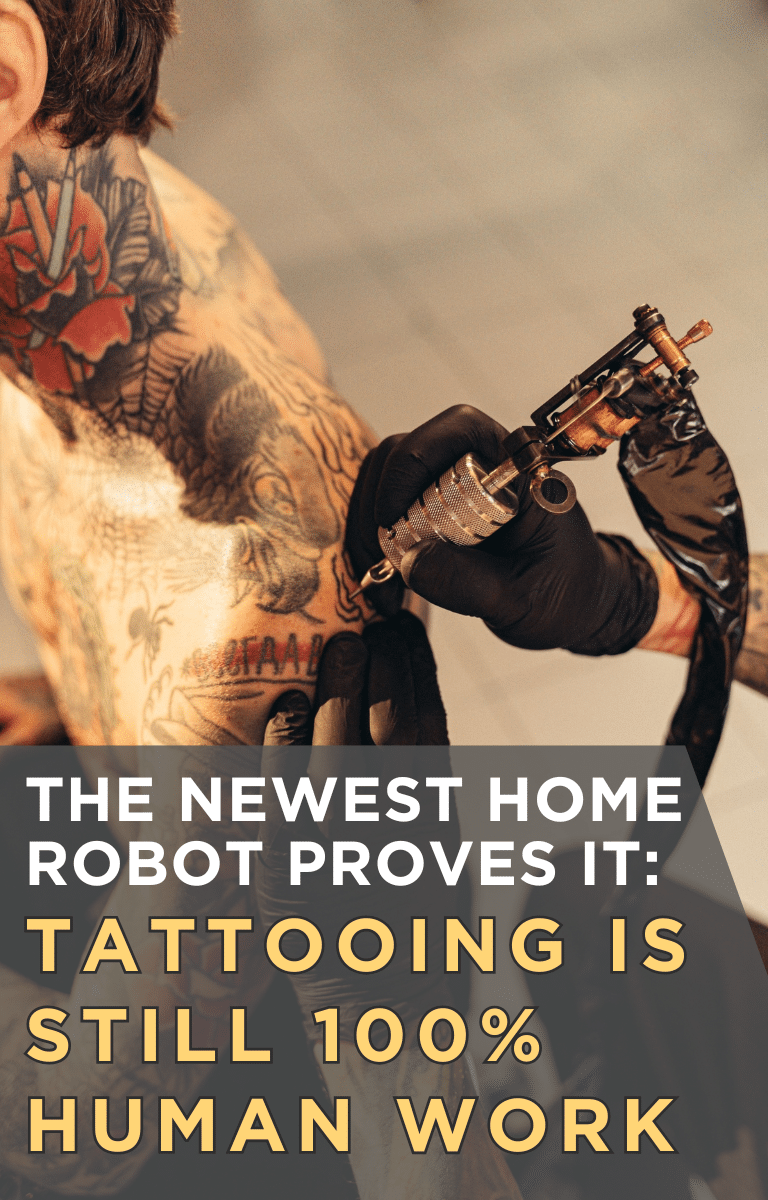
If you are stuck in a role that feels replaceable, that fear sits in your chest like a stone. Here is the thing worth remembering: not every craft can be automated, and Figure’s own results prove exactly where the line sits. A machine-proof Tattoo Artist career is one built on human creativity, trust, and physical skill that artificial intelligence cannot fully replicate, and a robot that still fails 44% of the time on a bedsheet is nowhere close to attempting it.
Tattooing is exactly that kind of work, and at Ink Different Tattoos we have spent 15 years training people just like you to claim it.
Key Takeaways
- AI-proof: Figure’s Helix 2.5 succeeded at bed-making and towel-folding only 56% of the time across 30 unseen homes; tattooing demands 100%, permanently, on human skin.
- Why now: As robots absorb routine chores, at a cost of $3.5 billion in training compute, hands-on creative careers grow more valuable, not less.
- Path: Ink Different’s Traditional Tattoo Apprenticeship runs 18 to 24 months with licensing support.
- Beginner-friendly: No prior art experience required; you start online and finish in real tattoo studios.
- Community: You join a “Good Humans” culture of Mentors and peers, not a faceless classroom or a fixed checkpoint trained once and deployed everywhere.
Why can robots make beds but not tattoos?
Robots can make beds, sort of, because bed-making is a repeatable task with fixed steps, while tattooing demands live judgment, human trust, and permanent decisions on a moving, breathing body. And even at that simpler task, Figure’s Helix 2.5 only pulled it off 56% of the time across 30 test homes, with pillow orientation and comforter smoothness graded on a strict pass-fail basis.
A bed does not flinch. It does not have a curve that changes with a breath, or a nervous first-timer who needs you to calm them down. Automation thrives on predictability, and tattooing is the opposite of predictable. Every client is a new puzzle with different skin, different pain tolerance, and a story they want carried on their body for life, nothing like the fixed couches, beds, and folding surfaces Figure’s robot was tested against.
The tasks machines conquer first are the boring, uniform ones, and even those aren’t fully conquered yet: toy tidying, the simplest-sounding of Figure’s three test chores, succeeded only 40% of the time. The work that survives is the work that asks a human to think, feel, and adapt in real time. That is your opening.

What makes tattooing impossible for machines to replicate?
Tattooing is impossible to fully automate because it fuses artistic decision-making, emotional connection, and precise physical technique on unique human skin that reacts differently every single time, unlike the standardized furniture and fabrics Helix 2.5 was trained and tested on.
Think about what actually happens in a session. You adjust your needle depth based on how a specific patch of skin takes ink. Then, you read body language and slow down when someone tenses up. You reshape a design on the spot because the client’s collarbone sits differently than the stencil predicted. Compare that to the most advanced self-correction Figure could report for Helix 2.5: stepping back to reposition, or walking around a bed to fix a fold.
Those micro-decisions are not programmable. They come from experience, empathy, and taste. As we explain in our piece on why tattoo artists are still essential, people do not just want ink. They want to be seen and understood by the human holding the tattoo machine.
Worth remembering: Trust is the product. Nobody wants a permanent mark from a robot that still gets nearly half its towel-folding trials wrong, let alone one that cannot understand why the mark matters to them.
Why is tattooing considered an AI-proof career?
Tattooing is an AI-proof career because it combines creative labor, in-person trust, and licensed hands-on skill, three things automation consistently struggles to replace, even with $3.5 billion in dedicated training compute behind the effort.
Creative and craft work has proven remarkably resilient. According to the U.S. Bureau of Labor Statistics on craft and fine artists, these professionals continue to find demand precisely because their work is original and hand-produced. A tattoo cannot be mass-manufactured, shipped from a warehouse, or generated from a fixed checkpoint tested identically across 30 different houses. It is made once, on one person, by one artist.
There is also a regulatory moat. Tattooing is bound by strict health and safety standards, including OSHA bloodborne pathogen standards, that require trained, accountable human professionals. That is not a barrier to fear. It is a wall protecting your future income, one that no amount of Index pretraining data gets a robot past.
Where do tattoo artists fit in the future job market?
Tattoo Artists sit in the resilient corner of the future job market, where demand for personalized, human-made, in-person creative services keeps growing even as routine roles disappear to automation, chore by chore, at a 56% success rate.
The jobs feeling the squeeze are the ones defined by repetition. The jobs gaining ground are the ones defined by identity, emotion, and human connection. Tattooing lives firmly in the second group. People will always want meaningful, custom work made by hands they trust, not a robot that needed 30 homes’ worth of testing just to get a bed made a little more than half the time.
This is why more people are treating a tattoo apprenticeship as a serious college alternative. Instead of borrowing heavily for a degree in a field that may be automated, you can invest in a skill that pays in creativity and cannot be downloaded.
How do you start a career that machines can’t touch?
You start a machine-proof tattoo career by finding structured, in-person Tattoo Artist Training that teaches fundamentals, gives you real studio hours, and supports you through state licensing.
- Step 1: Name the pain. Admit the job you are in now is draining your creative potential. That honesty is the seed of every real change.
- Step 2: Learn the fundamentals. Drawing, line work, shading, and machine handling. Beginners build these from zero with the right guidance.
- Step 3: Study the common traps. Read up on the mistakes aspiring tattoo apprentices should avoid so you skip the detours.
- Step 4: Get hands-on in a real Tattoo Studio. Practice skin, supervised client work, and hygiene protocols under a licensed Mentor.
- Step 5: Earn your license and build your brand. Finish job-ready, then grow your following with the right platforms to help tattoo artists build their brand.

What does the Traditional Tattoo Apprenticeship include?
Ink Different’s Traditional Tattoo Apprenticeship is an 18 to 24 month, four-phase Tattoo Artist Training that takes beginners from fundamentals to job-ready professionals with licensing support along the way.
This is the practical bridge from “I wish” to “I do.” You start online to build your foundations, then finish in real tattoo studios where the craft actually lives. No prior experience is required, because we designed this for people ready to change their lives, not just people with a portfolio.
- Personalized, hands-on training with live, in-person Mentors, not prerecorded videos.
- Start remote, finish in studios so you learn on real skin in a real environment.
- Built for beginners with no formal art background needed.
- Licensing support and job-ready skills so you finish prepared to work professionally.
We have been doing this since 2011, and that 15 years of experience means we know how to turn raw motivation into professional skill, tested on real people, in real tattoo studios, not in a controlled evaluation across 30 sample homes. You are the hero here. We are simply the guide who has walked this road with hundreds before you.
How does Master Mentorship push you further?
Master Mentorship is a one-year, in-person program pairing beginner and experienced artists with celebrity and award-winning Mentors to master a specific style, explode a career, and build a business.
If the Traditional Tattoo Apprenticeship plants the seed, Master Mentorship is the accelerant. You train directly alongside names like Al Fliction, Liz Cook, Kyle Dunbar, Boneface, and Jordi Pla. This is exclusivity you cannot buy in a lecture hall or download from any training dataset: access to the best, in person, focused on intensive skill development.
It is ideal if you already tattoo and want to level up, or if you are hungry to own your own tattoo studio and command a signature style.
Where can you train in Spanish?
Ink Different offers Spanish-speaking Tattoo Artist Training in Denver, Orange County, New York City, Miami, San Antonio, and San Diego, making a machine-proof creative career accessible to more people.
Talent does not speak only one language, and neither does opportunity. Whether you are searching for a tattoo apprenticeship near Miami or in San Antonio, our Spanish-speaking locations remove the language barrier that keeps so many gifted people from starting.

Ready to build a future no machine can take?
Get serious about a career automation can’t reach, and let Become A Tattoo Artist guide you from stuck to skilled.
Ready to become a Tattoo Artist? Apply now to Ink Different’s Traditional Tattoo Apprenticeship and start building an AI-proof career, with licensing support every step of the way. Or fill out our quick questionnaire to get personalized support and find out if our Traditional Tattoo Apprenticeship is right for you.
Frequently Asked Questions
Will robots ever replace tattoo artists?
No. Tattooing requires human trust, live judgment, and real-time adaptation to unique skin, qualities extremely difficult for machines to replicate, making it a genuinely machine-proof career.
Do I need art experience to start a tattoo apprenticeship?
No. Ink Different’s Traditional Tattoo Apprenticeship is built for beginners, teaching drawing, line work, and machine handling from scratch with no prior formal art background required.
How long does the Traditional Tattoo Apprenticeship take?
The Traditional Tattoo Apprenticeship runs 18 to 24 months through four phases: starting remotely to learn fundamentals, then finishing in real studios with licensing support and job-ready skills.
What makes Ink Different different from other training?
Ink Different offers live, in-person mentorship with award-winning mentors, 15 years of experience since 2011, a “Good Humans” community culture, and positions itself as a genuine college alternative.
Is a tattoo apprenticeship a good career change?
Yes. Tattooing is a creative, in-person, license-protected career that resists automation, offering people stuck in unfulfilling jobs a genuine path to meaningful, machine-proof work and income stability.
Can I train in Spanish?
Yes. Ink Different offers Spanish-speaking Tattoo Artist Training in Denver, Orange County, New York City, Miami, San Antonio, and San Diego, removing language barriers for aspiring artists worldwide.