
Linework Flash: Why Simple Designs Teach the Most
November 12, 2026
James Vaughn: From Ink Master to Master Mentor
November 13, 2026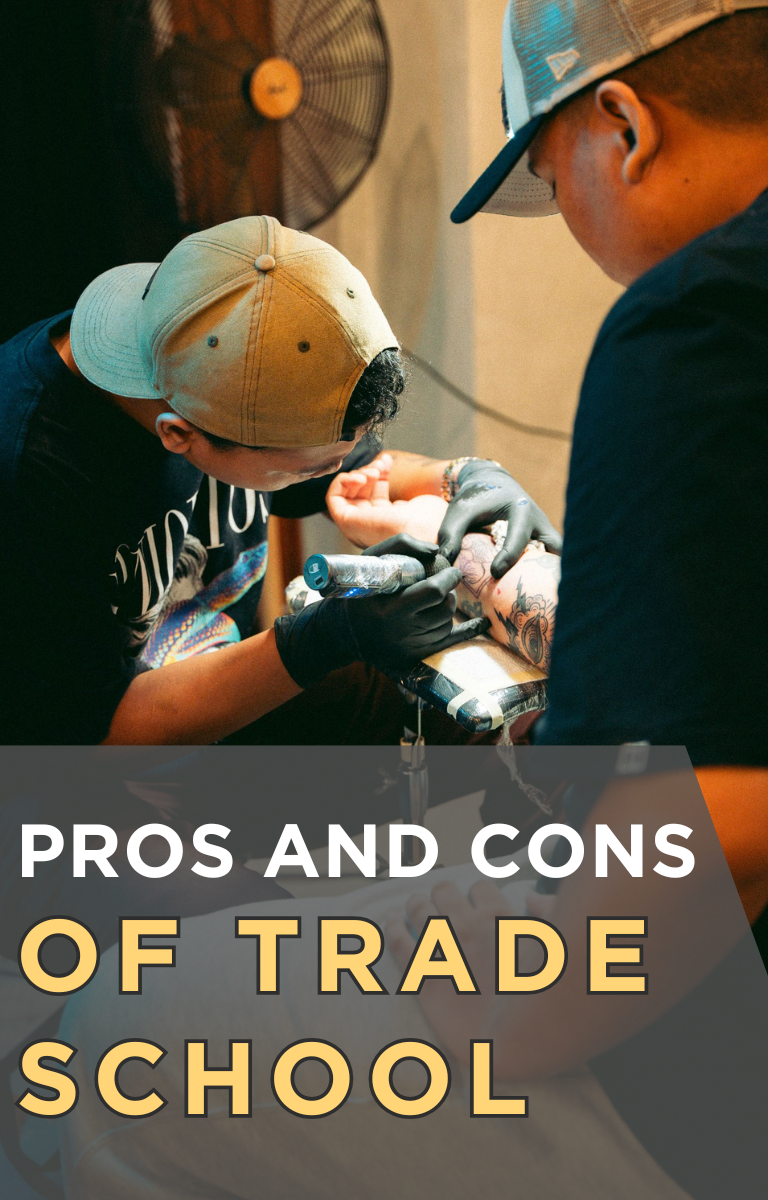
In This Article
- Key Takeaways
- What Is Trade School?
- What Are the Pros of Trade School?
- What Are the Cons of Trade School?
- Who Is Trade School Right For?
- How Do You Decide If Trade School Fits You?
- Why Is a Tattoo Apprenticeship a Smarter Alternative?
- What Can You Expect From Our Traditional Tattoo Apprenticeship?
- What Is the Master Mentorship Program?
- Ready to Become a Tattoo Artist?
- FAQ
Trade school’s biggest pros are that it’s usually faster, cheaper and more hands-on than a four-year degree, with training aimed at a specific job. The main cons are that it can be narrow, program quality varies, and you still need to plan for costs beyond tuition. Whether it’s right for you depends on the career you want and how that career is actually learned.
Interest in trade school is rising. In spring 2025, public two-year colleges with a heavy vocational focus grew enrollment by 11.7%, according to the National Student Clearinghouse Research Center. This guide lays out the pros and cons honestly, explains who trade school fits best and covers where tattooing fits in.
Key Takeaways
- Pro: Most trade school paths take a few months to two years, not four or more.
- Pro: Costs are usually much lower than a bachelor’s degree, and some trades offer paid apprenticeships.
- Con: Training is focused on one field, which can limit flexibility later.
- Con: Quality varies, so check outcomes before you enroll.
- For tattooing: Most Tattoo Artists learn through a tattoo apprenticeship, not a traditional trade school.
What Is Trade School?
Trade school is career-focused training that teaches the skills for one specific job, without general education requirements.
Trade schools go by many names: vocational schools, technical colleges and career institutes. Federal Student Aid describes career schools as places that typically offer programs of two years or less, combining classes with hands-on experience.
Common trade school fields include electrical work, HVAC, welding, cosmetology, automotive repair and medical support roles.

What Are the Pros of Trade School?
Trade school is usually faster, more affordable and more hands-on than a four-year degree, with a direct path to a specific career.
- Faster timeline: Many trade school paths take two years or less.
- Lower cost: The College Board reports average in-district tuition and fees of $4,150 at public two-year colleges in 2025-26, compared with $11,950 a year for in-state students at public four-year colleges.
- Hands-on learning: You learn by doing, with practical labs and real equipment.
- Job-focused skills: You finish trained for a defined field.
- Earn-while-you-learn options: In many trades, registered apprenticeships pay wages during training. According to Apprenticeship.gov, 93% of apprentices keep their jobs after completing an apprenticeship, with an average starting salary of $86,000.
- Skills that are harder to automate: Many hands-on trades depend on physical skill and judgment.
What Are the Cons of Trade School?
The main cons are a narrow focus, varying quality, extra costs beyond tuition and, in some programs, limited one-on-one mentorship.
- Narrow scope: Training for one trade can be limiting if you change your mind or your field shifts.
- Varying quality: Not every school has strong outcomes. Check graduation rates and earnings on the U.S. Department of Education’s College Scorecard where available.
- Extra costs: Tools, materials, licensing exams and living costs can add up beyond tuition.
- Classroom-heavy formats: Some programs rely mostly on group instruction rather than individual coaching.
- Big promises: Be cautious of schools that guarantee jobs or salaries without proof. The Federal Trade Commission’s guide to choosing a vocational school suggests asking detailed questions and checking with employers in the field.
Pro Tip: Before enrolling anywhere, ask how much hands-on time and individual feedback you’ll actually get. For many hands-on skills, that’s what turns a beginner into a working professional.
Who Is Trade School Right For?
Trade school is a strong fit for people who want a defined, hands-on career quickly, in a field that’s well taught through classes and labs, like electrical work, HVAC or many medical support roles.
You may do well in trade school if you know which trade you want, value speed over breadth and are entering a field with clear licensing standards and steady demand. Research pay and outlook in the BLS Occupational Outlook Handbook before choosing.
Creative crafts can work differently. In fields like tattooing, your style, portfolio and reputation matter as much as technique, and training is usually done one-on-one under a Mentor. We compare that path with a degree in our post on why tattoo apprenticeships are gaining ground as a solid alternative to college.

How Do You Decide If Trade School Fits You?
Look at your career goal, how that skill is usually learned, the total cost and the outcomes of the schools you’re considering.
- Step 1: Name your real goal. Write down the specific career you want in five years.
- Step 2: Learn how that trade is taught. Is it usually learned in school, through an apprenticeship or both?
- Step 3: Compare hands-on time. Ask each option how much supervised practice and individual feedback you’ll get.
- Step 4: Run the numbers. Add tuition, tools, licensing fees and time away from income.
- Step 5: Check outcomes. Look at completion rates, job placement and licensing pass rates.
- Step 6: Talk to people in the field. Ask graduates and working professionals what they’d recommend.
If you’re switching careers, read why a tattoo apprenticeship is perfect for career changers starting over.
Why Is a Tattoo Apprenticeship a Smarter Alternative?
For tattooing specifically, a tattoo apprenticeship is usually the better route. It pairs you with a Mentor who coaches you in real time, which is how the craft has traditionally been taught.
Most trade schools don’t teach tattooing. A few states do run tattoo licensing through approved schools. Oregon, for example, lists graduating from a licensed tattoo career school as a main path to licensure, according to the Oregon Health Licensing Office. In most places, though, the tattoo apprenticeship is the standard route.
Tattooing is built hand over hand, with someone experienced watching your technique. It’s also hard to automate, which we explain in why Tattoo Artists are still essential. And it can pay well. According to ZipRecruiter, the average Tattoo Artist in the United States earns $106,858 a year as of November 2026.

What Can You Expect From Our Traditional Tattoo Apprenticeship?
Ink Different’s Traditional Tattoo Apprenticeship runs 18 to 24 months across four phases. It takes you from complete beginner to job-ready Tattoo Artist with personalized, hands-on mentorship.
No prior art experience is needed. You train in person with a Mentor at one of 60+ tattoo studios nationwide.
- Phase 1, Art and Design Principles: Drawing, shading, digital design and building a portfolio.
- Phase 2, Machine Mastery and Practice Tattooing: Hand-control exercises, machine operation, lining, shading and color packing.
- Phase 3, Supervised Tattoos: Tattooing real skin under a Mentor’s direct supervision.
- Phase 4, Junior Artist Externship: Building client relationships and refining your skills while you start earning.
You’ll finish with job-ready skills, licensing support and a guaranteed job offer at one of Ink Different’s own tattoo studios. Interest-free payment plans help make training more accessible. Training also covers safety standards like the OSHA Bloodborne Pathogens Standard.
Good Humans Culture: You join a supportive, family-like community of tattoo apprentices and Mentors.
What Is the Master Mentorship Program?
The Master Mentorship is one year of in-person training with award-winning Master Mentors. It’s built to help you master a specific style, grow your personal brand and work toward owning a tattoo studio.
It’s for beginners and experienced Tattoo Artists alike. You’ll learn from Master Mentors like Al Fliction, Liz Cook, Kyle Dunbar, Boneface, Jordi Pla and Marcel Oliveira.
We also offer Spanish-speaking locations in Denver, Orange County, NYC, Miami, San Antonio and San Diego.
Ready to Become a Tattoo Artist?
Trade school is a great choice for many hands-on careers. But if tattooing is the trade you want, a structured tattoo apprenticeship with real mentorship is the most direct way in. Each Mentor takes just two tattoo apprentices per tattoo studio, so seats fill up quickly.
Ready to become a Tattoo Artist? Apply now to Ink Different’s Traditional Tattoo Apprenticeship and start building an AI-proof career with licensing support along the way.
Frequently Asked Questions
What are the main pros of trade school?
Trade school is usually faster and cheaper than a four-year degree, focuses on hands-on, job-specific skills and can lead to careers that are harder to automate.
What are the main cons of trade school?
Training can be narrow, quality varies between schools and costs like tools, exams and living expenses add up. Check outcomes before enrolling.
Is trade school worth it compared to college?
For many hands-on careers, yes. Average public two-year tuition was $4,150 in 2025-26, compared with $11,950 a year at public four-year colleges for in-state students. The right choice depends on your career goal.
Can you learn tattooing at a trade school?
Usually not. Most Tattoo Artists learn through a tattoo apprenticeship. A few states, like Oregon, run licensing through approved tattoo schools.
How long does a tattoo apprenticeship take?
Most take one to three years. Ink Different’s Traditional Tattoo Apprenticeship takes 18 to 24 months across four phases.
Do I need art experience to start a tattoo apprenticeship?
No. The Traditional Tattoo Apprenticeship starts with art and design principles, so beginners can start from scratch.