
Tattoo License Exams: What to Study
October 2, 2026
Tattoo Design Software That Helps You Price Custom Work Accurately
October 5, 2026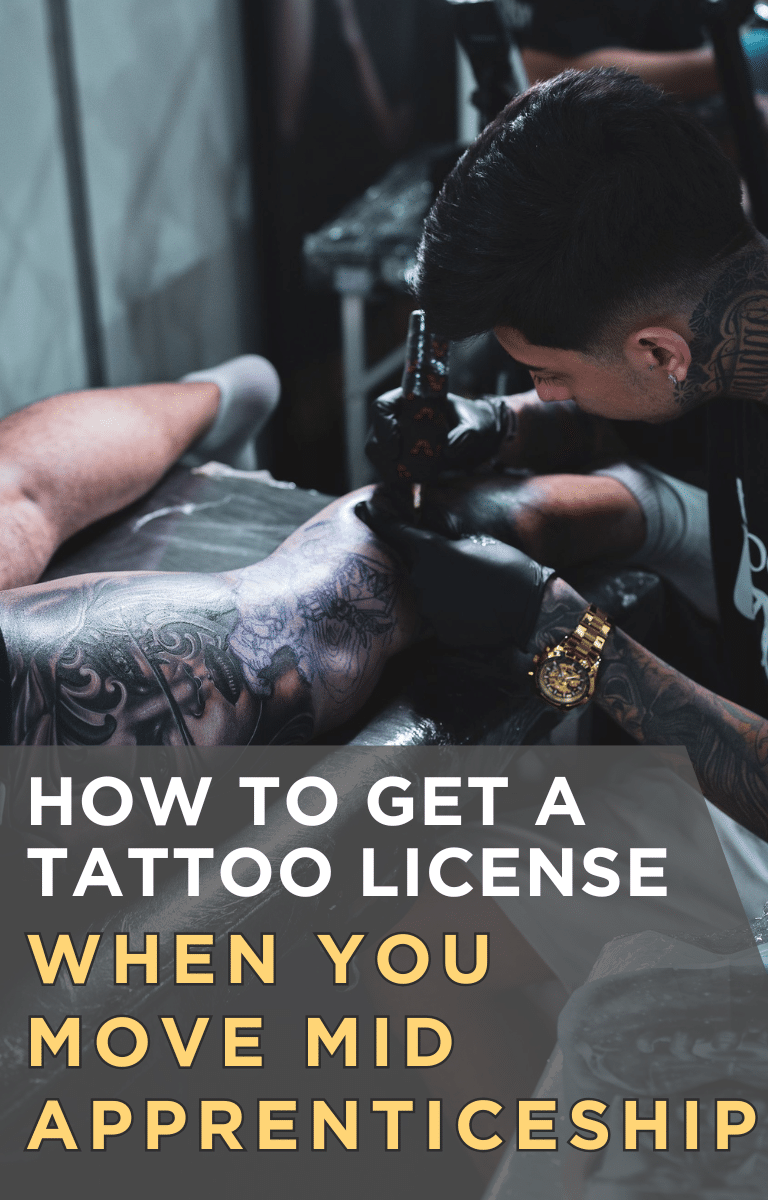
In This Article
- Key Takeaways
- What happens to your tattoo apprenticeship when you move?
- Do tattoo licenses transfer between states?
- How do you transfer a tattoo license mid apprenticeship?
- What documents do you need to keep your progress?
- What mistakes derail apprentices who move?
- How does a nationwide program protect your training?
- What can you expect from our Traditional Tattoo Apprenticeship?
- Ready to keep your momentum no matter where you move?
- Frequently Asked Questions
You packed your life into boxes, signed a new lease, and suddenly a quiet panic sets in: what happens to the tattoo apprenticeship you fought so hard to start? Moving mid-apprenticeship does not have to end your progress. Transferring a tattoo license mid apprenticeship is the process of continuing your Tattoo Artist training across state lines by documenting your completed hours, meeting the new state’s licensing requirements, and finding a Mentor who can pick up where your last one left off.
At Ink Different Tattoos, we have guided apprentices through relocations since 2011, and we want you to know the move is a detour, not a dead end.
Key Takeaways
- State Regulation: Tattoo licenses are state-regulated; hours and requirements rarely transfer automatically between states.
- Documentation is Essential: Keep detailed records of apprenticeship hours, bloodborne pathogen training, and mentor sign-offs.
- Research First: Check your destination state’s health department rules before moving, not after you arrive.
- Nationwide Programs Help: Training with a nationwide network turns a move into a studio transfer, not a complete restart.
- Career Resilience: Hand-crafted tattooing is AI-proof work tracked by the Bureau of Labor Statistics as a durable craft profession.
What happens to your tattoo apprenticeship when you move?
When you move mid apprenticeship, your training does not disappear, but you must reestablish it under the new state’s rules, find a new Mentor, and often meet a fresh set of documented requirements. The skills you built are yours forever; the paperwork is what needs to travel with you.
Tattooing is regulated at the state (and sometimes county) level, so the finish line can shift when you cross a border. A move without a plan can cost you weeks of momentum, which is the last thing you want when you have already invested time and heart into this craft.
Your job is to map the new route before you arrive, so the transition stays smooth.
Do tattoo licenses transfer between states?
Tattoo licenses generally do not transfer automatically between states because each state health department sets its own hour requirements, exams, and safety certifications. Some states offer reciprocity or credit for prior training, but you should never assume it.
For example, the requirements to get your tattoo license in Texas differ from what Colorado asks, and California has its own process for incoming artists. What one state counts as complete, another may treat as partial. That is why understanding the destination early matters so much.
You can read our breakdowns on how to get your tattoo license in Texas, transferring a tattoo license to California, and how long a tattoo license takes in Colorado to see how much the rules can vary.
Pro Tip: Call the new state’s health department before you sign a lease. Ask if they credit documented apprenticeship hours from another state, and get the answer in writing when possible.
How do you transfer a tattoo license mid apprenticeship?
You transfer a tattoo license mid apprenticeship by documenting your hours, researching the new state’s rules, securing a new Mentor, and completing any remaining requirements the destination demands. Follow these steps in order to protect every hour you have earned.
Step 1: Gather and verify your documented hours
Before you pack, collect written verification of every training hour, station observation, and supervised tattoo you completed. A mentor’s signature and a dated log are your strongest currency in a new state.
Step 2: Research the destination state’s requirements
Visit the new state or county health department website and note the exact hour count, exams, and certifications required. Many states require current bloodborne pathogen training that follows OSHA bloodborne pathogen standards.
Step 3: Renew or complete safety certifications
Your bloodborne pathogen certificate and first-aid credentials may need to be current and state-recognized. Renew them early so they do not stall your paperwork later.
Step 4: Find a licensed mentor in your new city
You need a licensed Tattoo Artist willing to continue supervising your training. This is where a nationwide program shines, because you can transfer into a partner Tattoo Studio instead of cold-calling shops as a stranger.
Step 5: Submit your application and finish remaining requirements
File your apprenticeship or license application with the new state, attach your documented hours, and complete whatever gap the destination requires. Then you are back on your path.
- Document every completed hour with mentor sign-offs.
- Research the new state’s exact licensing rules.
- Renew your safety certifications early.
- Secure a licensed mentor in your new city.
- Apply and finish any remaining requirements.
What documents do you need to keep your progress?
To keep your progress after moving, you need a signed hour log, bloodborne pathogen certification, a photographic portfolio of your work, and any written mentor attestations of completed phases. These records are the roots that let your training replant successfully.
- Hour log: Dated, signed proof of your supervised training hours.
- Safety certification: Current bloodborne pathogen and first-aid credentials.
- Portfolio: Photos of your line work, shading, and healed pieces.
- Mentor attestations: Written confirmation of the phases you completed.
- Identification: Government ID and any prior permits or receipts.
Keep digital and physical copies. A backed-up folder protects years of work from a single lost binder. For more on avoiding early missteps, read our guide on mistakes aspiring tattoo apprentices should avoid.
What mistakes derail apprentices who move?
The most common mistakes are assuming licenses transfer automatically, failing to document hours, and waiting until after the move to research the new state’s rules. Each of these turns a smooth detour into a long, frustrating restart.
Another trap is losing your Mentor connection entirely. A move without a plan can leave you searching for supervision for months, and that gap kills momentum. Protect it fiercely.
Some artists also let their portfolio and social presence go quiet during a move. Do not. Keeping your brand alive matters, and our post on platforms to help tattoo artists build their brand shows how to stay visible while you relocate.

How does a nationwide program protect your training?
A nationwide tattoo apprenticeship protects your training because a move becomes an internal studio transfer rather than a cold restart, with your hours, Mentors, and standards traveling with you.
At Ink Different Tattoos, we have spent years building a network of tattoo studios and Mentors across the country. When life pulls you to a new city, you are not starting over as a stranger. You are stepping into a network that already knows your progress.
Instead of losing sleep over whether your hours count, you get a team that helps you navigate the new state’s licensing support and keeps you moving toward working professionally.
Remember: Tattooing is one of the most AI-proof careers there is. A machine cannot replicate the human trust and hand-craft behind a great piece. Learn why in our post on why tattoo artists are still essential.
What can you expect from our Traditional Tattoo Apprenticeship?
Our Traditional Tattoo Apprenticeship is an 18 to 24 month, four-phase Tattoo Artist training that includes licensing support and job-ready skills. It is built for beginners, so no prior art experience is required.
You train hands-on, with personalized instruction inside real tattoo studios. Because we operate nationwide, a mid-apprenticeship move fits naturally into how we already work. Your progress stays with you as you grow.
This is a genuine college alternative. Instead of years of debt with no clear outcome, you invest in a craft, a license, and a career built on your own two hands. See why tattoo apprenticeships are gaining ground as a college alternative.
Why hand-crafted tattooing is a resilient, AI-proof career
You finish with job-ready skills, licensing support, and a guaranteed job offer at one of our tattoo studios, so you can step into your career knowing you earned your place. The Bureau of Labor Statistics tracks craft and fine artists as a durable, human-driven field, and hand tattooing sits squarely inside that resilient work.
Why mentorship with award-winning artists accelerates your brand
If you want to accelerate beyond the core apprenticeship, our one-year, in-person Master Mentorship pairs you with celebrity and award-winning Mentors like Al Fliction, Liz Cook, Kyle Dunbar, Boneface, and Jordi Pla. It is ideal for mastering a specific style, growing your career, and building toward studio ownership.
Why Spanish-speaking locations make Tattoo Artist Training accessible
We offer Spanish-speaking locations in Denver, Orange County, NYC, Miami, San Antonio, and San Diego, so language never stands between you and this craft. Wherever you land, there is a good chance we are near you.
Ready to keep your momentum no matter where you move?
A move should never be the reason you give up on the creative life you have been quietly craving. Moving mid apprenticeship is simply the next chapter, and you get to write it.
Seats in our tattoo apprenticeship are limited because live, in-person mentorship cannot be mass-produced. But the path is open, and our “Good Humans” community is ready to catch you wherever you relocate.
Ready to become a Tattoo Artist? Apply now to Ink Different’s Traditional Tattoo Apprenticeship and start building an AI-proof career with licensing support along the way. Not sure yet? Fill out our quick questionnaire to get personalized support and find out if our Traditional Tattoo Apprenticeship is right for you.
Frequently Asked Questions
Can I continue my tattoo apprenticeship after moving to a new state?
Yes. You can continue your apprenticeship by documenting hours, finding a licensed mentor, and meeting the new state’s requirements. A nationwide program smooths this transfer significantly.
Do tattoo licenses transfer between states automatically?
No. State health departments set their own rules. Some offer reciprocity or credit for documented training, but always confirm with the destination state first.
How long does the Traditional Tattoo Apprenticeship take?
The Traditional Tattoo Apprenticeship takes 18 to 24 months across four phases, starting remote and finishing hands-on in real Tattoo Studios.
Do I need prior art experience to start a tattoo apprenticeship?
No. Our apprenticeship is built for beginners and teaches drawing and machine fundamentals from day one, so you can start completely fresh.
What makes Ink Different different when relocating mid apprenticeship?
Ink Different operates studios nationwide, so your move becomes an internal transfer. Your training, mentors, and standards travel with you instead of restarting.
Where are your Spanish-speaking tattoo training locations?
We offer Spanish-speaking locations in Denver, Orange County, NYC, Miami, San Antonio, and San Diego for accessible Tattoo Artist Training nationwide.