Apprentice Spotlight: Why Restaurant Server Nautica Lessley Took a Leap of Faith on Tattooing
November 25, 2026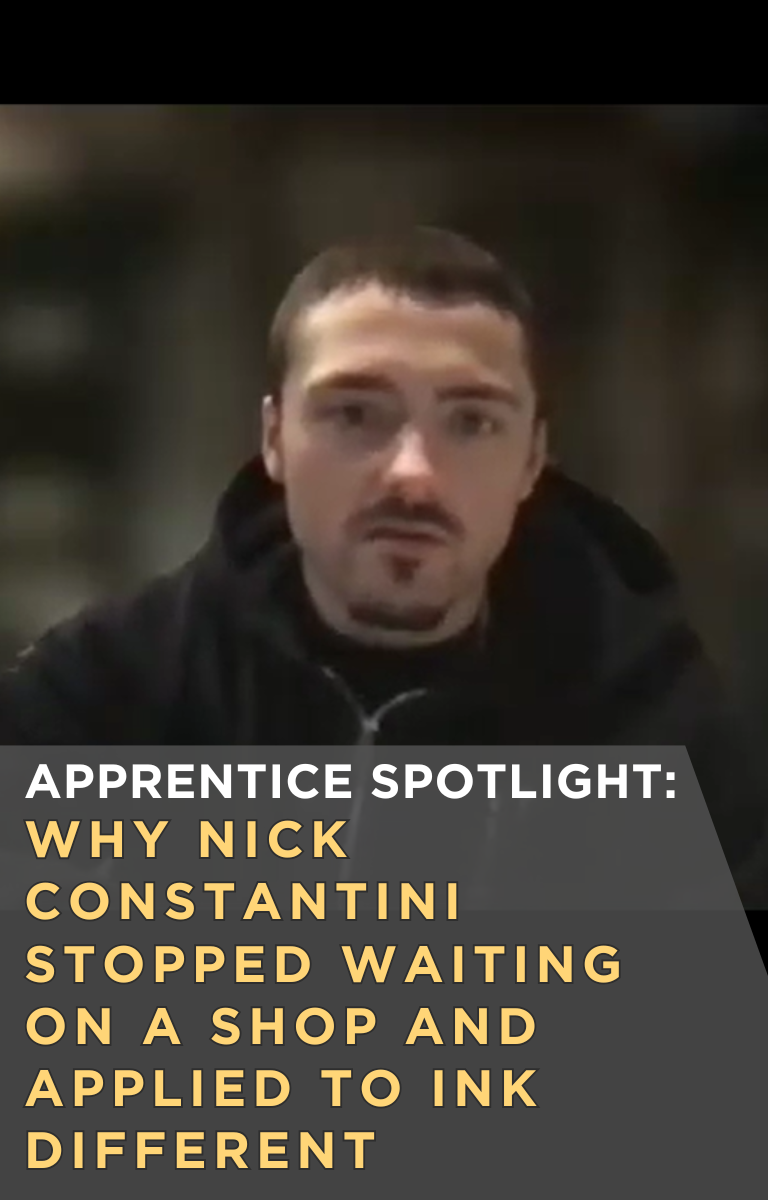
In This Article
- Key Takeaways
- Who Is Nick Constantini?
- Why Does Waiting on a Shop Rarely Work?
- What Changed When Nick Stopped Waiting?
- How Can You Stop Waiting and Start Training?
- What Does the Traditional Tattoo Apprenticeship Teach?
- Why Does This Path Build Real Confidence?
- What Is the Master Mentorship Program?
- How Does Ink Different Make Training Accessible?
- Ready to Stop Waiting?
- FAQ
Nick Constantini had been talking to a tattoo shop owner about an apprenticeship, but he could never get a clear answer. “I was never getting a definitive answer,” he says. “I just got tired of it, so I applied to Ink Different instead, and I was answered immediately.” Before that, Nick had faced a string of hard rejections from tattoo shops near him in Connecticut that weren’t taking apprentices. Now he’s finishing Phase One of Ink Different’s Traditional Tattoo Apprenticeship, on his way to Ink Different’s New Haven location. In his Apprentice Spotlight interview, he explained why he stopped waiting.
Key Takeaways
- His struggle: “There was nowhere around me that was open to taking anybody.”
- The breaking point: A tattoo shop owner who never gave him a clear yes or no.
- His move: He gave himself a deadline, applied to Ink Different, and heard back right away.
- His perspective: “It wasn’t anything personal, but it definitely was discouraging.”
- His goal: “Tattooing is what I want to do for my full career.”
Who Is Nick Constantini?
Nick Constantini is an Ink Different apprentice in Connecticut. He’ll train at Ink Different’s New Haven location, in the East Rock neighborhood, with Charmaine.
He doesn’t have an art school background. “I was never a big artist back in the day,” he says. He started getting tattooed as soon as he was legally allowed to, and the interest grew from there. He spent years teaching himself and working on his drawing fundamentals.
What drives him is the human side of tattooing. “I like working with people and helping create something,” he says. “That’s my main reason for why I want to be a Tattoo Artist.”
Why Does Waiting on a Shop Rarely Work?
For Nick, it simply never came together. “It was just a struggle, honestly, to find an apprenticeship,” he says. “There was nowhere around me that was open to taking anybody.”
He heard a lot of hard nos from local tattoo shops that weren’t taking on apprentices. Then he spent time talking with one shop owner about apprenticing there, but never got a definitive answer.
Ink Different’s Paul-Anthony Surdi, who has worked in tattooing for 15 years, says it’s rarely personal. Many longtime Tattoo Artists have emotional or professional barriers to taking on apprentices, he explains. Some have invested six or seven months in someone, only to watch that person move across the country.
Nick came to see it the same way. “I ended up realizing that it wasn’t anything personal,” he says, “but it definitely was discouraging.”
If you’re in the same spot, here’s how to ask for a tattoo apprenticeship without getting turned away, and how shops typically hire for tattoo apprentice openings.
Reality check: A “no” from a tattoo shop often has more to do with the shop than with you.
What Changed When Nick Stopped Waiting?
Nick had seen Ink Different’s ads on social media. When the waiting got old, he gave himself a deadline. “I just got tired of it,” he says. He applied, and the response came immediately.
What appealed to him was the structure. “When I saw a program that took a school approach to doing an apprenticeship, I was like, ‘This seems like the best option to get my career started,'” he says.
Submitting his art was a little nerve-wracking. “You get a little nervous because people are going to be looking at your art and judging it,” he says. “But I was more just happy. It felt like, ‘All right, this is my start.’ It felt like I was really beginning the journey.”
Other New Haven apprentices have made similar leaps, like Edward Cuff, who went from Amazon deliveries to a tattoo apprenticeship.
How Can You Stop Waiting and Start Training?
Nick’s path offers a few clear steps:
- Build your fundamentals on your own. Nick worked on his drawing for years before applying.
- Know when to move on. If a tattoo shop keeps stringing you along, that’s a sign.
- Give yourself a deadline. Nick set one, so he’d stop waiting on a maybe.
- Apply with your best work. Even if it makes you nervous.
- Treat it like school. “Anytime you have spare time, even just two hours, you’ve got to lock yourself into a class,” he says. “It’s really about how much you put into it.”
- Stay open to feedback. “You’re here to learn, and that’s your teacher,” he says. “Just take it, move forward and do what they asked you to fix.”
Rushing in without fundamentals is one of the mistakes aspiring tattoo apprentices make. Nick did the opposite.
What Does the Traditional Tattoo Apprenticeship Teach?
Ink Different’s Traditional Tattoo Apprenticeship is an 18 to 24 month, four-phase tattoo apprenticeship built for beginners. Ink Different has trained Tattoo Artists for 15 years. No prior art experience is required.
- Phase One: Art and design, online. Nick started with pencil flash sheets on paper, then moved to Procreate on an iPad.
- Phase Two: Machine practice on synthetic skin, online. Nick’s kit arrived the day of his interview.
- Phase Three: Supervised tattoos on real clients in a tattoo studio.
- Phase Four: Building independence and preparing for licensing.
In Phase One, Nick designed in four styles, including Japanese pieces with a demon mask, a koi fish, and a bonsai tree. New school was the biggest stretch. “I was a little nervous to do it because it was so different and out of my realm,” he says. “But it was cool to experiment and try something new.”
Connecticut’s permit requirement
Before starting, Nick met with Charmaine to get his state permit signed. Connecticut’s Department of Public Health says a student tattoo technician may practice under the personal supervision of a licensed tattoo technician for up to two years, with a notarized statement from that supervisor (CT DPH Training Permits). Training is also built on the OSHA bloodborne pathogens standard.
Why Does This Path Build Real Confidence?
Nick’s confidence shows in how he talks about what’s next. “I’m honestly not really nervous about machines at all,” he says. “I’m really excited and eager to get going.”
Part of that comes from having several instructors. Nick likes getting different eyes on his work. “Say I get my red pencils passed by Martin, and then Julian checks my blues,” he says. “I would try to switch it up between instructors just to get different eyes on it.”
He also likes working at his own pace. “I’m on my own time, so it’s up to me how fast I want to get through this,” he says. “I’m not trying to rush, but I want to get this started. Any spare time I have, it’s going right into this.”
You’ll finish with job-ready skills, licensing support, and a guaranteed job offer at one of Ink Different’s own tattoo studios. The Traditional Tattoo Apprenticeship is available at 60+ tattoo studios nationwide.
What Is the Master Mentorship?
Once you’ve built your foundation, Ink Different’s Master Mentorship offers advanced training with Master Mentors like Jordi Pla. Jordi made his own unconventional choice, giving up an aerospace scholarship to become a Tattoo Artist.
Nick already has a direction in mind: illustrative, semi-realistic, black and gray work, plus neo-traditional.
How Does Ink Different Make Training Accessible?
Ink Different’s online early phases let apprentices like Nick train around a job. Nick checked class times whenever he wasn’t working and attended multiple sessions a week. “I also appreciated how late the classes run, because there are times when I’m not around until 7 p.m., and I’m able to do a night class until midnight,” he says.
In New Haven, Ink Different owns its tattoo studio. According to Paul, it was a tattoo shop for about 20 years before becoming Ink Different’s. Here’s more on becoming a Tattoo Artist in New Haven. Connecticut residents may also want to look into vocational rehab funding options.
Ink Different also offers Spanish-speaking locations in Denver, Orange County, NYC, Miami, San Antonio, and San Diego.
Good to know: Seats are limited, with only two apprentices per tattoo studio per Mentor.
Ready to Stop Waiting?
Nick Constantini stopped waiting on a maybe and started his career. Now he’s honored to be featured. “It’s cool to be picked for something like that,” he says, “because I have been trying to work hard at it.”
People in his life are already asking him for tattoos once he reaches Phase Three.
Ready to become a Tattoo Artist? Apply now to Ink Different’s Traditional Tattoo Apprenticeship.
Frequently Asked Questions
Why did Nick stop waiting on a tattoo shop?
After hard rejections from local tattoo shops and a shop owner who never gave him a clear answer, he gave himself a deadline and applied to Ink Different.
How did Nick find Ink Different?
Through ads on social media. He heard back right after applying.
Do I need prior experience to apply?
No. Nick is self-taught, and the Traditional Tattoo Apprenticeship teaches design fundamentals from the beginning.
How long does the Traditional Tattoo Apprenticeship take?
Ink Different’s Traditional Tattoo Apprenticeship takes 18 to 24 months across four phases, with licensing support and a guaranteed job offer at one of Ink Different’s own tattoo studios.
Do I need a permit to train in Connecticut?
Connecticut’s Department of Public Health requires student tattoo technicians to register and train under a licensed tattoo technician’s personal supervision. Nick met with Charmaine to get his permit signed.
Is there a Spanish-speaking option available?
Yes. Ink Different offers Spanish-speaking locations in Denver, Orange County, NYC, Miami, San Antonio, and San Diego.