
How Long Is Trade School?
November 10, 2026
How to Make a Career Change: A Step-by-Step Plan
November 11, 2026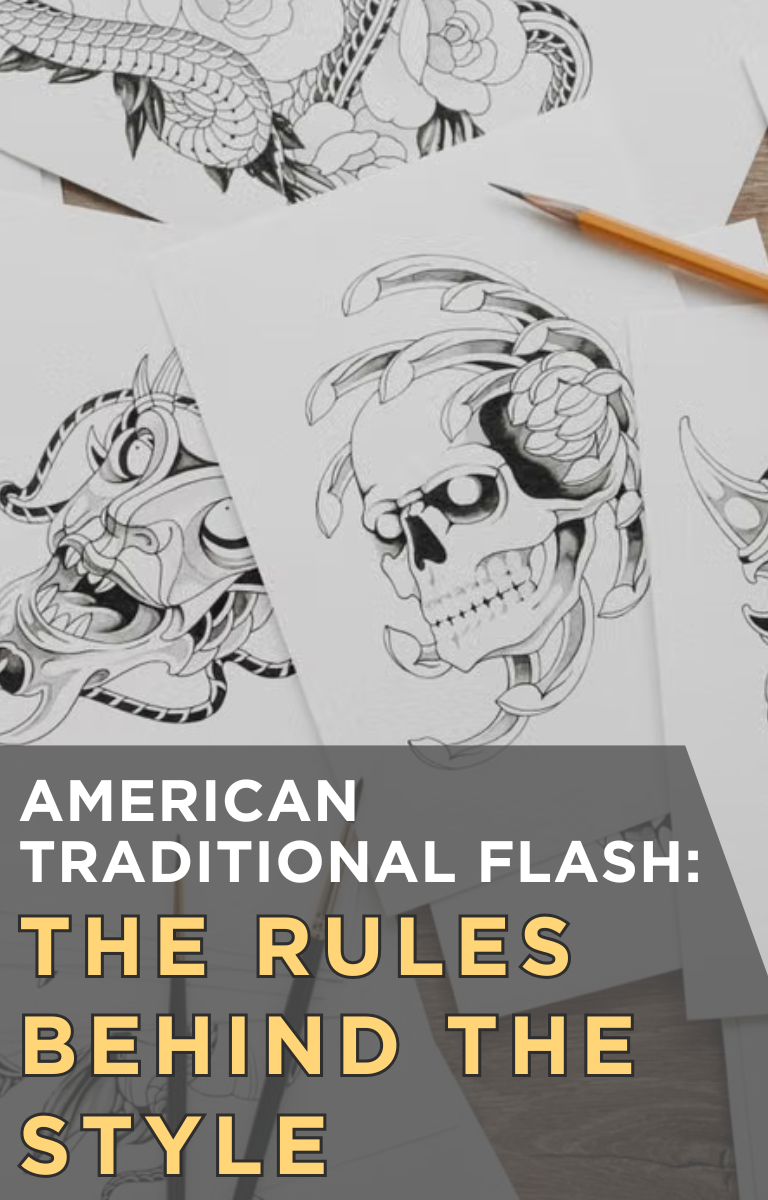
In This Article
- Key Takeaways
- What Is American Traditional Flash?
- Why Do the Rules Behind American Traditional Matter?
- What Are the Core Rules of the Style?
- Which Colors Define American Traditional Flash?
- What Are the Classic American Traditional Motifs?
- How Do You Draw Your First American Traditional Flash Sheet?
- How Do You Learn American Traditional the Right Way?
- What You Can Expect from Our Traditional Tattoo Apprenticeship?
- Ready to Become a Tattoo Artist?
- FAQ
American Traditional flash is a set of pre-drawn tattoo designs in the bold American Traditional style: heavy black outlines, a limited palette and classic imagery like eagles, roses, daggers and swallows. The designs are drawn on sheets so they can be tattooed again and again. Every element follows rules built to keep a tattoo readable for decades.
Flash is also part of American art history. The Smithsonian American Art Museum holds 20th-century hand-drawn tattoo flash in its collection. This guide breaks down the rules behind the style, the colors and motifs that define it and how to draw your first flash sheet. At Ink Different Tattoos, we’ve spent 15 years teaching tattoo apprentices these fundamentals.
Key Takeaways
- Definition: American Traditional flash is pre-drawn designs with bold black outlines, a limited palette and classic motifs.
- Core rules: Thick outlines, solid color, purposeful black shading and designs that read clearly from a distance.
- Why the rules exist: Bold lines and solid color hold up better as skin ages than fine, delicate work.
- Standard format: In North America, flash is commonly printed on 11 by 14 inch sheets.
- Learning path: In-person mentorship teaches the style faster and more reliably than online tutorials.
What Is American Traditional Flash?
American Traditional flash is sheets of pre-drawn, ready-to-tattoo designs in the bold style shaped by Tattoo Artists like Norman “Sailor Jerry” Collins. These are the roses, daggers, pin-ups and panthers you see on tattoo studio walls today.
Flash started as a practical tool. A client would walk into a tattoo studio, point at a design on the wall and leave with it the same day. The sheets let Tattoo Artists work quickly and consistently. Today, flash is still shown to walk-in customers in binders or on the walls of tattoo studios, and it’s now also advertised online and on social media.
Historic flash is preserved in museums across the country. New York’s South Street Seaport Museum, for example, holds flash by early Tattoo Artist Augustus “Gus” Wagner, dated roughly 1910 to 1930, as part of a collection Hyperallergic has covered. Studying these sheets is one of the best ways to understand the style’s DNA.
Why Do the Rules Behind American Traditional Matter?
The rules exist because bold outlines and solid color heal cleaner and age better on skin than thin, intricate work. They’re practical engineering, not arbitrary tradition.
Skin changes over time. It stretches, fades and blurs. A fine line can look stunning on day one and soften into a gray smudge years later. A thick black outline holds its shape and stays readable.
Sun exposure plays a role too. The American Academy of Dermatology notes that UV light can fade some tattoo inks. Bold, high-contrast designs tend to stay legible even as color softens.
Understanding why the rules exist is what lets you bend them on purpose instead of breaking them by accident.
Mentor Tip: Before you chase a trendy style, master American Traditional fundamentals. Every style you learn afterward comes faster.
What Are the Core Rules of the Style?
The core rules are bold black outlines, a limited palette, solid color fills, purposeful black shading and designs that read clearly from across a room.
Here are the non-negotiables:
- Bold outlines: Thick, confident black lines frame every element and give the design structure that lasts.
- Limited palette: A small set of colors keeps designs cohesive and striking.
- Solid fills: Color goes in flat and saturated, without soft gradients that blur over time.
- Black shading: Depth comes from deliberately placed black shading, not photorealistic blending.
- Readability: The design should be instantly recognizable, even from a distance or after years of wear.
These rules feel restrictive at first. That’s the point. Constraints force you to make decisions that matter. To see where beginners often stumble, read our guide to the mistakes aspiring tattoo apprentices should avoid.
Which Colors Define American Traditional Flash?
American Traditional flash relies on a tight palette, traditionally red, green, yellow and sometimes blue, all anchored by heavy black outlines and shading.
The limited palette has historical roots. Early Tattoo Artists had far fewer pigments to work with. Sailor Jerry helped change that. According to the profile of Sailor Jerry, he expanded the range of tattoo ink colors by developing his own pigments.
Even with today’s huge range of inks, the traditional palette remains the standard for the style. Working within it teaches you how black supports color, how negative space gives a design room to breathe and how contrast creates impact.
What Are the Classic American Traditional Motifs?
Classic motifs include eagles, roses, daggers, swallows, anchors, pin-ups, panthers, hearts and nautical imagery. Each carries symbolism rooted in sailor and military culture.
- Swallow: Safe return home and loyalty. In sailor lore, swallows marked long distances traveled at sea.
- Anchor: Stability and steady ground.
- Rose: Love and beauty, often paired with thorns or a dagger for contrast.
- Dagger: Courage, sacrifice or betrayal, depending on context.
- Eagle: Freedom, strength and patriotism.
Many of these designs took shape in sailor communities. Sailor Jerry reworked 1920s and 1930s designs with influences from Japanese artists, creating American Traditional designs with wider appeal. wikiwand
The style has also survived some major setbacks. Tattooing was illegal in New York City for 36 years, from 1961 to 1997, according to the University of Missouri–St. Louis Mercantile Library, which holds a collection of flash from the first decade of legal tattooing there. That collection exhibits typical American Traditional iconography, including animals, nautical motifs, symbols of luck and women.
How Do You Draw Your First American Traditional Flash Sheet?
Start with bold outlines, commit to a limited palette, pack solid color, add black shading for depth and arrange the designs so the sheet reads cleanly.
- Step 1: Study the classics. Look at historic flash by Tattoo Artists like Sailor Jerry and Ed Hardy, plus museum collections. Train your eye before your hand.
- Step 2: Sketch loose thumbnails. Block out basic shapes for an eagle, rose or anchor. Focus on silhouette and balance first.
- Step 3: Draw bold outlines. Commit to thick, confident lines. Every stroke should feel intentional.
- Step 4: Choose a limited palette. Pick two or three traditional colors plus black.
- Step 5: Pack solid color. Fill each area flat and even, without gradients.
- Step 6: Add black shading. Place shadows deliberately to create depth.
- Step 7: Arrange your sheet. Lay out several designs so they balance and read clearly. In North America, flash is commonly printed on 11 by 14 inch sheets.
Get the right gear first. These tools every beginner Tattoo Artist should know can save you wasted money and frustration.
How Do You Learn American Traditional the Right Way?
You learn it through in-person mentorship under an experienced Tattoo Artist who corrects your technique in real time.
Videos can show you what a swallow looks like. They can’t feel the pressure of your hand on skin or tell you why your line wavered. That feedback happens with a Mentor beside you in a working tattoo studio.
That’s why a structured tattoo apprenticeship beats going it alone. It’s also gaining ground as a solid alternative to college.
It’s a career that’s hard to automate, too. Software can’t replicate a Tattoo Artist’s hand skill or judgment, which is why Tattoo Artists are still essential. And the pay can be strong. According to ZipRecruiter, the average Tattoo Artist in the United States earns $106,858 a year.
What You Can Expect from Our Traditional Tattoo Apprenticeship?
Ink Different’s Traditional Tattoo Apprenticeship runs 18 to 24 months across four phases. It takes you from complete beginner to job-ready Tattoo Artist, with licensing support along the way.
You train in person with a Mentor at one of 60+ tattoo studios nationwide. The four phases build from drawing, flash design and machine fundamentals to supervised practice, live client work and licensing prep.
No prior art experience is required. You’ll join our “Good Humans” culture, a supportive, family-like community. You’ll finish with job-ready skills, licensing support and a guaranteed job offer at one of Ink Different’s own tattoo studios. Interest-free payment plans help make training more accessible.
Licensing rules vary by state. See how to get your tattoo license in Texas, tattoo license requirements in California or how long it takes to get a tattoo license in Colorado. Safety training covers the OSHA Bloodborne Pathogens Standard.
Want to go even further?
Our one-year, in-person Master Mentorship lets beginners and experienced Tattoo Artists train with celebrity and award-winning Master Mentors, including Al Fliction, Liz Cook, Kyle Dunbar, Boneface, Jordi Pla and Marcel Oliveira. It’s built to help you master a specific style and build a professional brand.
We also offer Spanish-speaking locations in Denver, Orange County, NYC, Miami, San Antonio and San Diego. Each Mentor takes just two tattoo apprentices per tattoo studio, so seats fill up quickly.

Ready to Become a Tattoo Artist?
American Traditional flash rewards discipline: bold lines, smart color choices and designs that hold up for decades. The best way to learn those rules is under a Mentor who can correct your hand as you go.
Ready to become a Tattoo Artist? Apply now to Ink Different’s Traditional Tattoo Apprenticeship and start building an AI-proof career with licensing support along the way.
Related reading: platforms to help tattoo artists build their brand, career change tattoo apprenticeship, and start your tattoo apprenticeship this spring.
Frequently Asked Questions
What is American Traditional flash?
American Traditional flash is pre-drawn tattoo designs in a bold-outline, limited-color style. It includes classics like eagles, roses, anchors and swallows, designed to be tattooed repeatedly from sheets.
Why does American Traditional use bold outlines and limited colors?
Bold outlines and solid color hold up better as skin ages. Thin, delicate work tends to blur and fade over time, while thick lines stay readable.
What size is a standard flash sheet?
In North America, tattoo flash is commonly printed on 11 by 14 inch sheets.
Who is known for American Traditional flash?
Norman “Sailor Jerry” Collins is one of the best-known names. He reworked earlier designs with Japanese influences and developed his own pigments. Early Tattoo Artists like Gus Wagner also left behind flash now held in museum collections.
Do I need art experience to learn American Traditional tattooing?
No. Ink Different’s Traditional Tattoo Apprenticeship is built for beginners and teaches drawing, flash design and machine handling from day one.
How long does the Traditional Tattoo Apprenticeship take?
It takes 18 to 24 months across four phases, with in-person training at a working tattoo studio.