Scott Campbell: Tattoo Artist and Fine Artist
November 17, 2026
Get Paid to Learn: Trade Programs and Apprenticeships That Pay You
November 17, 2026
In This Article
- Key Takeaways
- What should a beginner learn first in tattooing?
- Why does drawing come before the needle?
- What safety and sanitation skills do beginners need?
- How do you learn to handle a tattoo machine?
- Where should beginners practice their first lines?
- What are the first steps to start tattooing?
- What mistakes should beginners avoid?
- How does Ink Different help beginners start right?
- Ready to take the first step?
- FAQ
If you’re a beginner in tattooing, learn three things first: drawing fundamentals, safety and sanitation, and tattoo machine handling, in that order. Then practice on synthetic skin before ever working on a person. Those foundations matter more than any shortcut, and they’re usually learned best through a structured tattoo apprenticeship with an experienced Mentor.
This guide walks through each step, explains why the order matters and covers the mistakes that hold many beginners back.
Key Takeaways
- Drawing first: Clean linework, shading and design skills come before the needle.
- Safety early: Bloodborne pathogens training and sanitation habits protect you and every client.
- Machine control: Grip, angle, depth and speed are built through practice on synthetic skin.
- Mentorship matters: Real-time feedback helps you fix problems before they become habits.
- No experience needed: Many structured tattoo apprenticeships, including Ink Different’s, are built for beginners.
What should a beginner learn first in tattooing?
Start with drawing fundamentals, then safety and sanitation, then machine handling, before practicing on skin. These three pillars support everything a professional Tattoo Artist does.
Think of it like building a house. You don’t start with the roof. Your linework, your understanding of how a tattoo heals and your ability to keep a workspace clean are the foundation everything else rests on.
Rushing past the basics is one of the biggest reasons beginners stall. The ones who commit to the fundamentals build the strongest careers.
Why does drawing come before the needle?
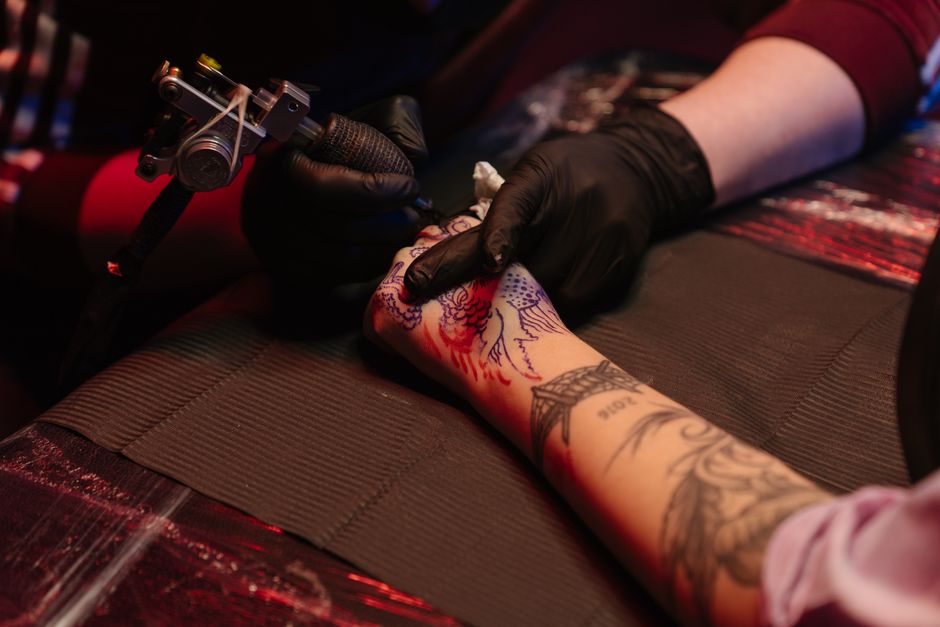
The tattoo machine can only follow what your hand already knows. Weak fundamentals on paper usually show up on skin, too.
Focus on the skills that separate beginners from professionals:
- Line control: Draw long, confident, unbroken lines until your hand is steady.
- Shading and value: Learn how light and shadow create depth.
- Composition: Design pieces that flow with the body.
- Breaking down references: Train your eye to simplify complex images into clear shapes.
If you’re worried you’re not a “natural,” don’t be. Research on skill-building supports focused practice. A 2019 review in Royal Society Open Science describes “deliberate practice” as activity designed by a skilled teacher specifically to improve performance. That’s what good tattoo training provides.
What safety and sanitation skills do beginners need?
Beginners need bloodborne pathogens training, sterilization knowledge, cross-contamination prevention and single-use equipment habits before working near broken skin.
A tattoo is a wound, and the client trusts you to keep it clean. The OSHA Bloodborne Pathogens Standard is the federal baseline for protecting workers from diseases spread through blood, and many states require bloodborne pathogens training to tattoo.
The stakes are real. In a 2011 to 2012 investigation, the CDC linked a cluster of skin infections to contaminated tattoo ink, noting that contamination can happen when inks are diluted with nonsterile water. Good habits, like using sterile supplies and never cutting corners, prevent problems like that.
You’ll also learn aftercare so you can guide clients after they leave. The American Academy of Dermatology’s tips for caring for tattooed skin are a trusted reference.
Pro Tip: A clean station builds trust. Clients notice when a Tattoo Artist takes hygiene seriously, and it’s often what turns a first visit into a lifelong client.
How do you learn to handle a tattoo machine?
Learn the machine’s parts first, then practice grip, angle, depth and speed on synthetic skin before tattooing anyone.
Get comfortable with your tools before you think about skin. The tools every beginner Tattoo Artist should know are a great place to start. You’ll come across two main types of machines. Coil machines use electromagnets, while rotary machines use a motor. This overview of the tattoo machine covers how both developed.
Machine control is about muscle memory. Go too shallow and the ink may not hold as it heals. Go too deep and you cause unnecessary trauma to the skin. Finding the right depth takes repetition, ideally with someone experienced watching and correcting you.
Where should beginners practice their first lines?
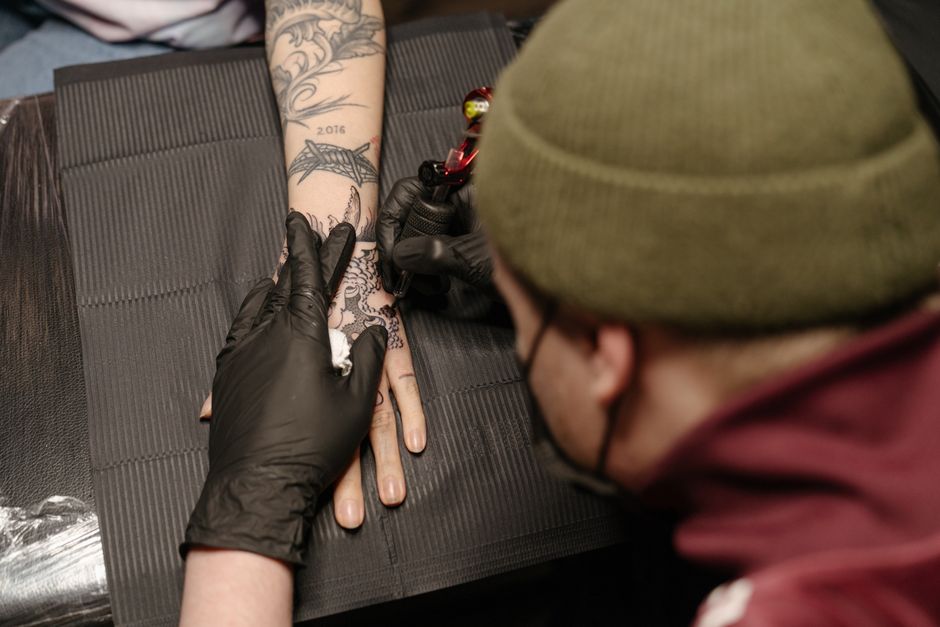
Start on synthetic practice skin. Move to supervised work on real clients only when a Mentor says you’re ready.
This progression lets you make mistakes safely, which is how you improve:
- Synthetic skin: Ideal for repeating lines, lettering and basic shading.
- Other practice surfaces: Some Tattoo Artists use alternatives that mimic the texture of skin. Follow your Mentor’s guidance on what to use.
- Supervised client work: The final step, always under an experienced Mentor’s direct supervision and following your state’s rules.
Your first lines won’t be perfect. That’s normal. Every Tattoo Artist you admire started with rough attempts.
What are the first steps to start tattooing?
Build a drawing habit, learn safety, get to know your equipment, practice on synthetic skin and find structured mentorship.
- Step 1: Draw every day. Fill sketchbooks and train your hand and eye.
- Step 2: Learn bloodborne pathogens safety. Find out what training your state requires.
- Step 3: Learn your tools. Understand machines, needles, inks, power supplies and grips.
- Step 4: Practice on synthetic skin. Build control with zero risk to a real person.
- Step 5: Find a structured tattoo apprenticeship. Real-time feedback from a Mentor saves years of trial and error.
- Step 6: Learn your state’s rules. Requirements vary. Oklahoma, for example, requires 1,500 apprenticeship hours, according to the Oklahoma State Department of Health.
- Step 7: Build your brand early. See these platforms to help new and aspiring Tattoo Artists build their brand.
What mistakes should beginners avoid?
Avoid skipping fundamentals, using cheap or unsafe kits, tattooing yourself or friends too early and trying to learn everything alone from videos.
Tattooing is a hands-on trade where real-time feedback matters. You can’t judge your own needle depth from a video. Tattooing without proper training also puts people at risk, and in many places, tattooing without a license breaks the law.
We cover more pitfalls in our guide to the mistakes aspiring tattoo apprentices should avoid.
How does Ink Different help beginners start right?
Ink Different’s Traditional Tattoo Apprenticeship runs 18 to 24 months and teaches every fundamental through in-person mentorship, with licensing support built in.
For 15 years, Ink Different has trained beginners with no experience to become working Tattoo Artists. It’s a college alternative for people who want to build a hands-on craft. Learn why tattoo apprenticeships are gaining ground as a solid alternative to college.
What You Can Expect from our Traditional Tattoo Apprenticeship
The Traditional Tattoo Apprenticeship has four phases, built for beginners. You train in person with a Mentor at one of 60+ tattoo studios nationwide, and no prior art background is required.
- Phase 1, Art and Design Principles: Drawing, shading, digital design and building a portfolio.
- Phase 2, Machine Mastery and Practice Tattooing: Hand-control exercises, machine operation, lining, shading and color packing.
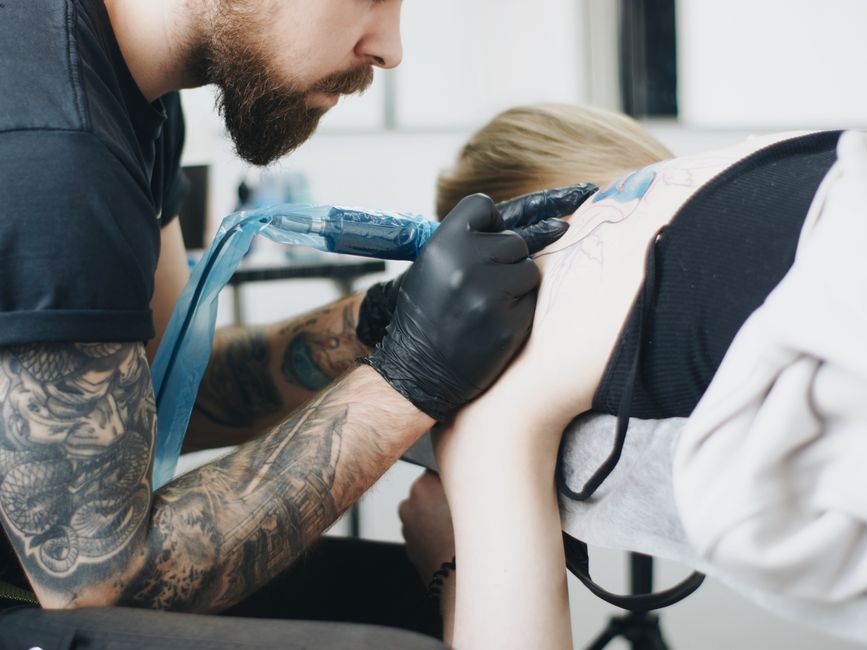
- Phase 3, Supervised Tattoos: Tattooing real skin under a Mentor’s direct supervision.
- Phase 4, Junior Artist Externship: Building client relationships and refining your skills while you start earning.
A Career That Comes With Confidence
You’ll finish with job-ready skills, licensing support and a guaranteed job offer at one of Ink Different’s own tattoo studios. Interest-free payment plans help make training more accessible.
Mentorship That Pushes Your Brand and Skills Further
Our one-year, in-person Master Mentorship trains beginners and experienced Tattoo Artists alongside celebrity and award-winning Master Mentors, including Al Fliction, Liz Cook, Kyle Dunbar, Boneface, Jordi Pla and Marcel Oliveira. It’s built for mastering a style, growing your career and owning your own business.
Making Tattoo Training Accessible for Everyone
We offer Spanish-speaking locations in Denver, Orange County, NYC, Miami, San Antonio and San Diego. Our “Good Humans” culture means you join a supportive, family-like community from day one.
Remember: Each Mentor takes just two tattoo apprentices per tattoo studio, because hands-on mentorship can’t be mass-produced. Seats fill up quickly.
Ready to take the first step?
Tattooing for beginners starts with the basics: drawing, safety and machine control, learned in the right order with real feedback. Build those foundations, and everything else gets easier.
Ready to become a Tattoo Artist? Apply now to Ink Different’s Traditional Tattoo Apprenticeship and start building an AI-proof career with licensing support along the way.
Frequently Asked Questions
What should I learn first when starting to tattoo?
Drawing fundamentals, then safety and sanitation, then machine handling. Get these solid before practicing on skin.
Do I need art experience to start tattooing?
No. Ink Different’s Traditional Tattoo Apprenticeship is built for beginners and starts with art and design principles.
What do beginners practice tattooing on?
Most start on synthetic practice skin, then move to supervised work on real clients when their Mentor says they’re ready.
Can I learn tattooing on my own from videos?
Videos can help with theory, but tattooing needs real-time feedback on depth, angle and pressure. Hands-on mentorship is the most reliable path.
How long does it take to become a Tattoo Artist?
Most tattoo apprenticeships take one to three years. Ink Different’s Traditional Tattoo Apprenticeship takes 18 to 24 months across four phases.
Where can I do a tattoo apprenticeship near me?
Ink Different offers the Traditional Tattoo Apprenticeship at 60+ tattoo studios nationwide, including Spanish-speaking locations in Denver, Orange County, NYC, Miami, San Antonio and San Diego.