
Get Paid to Learn: Trade Programs and Apprenticeships That Pay You
November 17, 2026
How to Avoid Needle Cross Lines and Blowouts
November 17, 2026
In This Article
- Key Takeaways
- What is a creative career beyond graphic design?
- Why do so many artists feel stuck in the wrong job?
- What creative careers can artists pursue?
- Why is tattoo artist one of the strongest creative careers?
- Which creative careers are AI-proof?
- How do you start a creative career from scratch?
- What does Ink Different’s Traditional Tattoo Apprenticeship offer?
- What is the Master Mentorship program?
- Ready to take the first step?
- FAQ
Creative careers for artists go far beyond graphic design. They include Tattoo Artist, animator, illustrator, muralist, concept artist, art director, ceramicist, set designer and fine artist. Each one pays you to use your imagination, skill and personal style. Some require a bachelor’s degree, while others, like tattooing, are learned through hands-on apprenticeships.
The pay varies widely. According to the U.S. Bureau of Labor Statistics, the median annual wage for art and design workers was $53,180 in May 2024, and some creative roles earn far more. This list covers the main options, how each one is usually learned and which hold up best as AI changes creative work.
Key Takeaways
- Many paths: Tattooing, animation, illustration, murals, concept art, art direction and fine art are all real creative careers.
- Pay ranges widely: BLS medians range from $56,260 for craft and fine artists to $111,040 for art directors.
- Training differs: Some creative careers typically need a bachelor’s degree, while tattooing is usually learned through an apprenticeship.
- AI resistance: Hands-on, in-person work like tattooing is harder to automate than screen-based design.
- No degree needed for tattooing: Ink Different’s Traditional Tattoo Apprenticeship trains beginners over 18 to 24 months.
What is a creative career beyond graphic design?
It’s any career where your original ideas, craftsmanship and personal style directly earn you income, from tattooing and murals to illustration, animation and set design.
Graphic design gets a lot of attention, so many talented people assume it’s the only “real” creative job. It isn’t. The creative economy includes many careers that never touch a layout grid.
The question isn’t whether creative work exists. It’s which path best fits your style, your strengths and how you want to work.
Why do so many artists feel stuck in the wrong job?
Many artists choose stability over creative work, then find their skills going unused year after year.
That trade-off can feel responsible at first. Over time, though, the gap between your skills and your daily work can grow. It often shows up as Sunday-night dread or a drawer full of unfinished sketches.
If that sounds familiar, it may be time to explore a change. Read about the mistakes aspiring tattoo apprentices should avoid if tattooing is on your list.
Reality Check: A career change isn’t reckless when your current path is costing you your creative potential. Planning carefully makes the switch much less risky.

What creative careers can artists pursue?
Here’s a list of creative careers beyond graphic design, with BLS pay data where available.
- Tattoo Artist: Permanent, personal art on skin, built on client trust and hands-on skill. According to ZipRecruiter, the average Tattoo Artist in the United States earns $106,858 a year as of November 2026. Usually learned through a tattoo apprenticeship.
- Special Effects Artist or Animator: Two- and three-dimensional models and animation for film, games and advertising. The BLS reports a median wage of $99,800 in May 2024. They typically need a bachelor’s degree in computer graphics, animation, fine arts, or a related field.
- Art Director: Leads the visual style of publications, products and productions. The BLS reports a median wage of $111,040 in May 2024. Many art directors start out in another art-related job, such as fine artist or photographer.
- Craft or Fine Artist: Paintings, sculpture, illustration, ceramics and other original work for sale and exhibition. The BLS reports a median wage of $56,260 in May 2024 and notes that craft and fine artists improve their skills through practice and repetition.
- Muralist: Large-scale wall art for cities, brands and businesses, usually commission-based.
- Illustrator: Artwork for books, editorial and products, either hand-drawn or digital.
- Concept Artist: Visual development for film, games and animation studios.
- Set and Prop Designer: World-building for theater, film and events.
- Audio and Sound Technician: For artists drawn to music and sound. The BLS reports a median wage of $56,600 in May 2024.
Before choosing, compare training, pay and outlook for each career in the BLS Occupational Outlook Handbook.
Why is tattoo artist one of the strongest creative careers?
Tattooing combines steady demand, strong income potential, creative freedom and in-person work that’s hard to outsource or automate.
Demand is real. According to Pew Research Center, 32% of Americans have a tattoo, and 22% have more than one. Many clients come back for more work and refer friends, so your reputation can become your business.
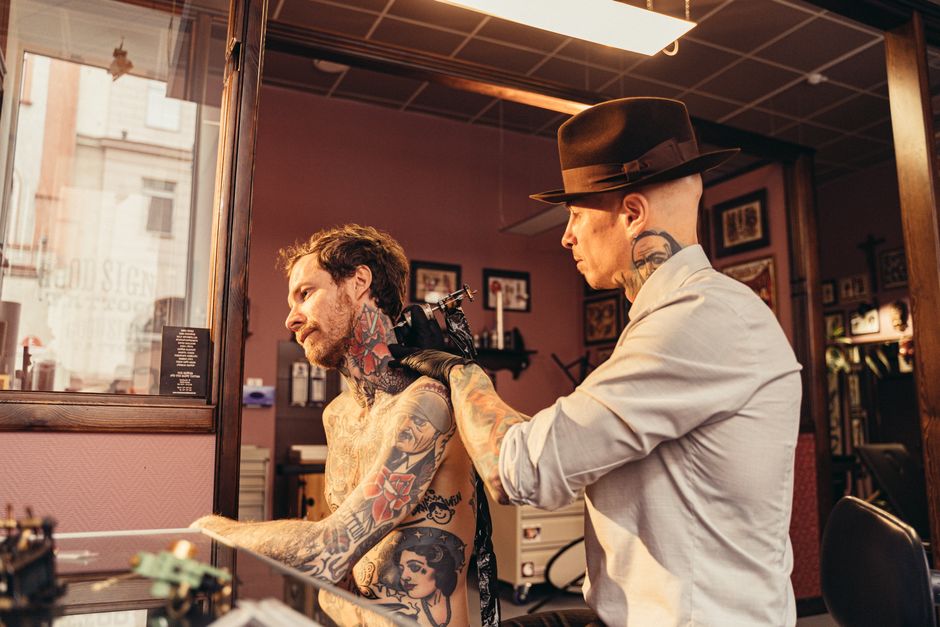
It’s also deeply personal work. A client sits with you for hours and trusts you with something permanent. That connection is part of why Tattoo Artists are still essential.
There’s also a clearer way in than many creative fields: a structured tattoo apprenticeship, plus whatever licensing or registration your state requires. Learn why tattoo apprenticeships are gaining ground as a solid alternative to college.
Which creative careers are AI-proof?
The creative careers that hold up best against AI are hands-on crafts that require physical skill, human trust and real-time judgment. Tattooing is near the top because it happens live, on another person’s skin.
AI tools can now generate logos, layouts and illustrations quickly, which is changing the competitive landscape for screen-based creative work.
Some work is much harder to automate. Tattooing requires you to read skin, manage pressure, adapt to movement and build trust in real time. It’s a live performance as much as a picture.
Think About It: The careers hardest to automate tend to be the ones that need a steady hand and a client sitting in front of you.

How do you start a creative career from scratch?
Choose a craft, find structured training, build your fundamentals daily and commit to a clear path.
- Step 1: Name your craft. Pick the creative career that genuinely excites you.
- Step 2: Learn how it’s trained. Some careers usually need a degree, while others, like tattooing, are learned through apprenticeships.
- Step 3: Find a Mentor-led path. Structured training beats scattered tutorials.
- Step 4: Build fundamentals daily. Linework, shading, composition and color theory support everything else.
- Step 5: Learn the business and safety side. For tattooing, that includes licensing, hygiene and the OSHA Bloodborne Pathogens Standard.
- Step 6: Build your brand. Share your progress with these platforms to help new and aspiring Tattoo Artists build their brand.
If tattooing is your path, get familiar with the tools every beginner Tattoo Artist should know.
What does Ink Different’s Traditional Tattoo Apprenticeship offer?
Ink Different’s Traditional Tattoo Apprenticeship runs 18 to 24 months across four phases. It takes complete beginners to job-ready Tattoo Artists with personalized, hands-on mentorship and licensing support.
You train in person with a Mentor at one of 60+ tattoo studios nationwide, and no prior experience is required.
- Phase 1, Art and Design Principles: Drawing, shading, digital design and building a portfolio.
- Phase 2, Machine Mastery and Practice Tattooing: Hand-control exercises, machine operation, lining, shading and color packing.
- Phase 3, Supervised Tattoos: Tattooing real skin under a Mentor’s direct supervision.
- Phase 4, Junior Artist Externship: Building client relationships and refining your skills while you start earning.
You’ll finish with job-ready skills, licensing support and a guaranteed job offer at one of Ink Different’s own tattoo studios. Interest-free payment plans help make training more accessible.
For 15 years, Ink Different has trained Tattoo Artists through its “Good Humans” culture, a family-like community where you’re never figuring it out alone.
What is the Master Mentorship?
The Master Mentorship is one year of in-person training for beginners and experienced Tattoo Artists. You train directly with celebrity and award-winning Master Mentors to master a specific style, grow your brand and work toward owning a tattoo studio.
You’ll learn from Master Mentors including Al Fliction, Liz Cook, Kyle Dunbar, Boneface, Jordi Pla and Marcel Oliveira.
We also offer Spanish-speaking locations in Denver, Orange County, NYC, Miami, San Antonio and San Diego.
Ready to take the first step?
There are plenty of creative careers beyond graphic design. If you want one that’s hands-on, personal and hard to automate, tattooing deserves a close look. Each Mentor takes just two tattoo apprentices per tattoo studio, so seats fill up quickly.
Ready to become a Tattoo Artist? Apply now to Ink Different’s Traditional Tattoo Apprenticeship and start building an AI-proof creative career with licensing support along the way.
Frequently Asked Questions
What creative careers exist besides graphic design?
Artists can pursue tattooing, animation, illustration, murals, concept art, art direction, ceramics, set design, sound work and fine art.
Which creative careers pay the most?
Among those listed, art directors ($111,040) and special effects artists and animators ($99,800) have the highest BLS medians. Tattoo Artists average $106,858, according to ZipRecruiter.
Which creative careers don’t require a degree?
Tattooing is usually learned through an apprenticeship, not a degree. Fine artists, muralists and illustrators also often build careers through practice and a strong portfolio.
Is it too late to start a creative career if I’m older?
No. Many career changers start in their 30s, 40s and beyond. Ink Different’s Traditional Tattoo Apprenticeship welcomes committed beginners.
Do I need prior art experience to become a Tattoo Artist?
No. The Traditional Tattoo Apprenticeship starts with art and design principles, so beginners can start from scratch.
Which creative career is most resistant to AI?
Tattooing is among the most resistant, because it depends on live physical skill, real-time judgment and client trust.