
How to Become a Tattoo Artist After a Layoff or Career Change
September 22, 2026
Tattoo Design Software That Actually Speeds Up Full Sleeve Planning
September 22, 2026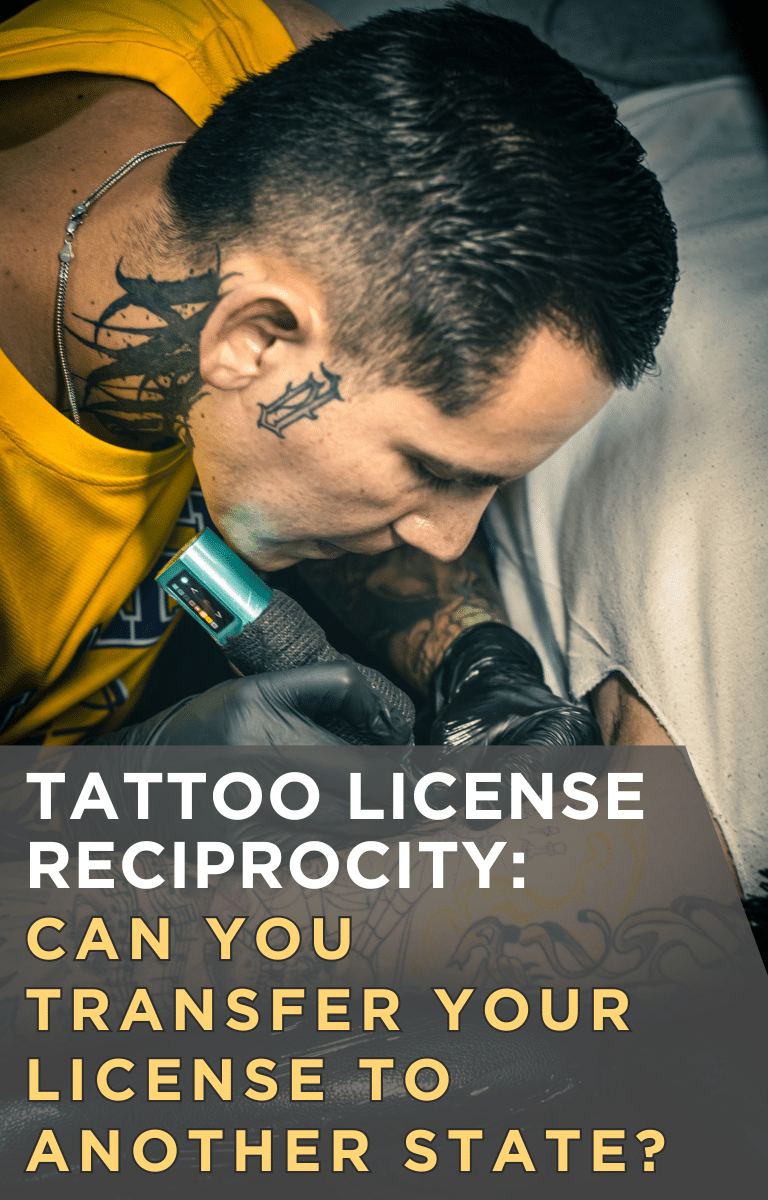
In This Article
- Key Takeaways
- What is tattoo license reciprocity?
- Can you transfer your tattoo license to another state?
- Why do requirements vary so much between states?
- How do you transfer a tattoo license step by step?
- What documents do you usually need?
- What mistakes should you avoid when transferring?
- How does Ink Different set you up for portability?
- Ready to build a career that travels with you?
- FAQ
Tattoo license reciprocity is the practice of one state recognizing or accepting a tattoo license issued by another state, allowing a licensed Tattoo Artist to work legally after meeting local requirements.
The tricky part is that true reciprocity for tattooing is rare, so most artists must re-apply, re-document, or re-test when they move. Here at Ink Different Tattoos, we have spent over 15 years helping aspiring artists build careers that hold up anywhere, not just in one shop or one town.
Let’s walk through exactly what happens to your license when you relocate, and how to protect the momentum you have worked so hard to earn.
Key Takeaways
- Reciprocity is rare: Most states do not offer true tattoo license reciprocity, so you usually re-apply locally.
- Rules are local: Tattoo licensing is set by states, counties, and cities, not one national standard.
- Bloodborne training transfers: A current OSHA-aligned bloodborne pathogens certificate often carries over between states.
- Documentation is king: Keep your portfolio, hours logged, and certificates organized to speed up any transfer.
- Training matters: A structured tattoo apprenticeship builds portable, job-ready skills that no state can invalidate.
What is tattoo license reciprocity?
Tattoo license reciprocity is when one state agrees to accept a tattoo license issued by another state, letting a licensed artist work without starting the entire process over. In practice, formal reciprocity for tattooing is uncommon compared to trades like cosmetology or nursing.
Unlike a driver’s license, which nearly every state honors, tattoo licensing is fragmented. Each state, and sometimes each county or city, writes its own rules. That means “portability” often looks less like a smooth transfer and more like re-applying with proof of your existing experience.
The good news? Your real assets, such as your skills, your portfolio, and your health-and-safety training follow you everywhere. Think of your license as a local permit and your craftsmanship as the seed. The permit stays in the soil of one state, but the seed can be replanted anywhere.
Can you transfer your tattoo license to another state?
You can often transfer your qualifications, but rarely your actual license, because most states require you to apply locally and prove you meet their standards. Some states make this easy for experienced artists; others treat you like a first-timer.
A handful of states with lighter regulation let you register quickly with proof of experience and a current bloodborne pathogens certificate. Stricter states may require documented apprenticeship hours, a local exam, or a health department inspection of your workspace before you can pick up a tattoo machine.
So the honest answer is: it depends on where you’re going. California, Texas, and Colorado each handle incoming artists differently. If you know your destination, research it early. We break down several state-specific paths in our guides on transferring a tattoo license to California and getting your tattoo license in Texas.
Why do requirements vary so much between states?
Tattoo licensing varies because there is no federal tattoo authority; states regulate it as a matter of public health, and each writes its own hygiene and training rules. Body art sits under state and local health departments, not one national board.
Because tattooing involves breaking the skin, the main concern is safety. That is why nearly every state anchors its rules to bloodborne pathogen control, following standards from OSHA’s bloodborne pathogen standards. Aftercare and infection prevention, guided by resources like the American Academy of Dermatology tattoo care guidelines, are also common threads.
Beyond health, states differ on apprenticeship hour minimums, exams, and even whether a county issues the permit instead of the state. This patchwork is exactly why your foundational training matters so much: solid, universally-respected skills give you leverage no matter where you land.
How do you transfer a tattoo license step by step?
To transfer your tattoo license, verify the new state’s rules, gather your documentation, apply through the correct agency, complete any required exam or inspection, and receive your local permit. Follow these steps to stay in control of the process.
- Step 1: Identify the governing body. Confirm whether the state, county, or city issues tattoo permits where you’re moving. Check the local health department website first.
- Step 2: Read the exact requirements. Look for apprenticeship hour minimums, exam rules, and whether they honor experience from another state.
- Step 3: Gather your paperwork. Pull together your current license, bloodborne pathogens certificate, portfolio, and any logged apprenticeship hours.
- Step 4: Submit your application and fees. Apply through the correct agency and pay any processing or permit fees on time.
- Step 5: Complete testing or inspection. Take any required health exam and pass a workspace or studio inspection if the state requires one.
- Step 6: Receive and display your new permit. Once approved, keep your permit visible in your tattoo studio and renew it on schedule.
Timelines vary widely. Some states process in days; others take weeks. If Colorado is your destination, our guide on how long a tattoo license takes in Colorado gives you a realistic picture.
Pro Tip: Call the health department directly before you move. A five-minute phone call can save you weeks of guessing and prevent you from arriving unable to legally work.
What documents do you usually need?
Most states ask for your current tattoo license, a valid bloodborne pathogens certificate, proof of apprenticeship hours or experience, a portfolio, a government ID, and application fees. Having these organized ahead of time is your biggest advantage.
- Current license or permit: Proof you’re already licensed in your home state.
- Bloodborne pathogens certificate: Often the most portable document, usually renewed annually.
- Apprenticeship documentation: Logged hours and mentor sign-offs proving your training.
- Portfolio: Photos of healed work that demonstrate your skill level.
- Government ID and fees: Standard identity verification plus application costs.
Notice the theme: documentation. Artists who track everything from day one move fastest. If you’re just starting out, learn what to organize early by understanding the mistakes aspiring tattoo apprentices should avoid.
What mistakes should you avoid when transferring?
The biggest mistakes are assuming reciprocity exists, moving before checking local rules, and letting your bloodborne pathogens certificate expire. Each one can leave you legally unable to work in your new city for weeks.
Another common trap is under-documenting your experience. If you never logged your apprenticeship hours or kept a healed-work portfolio, a stricter state may treat you like a beginner. Protect your progress by treating records as part of your craft.
Finally, don’t rely on outdated forum advice. Rules change. Always confirm current requirements directly with the state or county, and use trusted career data like the Bureau of Labor Statistics on craft and fine artists to understand the wider job landscape you’re stepping into.
How does Ink Different set you up for portability?
Ink Different Tattoos builds portable, job-ready skills and provides licensing support, so you graduate ready to work professionally and adapt to different states’ requirements. We treat your future as a career that should travel with you, not trap you.
Our nationwide Traditional Tattoo Apprenticeship is a serious college alternative for people who want a real, hands-on career. And because tattooing is a human craft built on trust, it remains an AI-proof career that no algorithm can replace.
Get Serious About Your Career With Become A Tattoo Artist
Our Traditional Tattoo Apprenticeship runs 18 to 24 months across four structured phases, with hands-on training in real tattoo studios under experienced Mentors who have walked this road themselves.
- Beginner-friendly: No prior art experience needed. We build your foundation from the ground up.
- Personalized training: Hands-on coaching tailored to your growth, not a one-size-fits-all classroom.
- Licensing support: We help you understand and meet the licensing requirements, so you’re job-ready on graduation.
- Portable documentation: Your logged hours and portfolio give you leverage if you ever move states.
A Career That Comes With Confidence
You finish this tattoo apprenticeship with a guaranteed job offer, real, market-ready skills, and the confidence to walk into any tattoo shop knowing you belong. That confidence, backed by proper documentation, is what makes your career portable in the first place.
Mentorship That Pushes Your Brand and Skills Further
Ready to level up faster? Our one-year, in-person Master Mentorship pairs you with celebrity and award-winning Master Mentors, including Al Fliction, Liz Cook, Kyle Dunbar, Boneface, and Jordi Pla. It’s built for beginners and experienced Tattoo Artists chasing a specific style, a career explosion, or tattoo studio ownership.
Making Tattoo Training Accessible for Everyone
We offer Spanish-speaking locations in Denver, Orange County, NYC, Miami, San Antonio, and San Diego, so more aspiring artists can join our “Good Humans” culture. You’re never just a number here; you’re part of a family-like community that has your back long after graduation.
Ready to build a career that travels with you?
Your license may be tied to a state, but your talent isn’t. The smartest move you can make is investing in training that gives you portable skills, organized documentation, and mentorship that lasts. Seats in our tattoo apprenticeship are limited.
Ready to become a Tattoo Artist? Apply now to Ink Different’s Traditional Tattoo Apprenticeship and start building an AI-proof career with licensing support along the way. Not sure yet? Fill out our quick questionnaire to get personalized support and find out if our tattoo apprenticeship is right for you.
Frequently Asked Questions
Does tattoo license reciprocity exist between all states?
No. True tattoo license reciprocity is rare. Most states require you to apply locally and prove your experience, since tattoo licensing is regulated by individual states, counties, and cities.
Can I transfer my tattoo license to California?
California regulates tattooing at the local county level, so you typically register locally with proof of a current bloodborne pathogens certificate and meet each county’s specific requirements before working.
Does my bloodborne pathogens certificate transfer between states?
Usually yes. A current OSHA-aligned bloodborne pathogens certificate is often accepted across states, though many require annual renewal. Always confirm with the local health department before you relocate.
How long does it take to transfer a tattoo license?
It varies by state. Some process applications in days, while stricter states take several weeks, especially if an exam or studio inspection is required before approval.
Do I need prior art experience to start a tattoo apprenticeship?
No. Ink Different Tattoos’ Traditional Tattoo Apprenticeship is built for beginners and teaches drawing and machine fundamentals from day one, over an 18 to 24 month program.
What makes Ink Different different from other training?
Ink Different offers live, in-person mentorship, a “Good Humans” community, over 15 years of experience, and portable, job-ready skills with licensing support, positioning it as a college alternative.