
Tattoo Business Cards That Get You Booked
November 24, 2026
Tattoo Needles Explained: Liners, Shaders and Magnums
November 24, 2026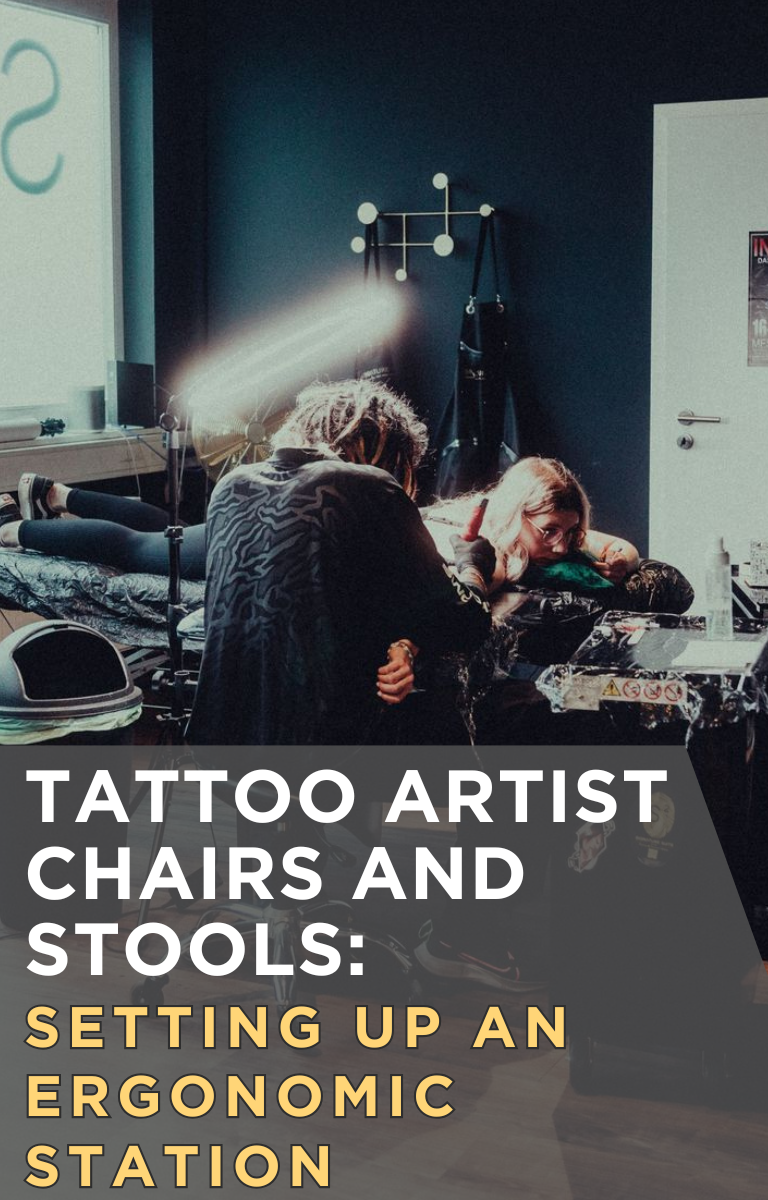
In This Article
- Key Takeaways
- What is an ergonomic tattoo station?
- Why does your chair and stool setup matter so much?
- What features should a good tattoo artist chair have?
- What makes a great tattoo artist stool?
- How do you set up an ergonomic tattoo station step by step?
- What ergonomic mistakes do new tattoo artists make?
- Where can you learn proper ergonomics and technique?
- Ready to build your career the right way?
- FAQ
An ergonomic tattoo station keeps your spine, shoulders, and wrists in a neutral, supported position while you work. The key pieces are an adjustable client chair that brings the tattoo to you, and a supportive, height-adjustable stool for you. Set your stool first, then raise and angle the client chair so the skin sits near your elbow height. Move the client instead of leaning, hunching or twisting.
Tattoo Artists have good reason to get this right. In a study by Ohio State University researchers published in Applied Ergonomics, the most common complaints among 34 Tattoo Artists surveyed were back pain (94%), headache (88%), neck pain (85%), and eye pain (74%), according to ScienceDaily’s report. Below, we cover what to look for in a chair and stool, how to set up your station, and the mistakes to avoid.
Key Takeaways
- Neutral posture: A good setup keeps your spine, shoulders and wrists relaxed and supported.
- Adjustable client chair: Height, recline and armrest adjustments let you bring the work to you.
- Supportive stool: Look for height adjustment, a stable five-caster base and saddle or lumbar support.
- Move the client, not yourself: Reposition the chair and limb before you lean or twist.
- Pain is common: Researchers found back, neck and shoulder strain is widespread among Tattoo Artists.
What is an ergonomic tattoo station?
An ergonomic tattoo station is set up so your body stays in a neutral, supported posture while you tattoo. That reduces strain on your back, neck, shoulders and wrists.
Your client chair, stool, armrests, lighting and supply tray all work together. When they’re set up well, you can focus on the tattoo instead of fighting your own body.
According to OSHA, ergonomics is about fitting the job to the worker, and good ergonomic practices can reduce musculoskeletal disorders. That’s especially relevant for tattooing, where you hold precise positions for long stretches.
Why does your chair and stool setup matter so much?
Tattooing means holding precise, static postures for long periods. Poor positioning can lead to chronic pain and injuries that make long sessions harder over time.
The research backs this up. In the Applied Ergonomics study, more than half of the Tattoo Artists studied reported discomfort over the previous 12 months in their neck, shoulders, hands and wrists, and back. When researchers measured muscle activity during real sessions, all 10 Tattoo Artists exceeded recommended exertion limits in at least one muscle group, and some exceeded them by as much as 25%, according to Ohio State University.
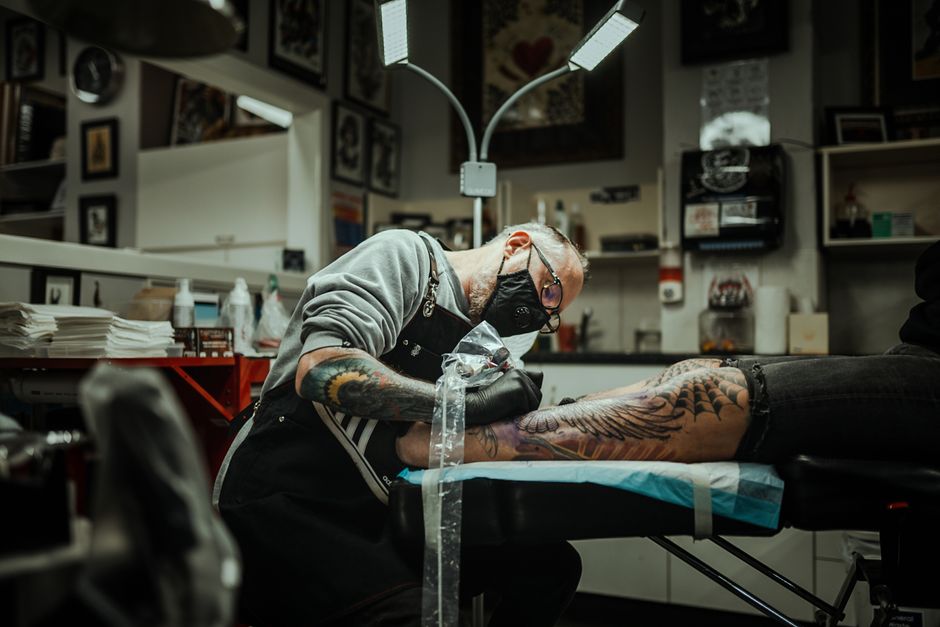
The researchers also noted how often Tattoo Artists perch on low stools, lean forward and crane their necks to get close to the tattoo. Your setup is one of the few injury risks you can control directly.
Mentor Tip: If you finish a session feeling physically wrecked, adjust your setup before you look for other fixes.
What features should a good tattoo artist chair have?
A good tattoo client chair adjusts in height, recline and angle, so you can bring any part of the body to a comfortable working level.
Look for these features:
- Height adjustment: Hydraulic or electric lift, so you can match the work to your seated position.
- Reclining backrest: Lets you position clients flat, upright or anywhere in between.
- Adjustable or removable armrests: Helpful for arm and hand tattoos without awkward reaching.
- Cushioned, wipeable surface: Comfortable for clients and easy to clean and disinfect.
- Stable, lockable base: No wobbling or sliding mid-line.
The Ohio State researchers pointed out that there’s no official “tattoo chair” standard, so many Tattoo Artists adapt dental chairs or massage tables. A flat table with bolsters can work well for large back and leg pieces, while an articulating chair gives you more control for most other placements.
What makes a great tattoo artist stool?
A great stool adjusts in height, rolls and swivels smoothly, sits on a wide base and supports a neutral spine through long sessions.
Two styles are common:
- Saddle stools: These place your hips in a riding position, which tilts the pelvis forward and encourages an upright spine. Many Tattoo Artists like them for long sessions.
- Backed ergonomic stools: These offer lumbar support and a backrest you can lean against between passes.
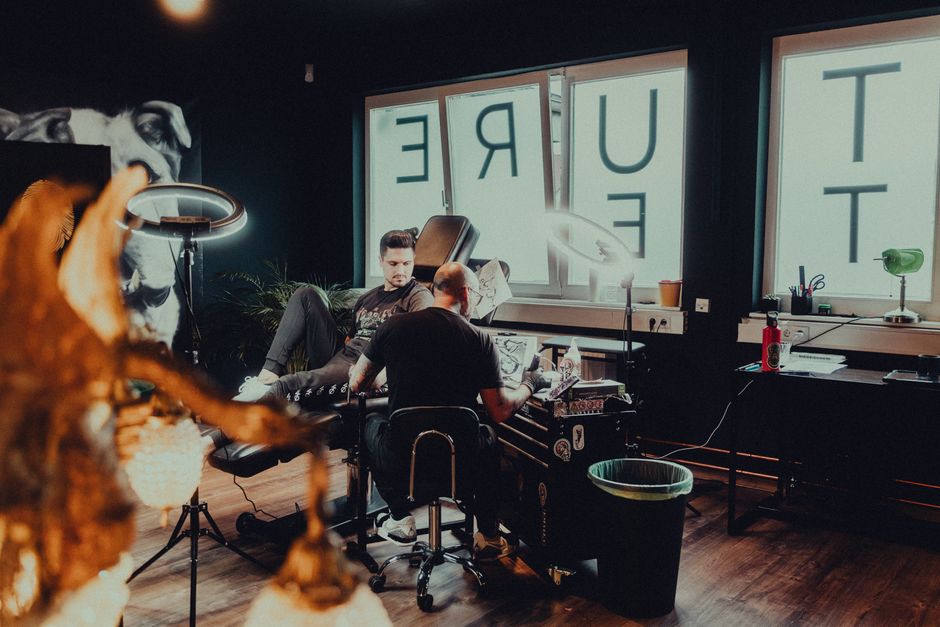
Whichever you choose, look for five casters for stability and a swivel seat, so you can turn without twisting your torso. Set the height so your feet rest flat and your thighs are level or angled slightly down. The Ohio State researchers recommended Tattoo Artists experiment with different chairs for themselves and try to support their back and arms.

How do you set up an ergonomic tattoo station step by step?
Set your stool first, raise the client chair to your working level, position the body part, place your light and keep supplies within easy reach.
- Set your stool height. Feet flat, thighs level or angled slightly down. This is your anchor.
- Raise the client chair to you. Bring the tattoo area to about your relaxed elbow height, so your shoulders stay down.
- Position the client. Use armrests, pillows or bolsters to bring the skin into a flat, easy-to-reach angle. Researchers suggested that, when it works for the tattoo, the client might stand or lean while you sit comfortably.
- Support your working hand. Rest the side of your hand on the skin or an armrest so your wrist stays neutral.
- Place your light. Eliminate shadows so you don’t need to crane your neck. The researchers also suggested a mounted magnifying glass to avoid leaning in.
- Keep supplies within reach. Ink caps, rinse cups and wipes should sit close enough that you never twist or overreach.
- Reset between areas. Readjust the chair and client whenever you move to a new part of the tattoo.
Your chair and stool belong on the same list as the other tools new Tattoo Artists need, since all of them shape how comfortably you work.
What ergonomic mistakes do new tattoo artists make?
The most common mistakes are hunching over the client, reaching across your body, bending the wrist and never readjusting the chair.
- Moving yourself instead of the client: Reposition the chair and the body part first.
- Flaring your elbows: Keep elbows close to your sides to protect your shoulders.
- Wrong chair or stool height: If you’re shrugging or hunching, adjust your heights.
- Skipping breaks: The Ohio State researchers recommended changing positions and taking more frequent breaks.
- Ignoring early pain: Small aches are a warning sign. Address your setup before they turn into injuries.
Physical strain often goes hand in hand with mental strain, which is why protecting your mental health and avoiding burnout belongs in the same conversation. Building good habits early is also a way to avoid some of the most common apprentice mistakes.
Where Can You Learn Proper Ergonomics and Technique?
Ergonomics and technique are easiest to learn from a Mentor who can watch your posture and correct it in real time. That’s part of Ink Different’s Traditional Tattoo Apprenticeship.
The Traditional Tattoo Apprenticeship runs 18 to 24 months across four phases, with in-person training at one of 60+ tattoo studios nationwide. No prior experience is required.
- Phase 1, Art and Design Principles: Drawing, shading, digital design and building a portfolio.
- Phase 2, Machine Mastery and Practice Tattooing: Hand-control exercises, machine operation, lining, shading and color packing.
- Phase 3, Supervised Tattoos: Tattooing real skin under a Mentor’s direct supervision.
- Phase 4, Junior Artist Externship: Building client relationships and refining your skills while you start earning.
Long practice hours are part of the process. Ink Different apprentice Edward Cuff explains why he never skips a day of practice during Phase 2, and a solid setup helps make that kind of consistency sustainable.
You’ll finish with job-ready skills, licensing support and a guaranteed job offer at one of Ink Different’s own tattoo studios. Licensing rules differ widely from state to state, as this state-by-state tattoo licensing map shows. Interest-free payment plans help make training more accessible.
For Tattoo Artists who want to go further, the one-year, in-person Master Mentorship offers training with celebrity and award-winning Master Mentors like Jordi Pla, who trains apprentices at his tattoo studio, Black Flamingo.
We also offer Spanish-speaking locations in Denver, Orange County, NYC, Miami, San Antonio and San Diego. Our “Good Humans” culture means you join a supportive, family-like community.
Ready to build your career the right way?
A good chair, a supportive stool and a few smart habits can protect your body for years of tattooing. Learning them early, with a Mentor beside you, makes them second nature. Each Mentor takes just two tattoo apprentices per tattoo studio, so seats fill up quickly.
Ready to become a Tattoo Artist? Apply now to Ink Different’s Traditional Tattoo Apprenticeship and start building a career with licensing support along the way.
Frequently Asked Questions
What is the best stool for a tattoo artist?
One that adjusts in height, swivels, rolls on a stable five-caster base and offers saddle or lumbar support, so your feet rest flat and your spine stays neutral.
What chair do Tattoo Artists use for clients?
Many use adjustable tattoo chairs or adapted dental chairs, and some use massage tables with bolsters for large pieces. Height and recline adjustments are the most useful features.
How common is back pain among Tattoo Artists?
Very common. In one survey of 34 Tattoo Artists, 94% reported back pain, and 85% reported neck pain.
How do I avoid back pain while tattooing?
Set your stool first, raise the client chair to about elbow height, move the client instead of leaning, keep your elbows close and take regular breaks.
Do I need prior experience to join a tattoo apprenticeship?
No. The Traditional Tattoo Apprenticeship is built for beginners and starts with art and design principles.
How long does the Traditional Tattoo Apprenticeship take?
It takes 18 to 24 months across four phases.
Sources (all checked November 20, 2026)