
Spooky Season Flash: Classic Halloween Tattoo Designs Every New Tattoo Artist Should Learn
October 1, 2026
Only 25% of Tattoo Artists Are Women. A UK Gallery Show Spotlights Them
October 2, 2026
In This Article
- Key Takeaways
- What is a tattoo training initiative?
- Why does stable work lower recidivism?
- Why is tattooing a smart trade for a second chance?
- What makes Pennsylvania a strong case study?
- How do you start tattoo training from scratch?
- How does Ink Different support this path?
- What is the Master Mentorship option?
- How does Ink Different make training accessible?
- Ready to build a stable career?
- FAQ
Coming home from prison with no job and no direction is one of the hardest restarts there is. Pennsylvania is now testing a new answer to that problem: tattoo training. The state’s Department of Corrections is launching a tattoo apprenticeship at SCI Frackville in Schuylkill County. It will teach incarcerated people professional tattooing, with a focus on safety, health, and career skills for life after release.
This story is worth paying attention to even if you’ve never been near a prison. It shows how seriously tattooing is now taken as a career. At Ink Different Tattoos, we’ve seen what a structured tattoo apprenticeship can do for someone with drive and no connections. Let’s look at what Pennsylvania is doing and why stable work matters so much.
Key Takeaways
- The news: Pennsylvania’s Department of Corrections is hiring a professional Tattoo Artist to lead a tattoo apprenticeship for incarcerated people at SCI Frackville.
- The data: Stable employment can drop recidivism from 52% to 16%, according to the U.S. Department of Commerce.
- Why tattooing: It’s a skill-first, AI-proof trade where your portfolio matters more than your résumé.
- The standard: Apprentices practice on paper and synthetic skin before working on people. Every serious tattoo apprenticeship should work that way.
- No art needed: Ink Different’s Traditional Tattoo Apprenticeship welcomes complete beginners.
What is a tattoo training initiative?
A tattoo training initiative is structured, hands-on training that teaches people to tattoo safely and professionally so they can earn a stable living.
Pennsylvania’s version is a good example. In September, the Department of Corrections announced it’s looking for an actively practicing professional Tattoo Artist to lead training at SCI Frackville. The instructor will teach 32 to 40 hours each week.
Training will cover health, safety, sanitation, and disease prevention. It also covers art and design, equipment, customer communication, and tattoo studio operations. Apprentices start in the classroom and practice on paper and synthetic skin. They move to supervised work on human skin only after proving their skills and getting department approval.
This isn’t a short-term experiment either. The instructor will be hired on a two-year contract with the option of three one-year renewals. Tattooing also joins about two dozen vocational trades already offered in Pennsylvania state prisons, like auto mechanics, construction, and culinary arts.
Why does stable work lower recidivism?
Steady work gives people income, structure, and a reason to protect the life they’re building.
The numbers are hard to ignore. The U.S. Department of Commerce reports that stable employment can drop recidivism among former inmates from 52% to 16%. Pennsylvania’s recidivism rate sits at 54%, costing the state billions every year.
The benefits go beyond the prison budget. A steady paycheck supports families, strengthens neighborhoods, and eases pressure on other public services. That’s why Pennsylvania officials describe the goal as giving people relevant, in-demand skills for their return home.
There’s also identity. When you have a trade, your past doesn’t define you. You’re a Tattoo Artist with clients, a schedule, and a reputation to build.
The heart of it: Most people don’t need a handout. They need a path, a skill, and someone willing to teach them.

Why is tattooing a smart trade for a second chance?
Tattooing rewards skill over credentials, has steady demand, and can’t be replaced by automation.
Clients don’t ask a Tattoo Artist for a diploma. They ask to see the work. Your portfolio speaks louder than your history, which makes tattooing one of the more welcoming trades for people rebuilding their lives.
The demand is real. Up to 38% of Americans have at least one tattoo, according to PBS estimates. Pennsylvania alone has an estimated 1,500 tattoo studios, staffed by thousands of Tattoo Artists.
It’s also future-proof. Software can generate a design, but it can’t calm a nervous client or safely tattoo living skin.
Safety is where the discipline comes in. Pennsylvania requires its instructors to hold current OSHA bloodborne pathogen certification. The same standard is part of any legitimate tattoo apprenticeship, and those habits carry into every part of life.
What makes Pennsylvania a strong case study?
Pennsylvania shows how much the details matter when turning tattoo training into real careers.
First, the state is setting a high bar for who teaches. The instructor needs at least three years of active tattooing experience and experience supervising apprentices. They also have to pass department background checks. Experience running a tattoo studio or teaching a trade is a plus.
Second, the training goes beyond technique. Apprentices will learn about licensing pathways, job opportunities, and how the professional tattoo industry works after release. Pennsylvania doesn’t license Tattoo Artists statewide, but Philadelphia and Allegheny County have their own local rules. Knowing those rules is part of working legally.
Third, it tackles a health problem. The department says the training promotes sanitary tattooing as an alternative to illicit tattooing, which carries real health risks.
The lesson for anyone considering this career is simple. Good tattoo training has the same ingredients everywhere: an experienced Mentor, strict safety standards, steady progress from practice skin to clients, and a clear path to paid work.
How do you start tattoo training from scratch?
You start by committing to the change, learning the fundamentals, and training under a professional Tattoo Artist inside a working tattoo studio.
Here’s the practical path, even with zero art background.
- Step 1: Commit to the change. Decide you are done waiting. This is the single biggest hurdle, and it is entirely yours to clear.
- Step 2: Learn the fundamentals. Drawing, line work, shading, and machine handling. You start remote and build a foundation before touching skin.
- Step 3: Get the right tools and knowledge. Understand your gear early. Our guide to tools every beginner tattoo artist should know is a great starting point.
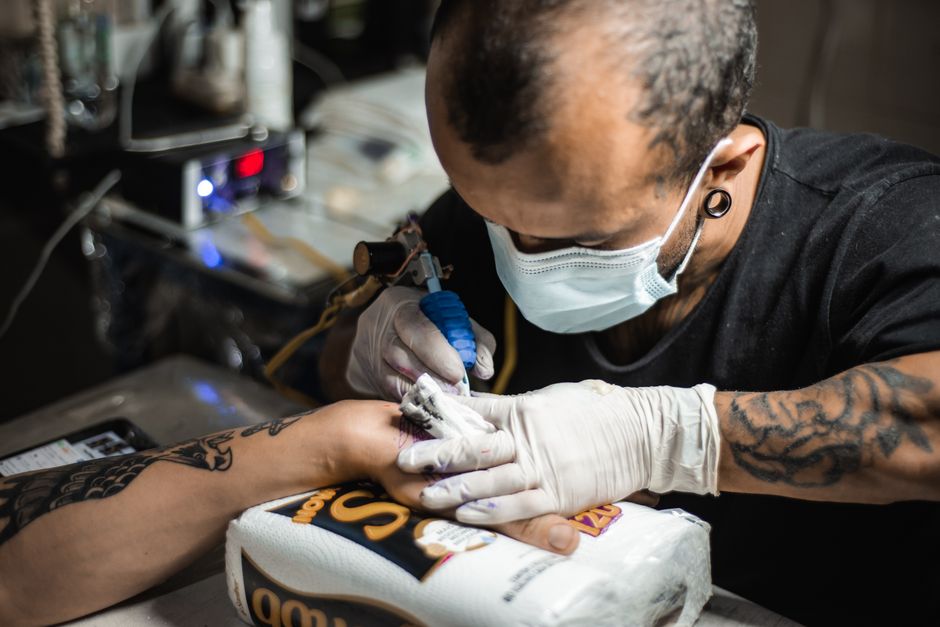
- Step 4: Train under a Mentor in a studio. Move from practice surfaces to supervised client work in a real Tattoo Shop.
- Step 5: Build your portfolio and brand. Document your work and grow an audience. See our list of platforms to help tattoo artists build their brand.
- Step 6: Complete licensing. Finish required hours, safety training, and state paperwork so you can work legally and confidently.
Avoid the common traps along the way. We put together a rundown of the mistakes aspiring tattoo apprentices should avoid so your journey stays on the fastest track.
How does Ink Different support this path?
Ink Different Tattoos supports this path through the Traditional Tattoo Apprenticeship. You get hands-on training, live mentorship, licensing support, and a guaranteed job offer.
We’ve been training professional Tattoo Artists since 2011. Our Traditional Tattoo Apprenticeship is built as a college alternative for people who want a real skill without piling up college debt.
Here’s what to expect:
- Length: 18 to 24 months across a proven four-phase structure.
- Training: Hands-on learning in our tattoo studios, guided by professional Tattoo Artists.
- For beginners: No prior art experience needed. We teach you from the ground up.
- Career outcome: Job-ready skills, licensing support, and a guaranteed job offer at one of our tattoo studios.
Each Mentor takes on only two tattoo apprentices per tattoo studio, so you get real one-on-one attention. You’re never on your own either. Our “Good Humans” culture means you join a supportive community that wants you to win.
What is the Master Mentorship option?
Master Mentorship is a one-year, in-person experience where you train directly with award-winning Master Mentors.
It’s built for people who want to go deeper, whether that means mastering a style, growing their career, or opening their own tattoo studio. You learn alongside Master Mentors like Al Fliction, Liz Cook, and Kyle Dunbar. It’s open to beginners and experienced Tattoo Artists who are serious about skill-building and business ownership.
That kind of access is rare. It puts you in the room with people who’ve helped shape the tattoo industry.
How does Ink Different make training accessible?
Ink Different makes tattoo training accessible with a beginner-friendly structure and Spanish-speaking locations across the country.
We offer Spanish-speaking Tattoo Artist training in Miami, Brooklyn/NYC, Denver, Orange County, Naples, Oklahoma City, San Antonio, and San Diego. Language shouldn’t stand between you and a stable career.
Neither should your starting point. With 60+ locations nationwide, a tattoo apprenticeship may be closer than you think. Seats are limited, so starting sooner gives you more options.
Ready to build a stable career?
Pennsylvania is betting that a real trade, taught the right way, can change where someone’s life goes next. The same idea applies to anyone stuck in a job that’s going nowhere. Skill, structure, and a steady paycheck are how people build a future with their own hands.
Ready to become a Tattoo Artist? Apply now to Ink Different’s Traditional Tattoo Apprenticeship and start building an AI-proof career with licensing support along the way. Not sure yet? Fill out our quick questionnaire to get personalized support and find out if our Traditional Tattoo Apprenticeship is right for you.
Frequently Asked Questions
How does tattoo training reduce recidivism?
It gives people a trade and a path to steady income. The U.S. Department of Commerce reports that stable employment can drop recidivism from 52% to 16%.
Do I need art experience to start a tattoo apprenticeship?
No. Ink Different’s Traditional Tattoo Apprenticeship welcomes beginners and teaches drawing, machine handling, and safety from day one.
How long does the Traditional Tattoo Apprenticeship take?
It takes 18 to 24 months across a four-phase structure, with hands-on training in our tattoo studios and licensing support.
What makes Ink Different different from a tattoo school?
You train inside working tattoo studios with live, in-person mentorship and licensing support. You also finish with a guaranteed job offer.
Is tattooing a stable long-term career?
Yes. Tattooing rewards skill over credentials and can’t be automated. With up to 38% of Americans tattooed, demand stays strong.
Are there Spanish-speaking tattoo training locations?
Yes. Ink Different offers Spanish-speaking training in Miami, Brooklyn/NYC, Denver, Orange County, Naples, Oklahoma City, San Antonio, and San Diego.