Apprentice Spotlight: Why Art School Grad David Johnston Chose Tattooing Over Graphic Design
November 5, 2026
Apprentice Spotlight: How Art Became Therapy, Then a Tattoo Career, for Firefighter Stephen Salasek
November 6, 2026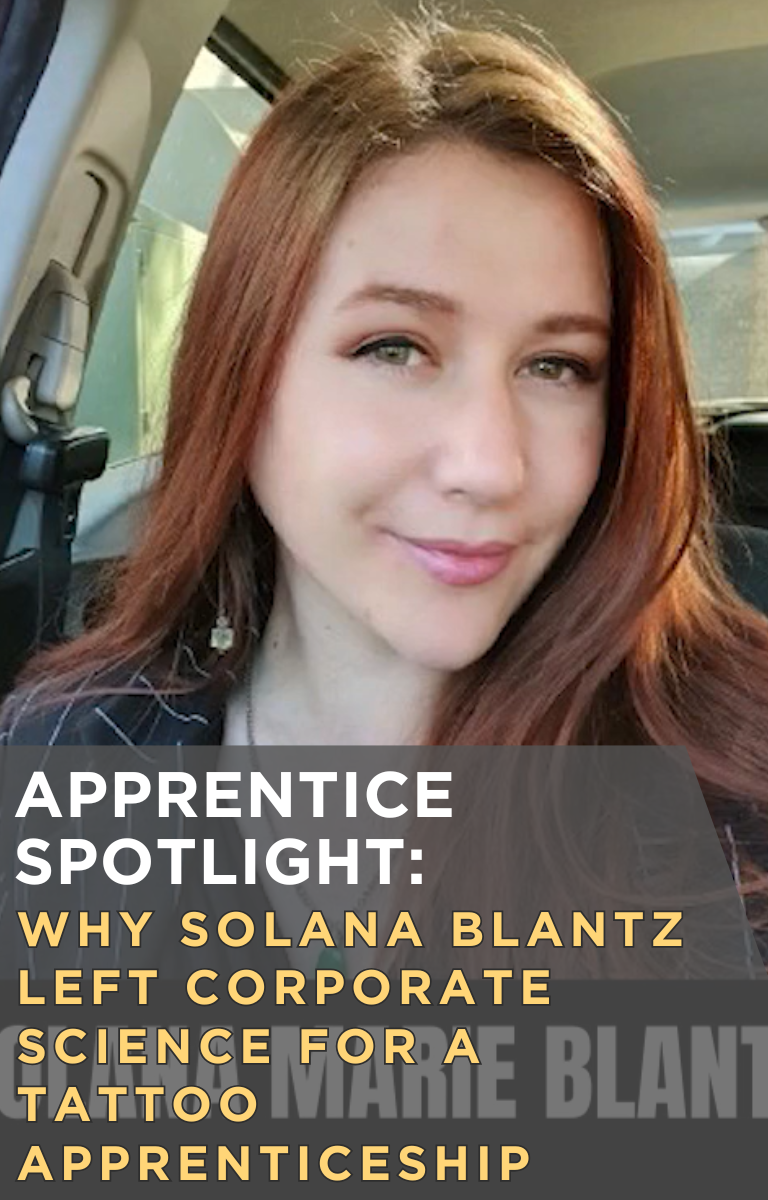
In This Article
- Key Takeaways
- Who is Solana Blantz?
- Why did she leave corporate science?
- What science skills transfer to tattooing?
- How did she decide to make the leap?
- What can you expect from a tattoo apprenticeship?
- How can you follow Solana’s path?
- What Ink Different offers aspiring Tattoo Artists
- Ready to make your own leap?
- FAQ
“I’ve gone through college, started a career in science,” Solana Blantz says, “and I’ve realized that it’s not so much for me.” It wasn’t the science she wanted to leave. She loved the research, and she loved keeping her coworkers safe as a lab manager. It was the corporate side that didn’t fit. She wanted a career she could “really grow into, improve on every day.” So she returned to something she’d loved for a long time: line work and ink.
Today, Solana is in Ink Different’s Traditional Tattoo Apprenticeship and preparing to train in a tattoo studio in San Diego. In her Apprentice Spotlight interview, she shared why she made the switch.
Key Takeaways
- What she left: A biotech career that included DNA isolation, sequencing, and managing a lab.
- Why she left: She loved the science, but the corporate level wasn’t for her.
- What she wanted: A structured path, the chance to learn from multiple Mentors, and personal feedback.
- How she made it work: Financial help from her grandmother and flexible, part-time gig work.
- What transferred: Her lab safety experience, including working with OSHA to bring her lab up to code.
Who is Solana Blantz?
Solana Blantz is an Ink Different apprentice who left a career in science for tattooing.
She studied biology and did plant research in college. “You add a chemical reagent and maybe your plant glows, ideally,” she explains. She then moved into the biotech industry, where she isolated DNA, cleaned up samples, and made sure they were properly sequenced.
Eventually, she became a lab manager. When her lab needed to be brought up to code, she took over lab safety and worked with OSHA.
Art was always part of her life, too. She has long loved line work and blackwork, and her biologist’s eye still shows up in her designs.
Why did she leave corporate science?
Solana didn’t leave because she disliked the work. “I loved the actual science,” she says. “I loved trying to make a safe environment for my co-workers and making sure everyone was aware of what chemicals they were working with, what their risks were, how to be safe.”
The problem was the corporate side. “The corporate level was not too agreeable for me, I think,” she says.
She wanted something different: a career where she could grow, feel a personal connection, and improve every day. Tattooing offered all three.
If you’re feeling a similar pull, read why a tattoo apprenticeship is perfect for career changers.
Reality check: You can love parts of your current career and still know it isn’t the right long-term fit. That’s what Solana realized.
What science skills transfer to tattooing?
Solana’s biggest carryover is safety.
As a lab manager, she made sure her coworkers understood the risks they worked with and how to stay protected. That translates directly to keeping a tattooing space safe, clean, and hygienic for clients, including following the OSHA bloodborne pathogens standard.
Her science background also shapes her art. For a Phase One assignment drawing one subject in three styles, she chose mushrooms. “Once again, biologist,” she laughs. “I like a lot of whimsical, silly animal type things.”
How did she decide to make the leap?
Solana knew what she needed from training before she applied.
She wanted structure
Solana liked having a standard, consistent curriculum with clear expectations.
She wanted to learn from many Tattoo Artists
The chance to learn from multiple Mentors was a big draw.
Solana wanted personal attention
Compared to a large university, where students can get lost, she values small classes and responsive instructors. “One thing that I particularly like about this program is that it’s pretty personal,” she says. “I can ask more questions, be a bit obnoxious with how many questions I ask, and really feel like I’ve gotten the answers that I was looking for.”
She figured out the money
To balance time, money, and energy, she got financial support from her grandmother and does flexible, part-time gig work around her classes.
Before you start, read about the mistakes aspiring tattoo apprentices should avoid.
What can you expect from a tattoo apprenticeship?
At Ink Different, a tattoo apprenticeship moves through four phases, from drawing to tattooing real clients.
Solana’s experience so far:
- Phase One: Art and design. She stepped outside her blackwork comfort zone with new school, and her lines went from sketchy, multi-stroke lines to clean, single-pass lines.
- Tattoo history: She studied Ink Americana: A History of Modern Tattooing in the United States and joined a seminar with its author, Gabriel Jaksich.
- Phase Two: Machine practice. She’s halfway through, working with a rotary machine on practice pads and fruit.
Phase Two classes have a maximum of 10 people. Next, she’ll move into a tattoo studio in San Diego for supervised work on real skin.
How can you follow Solana’s path?
Step 1: Be honest about what isn’t working. Solana loved science but knew the corporate side wasn’t for her.
Step 2: Know what you need from training. For her, that meant structure, multiple Mentors, and personal feedback.
Step 3: Make a financial plan. Family support and flexible gig work made it possible for her.
Step 4: Bring your strengths with you. Her lab safety experience carries straight into tattooing.
Step 5: Ask every question. Small classes make it easy to get real answers.
Step 6: Start lining up your first clients. Solana is already collecting names from friends and family who want free tattoos once she’s ready.
For supplies, see the tools every beginner Tattoo Artist should know. To start building your name, explore these platforms to help Tattoo Artists build their brand.
What Ink Different offers aspiring Tattoo Artists
Ink Different has trained Tattoo Artists for 15 years, with a “Good Humans” culture at its core.
How the Traditional Tattoo Apprenticeship Works
Ink Different’s Traditional Tattoo Apprenticeship takes 18 to 24 months across four phases. Phases One and Two happen online, covering art and design, then machine practice on synthetic skin. Phases Three and Four take place in a tattoo studio, with supervised work on real clients and preparation for licensing. No prior experience is required.
A Career Built on Skills and Licensing Support
This is a career that comes with confidence. You’ll finish with job-ready skills, licensing support, and a guaranteed job offer at one of Ink Different’s own tattoo studios. The Traditional Tattoo Apprenticeship is available at 60+ tattoo studios nationwide.
Advanced Mentorship for Experienced Artists
Once you’ve built your foundation, Ink Different’s Master Mentorship connects you with Master Mentors, including Al Fliction, Liz Cook, Kyle Dunbar, Boneface, Jordi Pla, Marcel Oliveira, and Kara Gutierrez.
Accessibility Across the Country
Ink Different offers Spanish-speaking locations in Denver, Orange County, NYC, Miami, San Antonio, and San Diego.
Ready to make your own leap?
Solana Blantz left corporate science for a career she can grow into every day. Now she’s halfway through Phase Two and counting down to the tattoo studio.
“I’m very excited to actually get in the shop,” she says. “I’m excited to meet the person I’m going to work with. Most, I’m excited to actually be able to start tattooing people.”
Seats are limited, with only two apprentices per tattoo studio per Mentor.
Ready to become a Tattoo Artist? Apply now to Ink Different’s Traditional Tattoo Apprenticeship and start building an AI-proof career with licensing support and a guaranteed job offer at one of Ink Different’s own tattoo studios.
Frequently Asked Questions
Why did Solana Blantz leave science?
She loved the science and lab safety work, but the corporate side wasn’t a fit. She wanted a career she could grow into and improve at every day.
How did Solana afford her tattoo apprenticeship?
She received financial support from her grandmother and does flexible, part-time gig work around her classes.
Does a science background help with tattooing?
For Solana, yes. Her lab safety experience translates directly to keeping a tattooing space safe and clean.
Do I need art experience to start?
No. The Traditional Tattoo Apprenticeship is built for beginners.
How long does the Traditional Tattoo Apprenticeship take?
Ink Different’s Traditional Tattoo Apprenticeship takes 18 to 24 months across four phases, with licensing support and a guaranteed job offer at one of Ink Different’s own tattoo studios.
Is it too late to switch careers into tattooing?
No. Solana switched after college and a career in science.