Apprentice Spotlight: Why Solana Blantz Left Corporate Science for a Tattoo Apprenticeship
November 6, 2026
Apprentice Spotlight: Why Job Coach Emma Huff Hoffman Decided It Was Time to Become a Tattoo Artist
November 6, 2026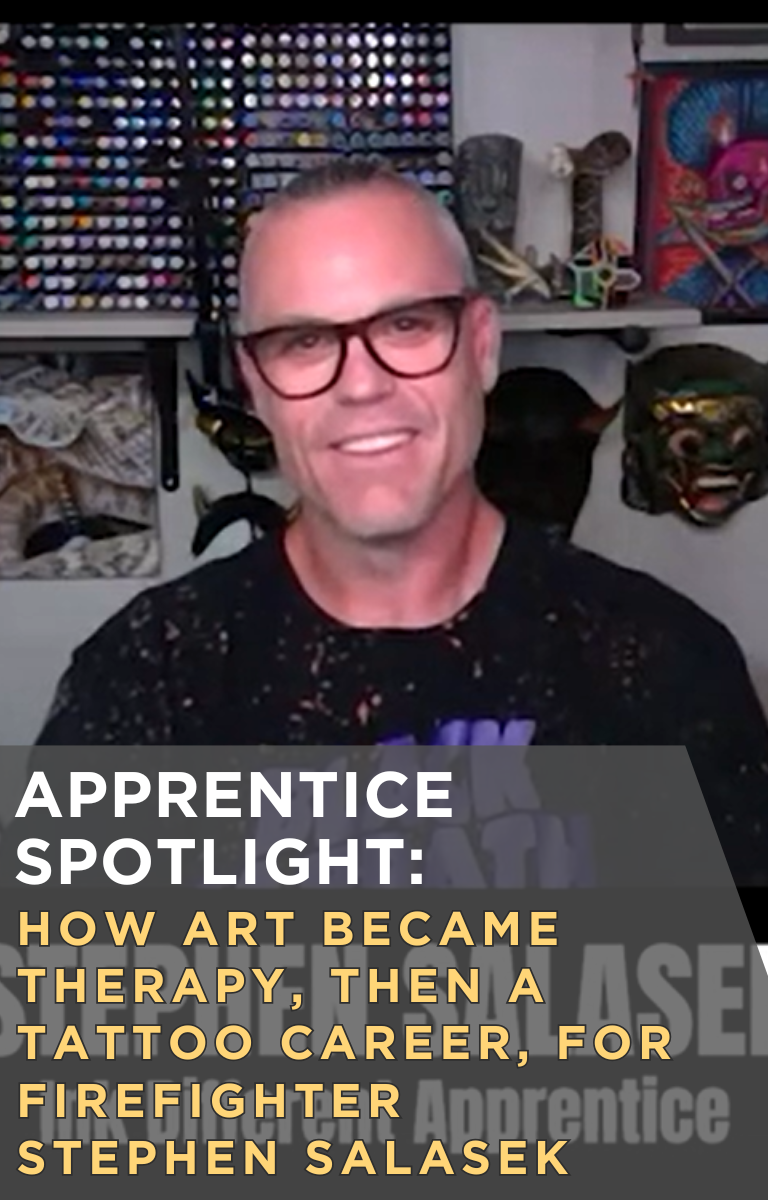
In This Article
- Key Takeaways
- Who is Stephen Salasek?
- How did art become therapy for a firefighter?
- Why did tattooing feel like the next natural step?
- What does it take to turn a passion into a career?
- How can you follow a path like Stephen’s?
- What is the Traditional Tattoo Apprenticeship?
- How does Master Mentorship push you further?
- Who can start a tattoo career with Ink Different?
- Ready to become a Tattoo Artist?
- FAQ
“Artwork is a form of therapy for me,” says Stephen Salasek. “It really is.” Stephen has been a firefighter with the Phoenix Fire Department since 2006. Somewhere along the way, between the job and raising three kids with his wife, he stopped drawing for nearly 10 years. When he finally picked a pencil back up, it changed everything.
Today, he’s a tattoo apprentice in Ink Different’s Traditional Tattoo Apprenticeship, still working full-time as a firefighter. In his Apprentice Spotlight interview, Stephen shared how art became his therapy, and how that therapy became a calling.
Key Takeaways
- The toll: Stephen says mental health takes a hit in public safety, and you don’t realize how much until it hits you.
- The voice: Something told him to pick up paper and pencils again, and drawing became true therapy.
- The calling: He says he stumbled into firefighting, but tattooing feels like a calling “down to a soul level.”
- The lesson: American traditional taught him to simplify designs so they heal right on skin.
- The future: He wants to bring 20 years of perspective to the tattoo chair as a kind of “skin shaman.”
Who is Stephen Salasek?
Stephen Salasek is a Phoenix firefighter of 20 years, a husband, a dad of three, and an Ink Different tattoo apprentice.
He’s been drawing since he was about five years old. As a kid, he was inspired by old-school Santa Cruz skateboard art, punk rock, metal, and monsters.
He was always interested in tattooing. But going door to door looking for a tattoo apprenticeship was hard, and he never found the right Mentor. After college didn’t feel like a fit, he joined the fire department in 2006.
How did art become therapy for a firefighter?
For Stephen, art came back when he needed it most.
He was working at a busy station in a rough area of Phoenix and saw a lot there. “Mental health takes a hit in public safety,” he says. “I knew that getting into it, but you don’t start realizing how much it does until it hits you.”
He had no hobbies at the time. He was going on shift and coming home from shift. “People say, ‘Don’t take stuff home with you,’” he says, “but you take stuff home with you. That’s the reality.”
Then he heard what he describes as a little voice in his ear. “It just was telling me, ‘Hey, just get a pad of paper, get pencils, get pens, just start doing it again.’”
So he did. On his days off, he’d get so absorbed in drawing that eight hours would go by. “I was getting lost in it in a really good way,” he says. That’s when he realized he had to have that art outlet.
Remember this: For Stephen, the thing he turned to for relief became the thing he wanted to do for a living.
Why did tattooing feel like the next natural step?
Stephen says tattooing doesn’t just feel like a career move. It feels like a calling.
“Even getting onto the fire department, I didn’t have that kind of calling-type feeling,” he says. “It was something I kind of stumbled into.” Tattooing is different. “It’s that calling for me. I just feel so connected to it. It’s down to a soul level.”
He also sees a deep connection between his two careers. Old-school Tattoo Artists sometimes call themselves “skin shamans.” After 20 years of seeing people at their best and worst, Stephen believes he can bring that understanding to the tattoo chair.
“In a 20-year career, you see so much stuff from one end of the spectrum to the other,” he says. “You really start valuing just moments in life… recognizing when people are in celebration of something, but recognizing also when people are hurting, when people are struggling.”
Tattooing is a deeply human craft, which is why Tattoo Artists are still essential.
What does it take to turn a passion into a career?
For Stephen, it took real mentorship.
Before Ink Different, he tried what he calls “YouTube University,” plus another online tattooing course. The problem was the lack of direct contact with instructors. “Sometimes you would ask for help on something and you just heard no response,” he says. “So you’re kind of stuck in the water.”
He’d followed Ink Different on social media for a long time, but the closest location was in Los Angeles. That wasn’t possible with his career and family. Then he got a text announcing a new tattoo apprenticeship in Phoenix. He worried it was a scam, but he responded, sent in his portfolio, went through the interview, and was accepted.
Now he values the small, interactive classes. “At a college level, there’s so many students packed into a course,” he says. “But within these classes, it’s a small class group, which is great. If you’ve got a question, they’ll take the time to break it down for you, right there in class.”
It also takes learning to design for skin. American traditional was his biggest challenge. “I could put all this detail into this tiny little design,” he says, “but it’s not going to translate onto skin because it’s not going to heal right.” His goal became simpler designs that still clearly read, like a rose that “still has to look like a rose.”
Before you start, read about the mistakes aspiring tattoo apprentices should avoid.
How can you follow a path like Stephen’s?
Step 1: Listen to what you reach for. Stephen turned to art when the job got heavy.
Step 2: Make room for it. He started drawing on his days off and realized how much he needed it.
Step 3: Find real feedback. Online videos left him stuck. Small classes with responsive instructors helped him grow.
Step 4: Fit training around your life. Stephen works 24-hour shifts followed by two days off. He works on design assignments on his iPad between calls and schedules his Zoom classes around sleep and picking up his kids.
Step 5: Learn to design for skin. Simplify so your work heals cleanly.
Step 6: Learn the tools. In Phase One, he learned to use colored pencils with a tattooing mindset, mimicking shading pressure and gradients, and to clean up sketches with Procreate layers. See the tools every beginner Tattoo Artist should know.
What is the Traditional Tattoo Apprenticeship?
Ink Different’s Traditional Tattoo Apprenticeship is an 18 to 24 month, four-phase tattoo apprenticeship built for beginners. Ink Different has trained Tattoo Artists for 15 years. No prior art experience is required.
- Phase One: Art and design, online. Stephen studied American traditional, neo-traditional, new school, and Japanese traditional.
- Phase Two: Machine practice on synthetic skin, online. Stephen recently started Phase Two and received his Mast Archer tattoo machine and practice skins.
- Phase Three: Supervised tattoos on real clients in a tattoo studio.
- Phase Four: Building independence and preparing for licensing.
Safety is part of the training, including the OSHA bloodborne pathogens standard.
This is a career that comes with confidence. You’ll finish with job-ready skills, licensing support, and a guaranteed job offer at one of Ink Different’s own tattoo studios. The Traditional Tattoo Apprenticeship is available at 60+ tattoo studios nationwide.
How does Master Mentorship push you further?
Once you’ve built your foundation, Ink Different’s Master Mentorship connects you with Master Mentors, including Al Fliction, Liz Cook, Kyle Dunbar, Boneface, Jordi Pla, Marcel Oliveira, and Kara Gutierrez.
Stephen already knows where he wants to go: Japanese traditional. He’s drawn to its deep symbolism, its rules, and how it naturally flows with the body.
Who can start a tattoo career with Ink Different?
Anyone serious about the craft. You don’t need art school or prior tattoo experience. You also don’t need to quit your job to begin, since Phases One and Two happen online.
Ink Different offers Spanish-speaking locations in Denver, Orange County, NYC, Miami, San Antonio, and San Diego. You’ll join a “Good Humans” culture, a supportive community from day one.
A note on timing: Seats are limited, with only two apprentices per tattoo studio per Mentor.
Ready to become a Tattoo Artist?
Stephen Salasek found his way back to art when he needed it most. Now he’s turning that therapy into a career, while still serving his community as a firefighter.
He sees tattooing as a way to help people, too. He’s excited to bring his perspective to the tattoo chair and help clients process their emotions through art.
Ready to become a Tattoo Artist? Apply now to Ink Different’s Traditional Tattoo Apprenticeship and start building an AI-proof career with licensing support and a guaranteed job offer at one of Ink Different’s own tattoo studios.
Frequently Asked Questions
How did art become therapy for Stephen Salasek?
After years of carrying the stress of public safety home, Stephen started drawing again on his days off. He’d lose himself in it for hours and realized he needed that outlet.
Is Stephen still a firefighter?
Yes. He’s training while working full-time with the Phoenix Fire Department.
Do I need prior art experience to start?
No. Stephen has been drawing since childhood, but the Traditional Tattoo Apprenticeship is built for beginners.
How long does the Traditional Tattoo Apprenticeship take?
Ink Different’s Traditional Tattoo Apprenticeship takes 18 to 24 months across four phases, with licensing support and a guaranteed job offer at one of Ink Different’s own tattoo studios.
Can I change careers into tattooing later in life?
Yes. Stephen is training after 20 years as a firefighter.
Where can I find a tattoo apprenticeship near me?
The Traditional Tattoo Apprenticeship is available at 60+ tattoo studios nationwide, including Spanish-speaking locations in Denver, Orange County, NYC, Miami, San Antonio, and San Diego.