
How to Become a Tattoo Artist in Minnesota
August 7, 2026
How to Become a Tattoo Artist in Oregon
August 11, 2026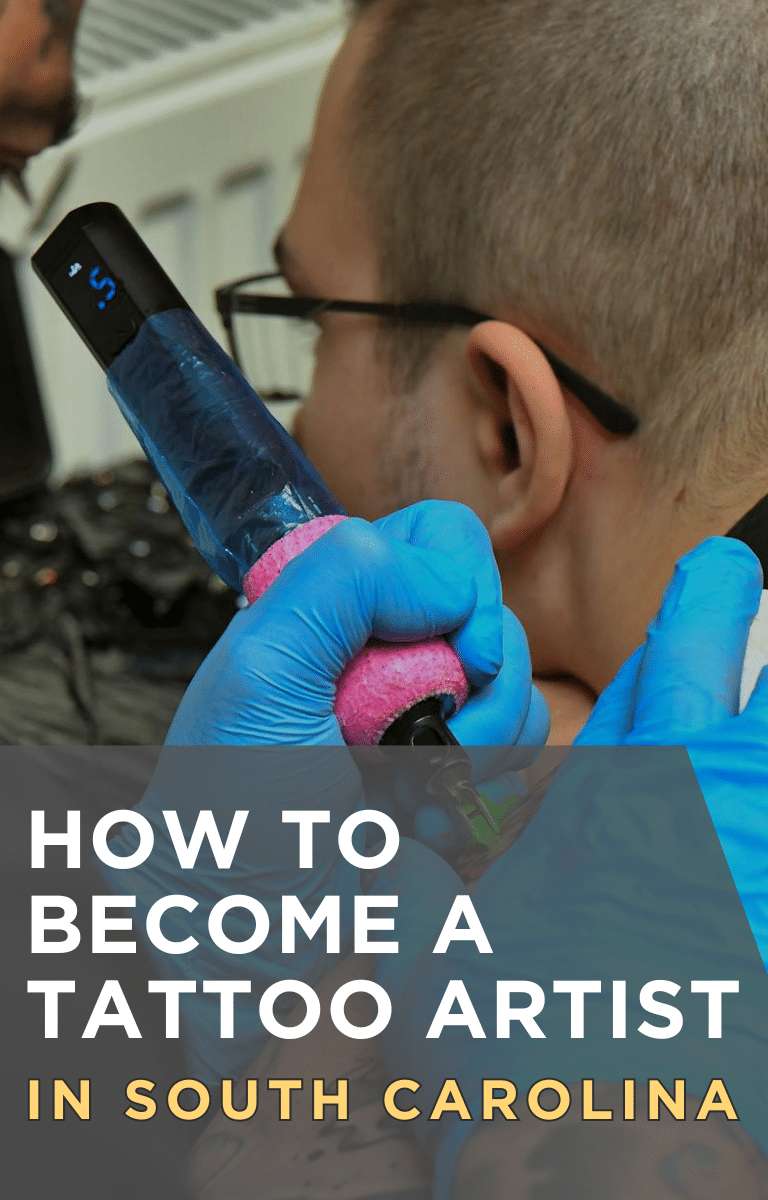
Below you will find the regulator, the governing statute, the step-by-step path, and the smart way to train through a real tattoo apprenticeship. Every licensing claim here comes straight from South Carolina’s official rules, and where a detail is not published we tell you to confirm with the state rather than guess.
Key Takeaways
- Regulator: The South Carolina Department of Public Health (DPH) oversees tattoo artist registration and facility inspection.
- Governing law: Tattooing in South Carolina is regulated under S.C. Code Section 44-34-10.
- Licensing model: South Carolina uses a state license, requiring artist registration and practice in an inspected facility.
- Key restriction: State law prohibits tattoos on the face or neck.
- Transfers: Out-of-state credentials are ineligible for transfer, so plan to register directly with South Carolina.
Table of Contents
- South Carolina tattoo licensing at a glance
- How does South Carolina regulate tattooing?
- What does the state license mean for you?
- How do you get a tattoo license in South Carolina step by step?
- What does a tattoo license in South Carolina cost?
- What if you are moving to South Carolina from another state?
- What mistakes should you avoid?
- How can Ink Different help you learn to tattoo?
- Frequently Asked Questions
South Carolina tattoo licensing at a glance
South Carolina requires every Tattoo Artist to register with the state and to work inside an inspected facility under S.C. Code Section 44-34-10.
- Regulator: Department of Public Health (DPH)
- Governing law: S.C. Code Section 44-34-10
- Licensing model: State license (artist registration)
- Core requirements: Artist registration, practice in an inspected facility, proof of age, and bloodborne pathogens (BBP) certification
- Special restriction: Tattoos on the face or neck are prohibited
- Fees: Not listed in our verified facts, so confirm current amounts with the DPH
How does South Carolina regulate tattooing?
South Carolina regulates tattooing at the state level through the Department of Public Health, which registers artists and inspects the facilities where they work.
Unlike states that leave tattoo rules entirely to counties, South Carolina sets a single statewide standard under S.C. Code Section 44-34-10. That means the same core requirements apply whether you plan to work in Charleston, Columbia, Greenville, or a smaller town.
The DPH handles two connected pieces: the individual artist registration and the inspection of the Tattoo Studio itself. Both must be in good standing for you to tattoo legally. The state also enforces a distinctive rule that many other states do not have, which we cover in the next section.
What does the state license mean for you?
A state license means you must be individually registered as a Tattoo Artist and can only practice in a facility that the state has inspected.
In practice, you cannot simply pick up a Tattoo Machine and start working out of your home or a pop-up space. Your tattooing has to happen inside a facility that meets South Carolina’s inspection standards, and your name has to be on file as a registered artist.
The state also lists specific requirements you must satisfy: proof of age, current bloodborne pathogens (BBP) certification, and completed artist registration. BBP certification shows you understand how to prevent the spread of infections, which is central to safe tattooing.
Important: South Carolina law prohibits tattoos on the face or neck. This is a hard legal restriction, not a studio preference, so make sure you and any clients understand it before booking work.
Because South Carolina lists out-of-state credentials as ineligible for transfer, you should treat South Carolina registration as its own process even if you already hold a license elsewhere.
How do you get a tattoo license in South Carolina step by step?
You earn a South Carolina tattoo license by training thoroughly, completing BBP certification, proving your age, registering as an artist, and working in an inspected facility.
Here is a practical path that lines up with the verified state requirements. Always confirm the exact current forms and steps directly with the South Carolina Department of Public Health, since procedural details can change.
- Learn to tattoo through a real tattoo apprenticeship. The state expects competent, safe artists. A structured Tattoo Apprenticeship Program under an experienced Mentor is how you build the skills to pass inspection scrutiny and serve clients well.
- Complete bloodborne pathogens (BBP) certification. This is a listed requirement. BBP training covers safe handling, sterilization, and cross-contamination prevention.
- Gather proof of age. South Carolina requires documentation that you meet the age requirement, so keep a valid government identification ready.
- Complete your artist registration with the DPH. This is the formal step that puts you on record as a registered Tattoo Artist in South Carolina.
- Work in an inspected facility. You must practice in a Tattoo Studio that the state has inspected. Confirm the facility’s status before you start tattooing there.
- Follow the face and neck restriction. Build your client consultation habits around the rule that face and neck tattoos are prohibited under state law.
What does a tattoo license in South Carolina cost?
Our verified facts do not list specific South Carolina tattoo license fees, so you should confirm the current amounts directly with the Department of Public Health.
Because fees, renewal cycles, and facility charges can change, we do not publish a dollar figure we cannot verify. The official DPH tattoo facilities page is the right place to check the exact costs for artist registration and any facility-related fees.
When you budget, think beyond the registration line item. You will also invest in your training, your BBP certification, and the quality equipment that lets you work safely and professionally. Those investments are what actually make you employable, and they pay off across a long career.
Tip: Treat any fee you see quoted on a third-party blog as unconfirmed. Verify every number against the South Carolina DPH before you rely on it.
What if you are moving to South Carolina from another state?
If you already hold a tattoo credential elsewhere, know that South Carolina lists out-of-state credentials as ineligible for transfer, so you will register fresh with the state.
This is common with state-run systems. Your experience and portfolio still matter enormously when a Tattoo Studio decides to hire you, but the legal registration itself does not carry over automatically. Plan to complete South Carolina’s artist registration, confirm your BBP certification meets state expectations, and provide proof of age.
Reach out to the Department of Public Health early so you understand the current forms and any documentation they want from an incoming artist. Getting this right up front keeps you from losing working time after your move.
What mistakes should you avoid?
The most damaging mistakes are tattooing before you register, working in an uninspected facility, and ignoring the face and neck prohibition.
- Skipping registration. Tattooing without being a registered artist puts your career and any studio at risk. Complete the DPH artist registration first.
- Working in an uninspected space. The state requires practice in an inspected facility. Confirm the Tattoo Studio’s inspection status before you accept work there.
- Letting BBP certification lapse. Bloodborne pathogens certification is a listed requirement. Keep yours current and documented.
- Offering face or neck tattoos. These are prohibited under South Carolina law. Do not make exceptions, no matter how a client asks.
- Assuming an out-of-state license transfers. It does not. Register directly with South Carolina.
- Trusting a quick-classroom shortcut. Real skill comes from a hands-on tattoo apprenticeship under a working Mentor, not a quick classroom promise.
How can Ink Different help you learn to tattoo?
Ink Different is the college alternative for serious artists, training you through a hands-on Traditional Tattoo Apprenticeship that builds real, employable skill.
Instead of a generic classroom, you learn from an experienced Mentor inside the daily rhythm of professional tattooing: consultations, stencil work, machine control, sanitation, and client care. That is the foundation South Carolina’s inspection-based system expects, and it is the foundation clients pay for. The Traditional Tattoo Apprenticeship runs 18 to 24 months across four phases, starts remote, and welcomes beginners.
Tattooing is also one of the most AI-proof careers you can choose. A generative model cannot hold a Tattoo Machine, read a client’s skin, or build the trust that a great custom piece requires. According to ZipRecruiter, a Professional Tattoo Artist can earn over $106,000 a year, which makes this a genuine alternative to a traditional degree and its debt.
Our Tattoo Apprenticeship Program pairs craft training with licensing support, so you understand how to line up your BBP certification, your artist registration, and your inspected-facility requirements along the way. We help you connect the dots between learning the art and meeting South Carolina’s rules.
Ready to become a Tattoo Artist? Apply now to Ink Different’s Traditional Tattoo Apprenticeship and start building an AI-proof career, with licensing support along the way.
Frequently Asked Questions
Do I need a state license to tattoo in South Carolina?
Yes. South Carolina uses a state license model that requires artist registration with the Department of Public Health and practice inside an inspected facility, under S.C. Code Section 44-34-10.
Who regulates tattooing in South Carolina?
The South Carolina Department of Public Health (DPH) regulates tattooing. It handles artist registration and inspects the facilities where tattooing takes place.
Are face and neck tattoos legal in South Carolina?
No. South Carolina law specifically prohibits tattoos on the face or neck. This is a distinctive restriction built into the state’s tattoo statute.
Can I transfer my tattoo license from another state?
No. South Carolina lists out-of-state credentials as ineligible for transfer, so you must complete South Carolina’s artist registration directly even if you are already licensed elsewhere.
What does a tattoo license cost in South Carolina?
Specific fees are not listed in our verified facts. Confirm the current registration and facility costs directly with the South Carolina Department of Public Health before you rely on any figure.
Do I need bloodborne pathogens certification?
Yes. Bloodborne pathogens (BBP) certification is a listed requirement for tattooing in South Carolina, alongside artist registration and proof of age.