
How Much Do Tattoo Artists Make Owning Their Own Shop?
September 30, 2026
How to Become a Tattoo Artist if You Are Left Handed
September 30, 2026
In This Article
- Key Takeaways
- What is a cover up tattoo?
- Why are cover up tattoos harder than fresh ink?
- What style skills matter most for cover ups?
- How does color theory make or break a cover up?
- How do you plan a cover up tattoo step by step?
- Where can you actually learn cover up skills?
- What does Ink Different’s training offer?
- Ready to become a Tattoo Artist?
- FAQ
You know that feeling when a client sits in your chair, rolls up a sleeve, and shows you the tattoo they regret? The faded ex’s name. The tribal band that no longer fits who they are. The shaky flash piece from a friend’s kitchen. In that moment, they aren’t just asking for ink. They’re asking you to help them turn the page on a chapter of their life.
That is the weight and the privilege of the cover up, and it is one of the most valuable skills you can carry as a Tattoo Artist. A cover up tattoo is a new design applied over an existing, unwanted tattoo, engineered to hide or transform the old ink using strategic color, contrast, and composition.
Key Takeaways
- Definition: A cover-up tattoo strategically hides old ink using darker values, saturated color, and smart design placement.
- Top skill: Color theory and value control matter most, since new ink must overpower what is already there.
- Design first: Successful cover-ups start with planning, not the tattoo machine, mapping the old tattoo before drawing anything.
- Learnable: Cover-up mastery comes from live, hands-on mentorship, not video tutorials or guesswork.
- Career-proof: Cover-up demand keeps skilled tattoo artists in a creative, AI-proof career built on human touch.
What is a cover-up tattoo?
A cover-up tattoo is a fresh design placed directly over an existing, unwanted tattoo, using darker values, denser saturation, and clever composition to disguise the original ink so it disappears into the new piece.
Think of the old tattoo as a stain on a canvas. You cannot simply paint white over it and expect it to vanish. You have to work with what is already there, building a new image that is intentional enough to command all the attention. Every mark you make either fights the old ink or hides it.
Cover-ups range from full transformations (an old name becomes a bold floral piece) to blast-overs and reworks that reinterpret existing art. Each one is a puzzle, and the artist who solves it well becomes the one clients trust with their skin.
Why are cover-up tattoos harder than fresh ink?
Cover-up tattoos are harder because you are not starting on a blank slate: you must design around darkness, scarring, and saturation that already exists in the skin, which limits your color and value choices dramatically.
With a fresh tattoo on clean skin, the world is open. You can go light, delicate, or minimal. With a cover-up, the old ink sets the rules. Dark tribal work, for example, forces you toward equally dark, high-contrast designs. Ignore that, and the ghost of the old tattoo will haunt every healed session.
This is exactly the kind of real-world problem-solving that separates trained professionals from beginners.

What style skills matter most for cover-ups?
The style skills that matter most for cover-ups are value control, color theory, design composition, and confident line and packing technique, because each one directly determines whether the old tattoo stays hidden after healing.
Let’s break down the toolkit you actually need to build. These are the skills we drill with every tattoo apprentice, because they are the difference between a cover-up that lasts and one that fades back into a mess.
- Value control: Knowing how dark you need to go to overpower existing ink without turning everything into a black blob.
- Color theory: Understanding which colors sit on top of others and which get swallowed.
- Composition and flow: Designing so the new imagery naturally absorbs the shape of the old.
- Smooth packing: Laying solid, even saturation so no old lines peek through.
- Reading skin: Recognizing scarring, ink density, and how a piece will heal over time.
Pro Tip: Great cover up artists think like negotiators. You are not erasing the past, you are convincing the eye to look somewhere new.
Building these skills is the same reason mastering your fundamentals matters. Get comfortable with your gear first by reviewing the tools every beginner tattoo artist should know.
How does color theory make or break a cover-up?
Color theory makes or breaks a cover-up because darker and more saturated colors will always dominate lighter ones, so you must choose shades that layer over the old ink instead of being overwhelmed by it.
Here’s the honest truth: you cannot cover dark with light. A black tribal band will not disappear under soft pastels. Skilled artists lean on deep, rich tones, purples, blacks, dark greens, and dense reds, to reclaim the space. Then they build brightness back in through smart contrast and negative space.
This is where science meets craft. Understanding pigment behavior in skin is a form of applied knowledge, similar to how professionals follow safety and health standards. The OSHA bloodborne pathogen standards govern how you protect clients, while resources like the American Academy of Dermatology tattoo care guidelines help you understand how skin heals and holds pigment over time.
How do you plan a cover up tattoo step by step?
You plan a cover up tattoo by evaluating the old ink, choosing a design that matches its value, mapping placement, drawing a stencil, and building saturation in confident layers.
A cover up is won or lost in the planning stage. Follow these steps, and you turn guesswork into a repeatable process that works on every client’s skin.
- Assess the existing tattoo. Note how dark it is, whether it’s scarred, and how much surface area it covers.
- Set realistic expectations. Talk your client through what’s possible so you’re building trust, not overpromising.
- Choose a design that fits the darkness. Pick imagery bold enough to dominate, like florals, animals, or organic shapes with strong contrast.
- Map the old shape. Design so the busiest parts of your new piece land exactly where the old ink is heaviest.
- Create and place the stencil. Test the flow on the body before committing.
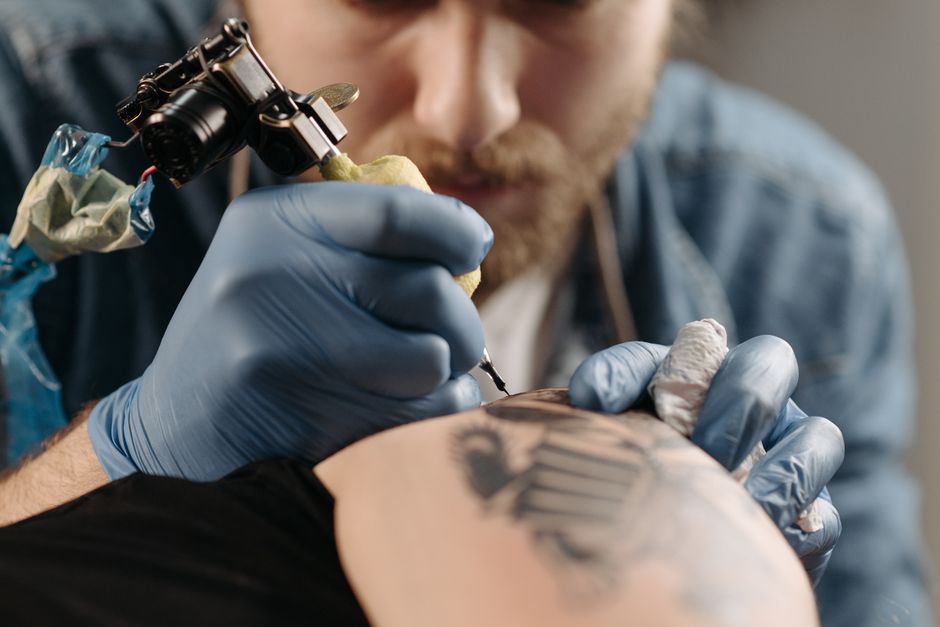
- Build in layers. Lay your foundation, pack your saturation, then refine contrast so nothing old shows through after healing.
Notice how much of this happens before you ever pick up the tattoo machine. That planning discipline is exactly what a strong tattoo apprenticeship trains into you, and it’s part of why tattoo apprenticeships are gaining ground as a college alternative.
Where can you actually learn cover up skills?
You learn cover up skills through live, in-person mentorship where an experienced tattoo artist guides you on real skin, because no video or online course can teach the feel and judgment cover ups demand.
You can watch a thousand tutorials and still freeze when a client’s regret is sitting under your needle. Cover ups reward experience, feedback, and repetition under a mentor who has solved these puzzles hundreds of times. That kind of learning cannot be faked.
This is also why cover up work is such a powerful reminder that skilled tattoo artists are not going anywhere. Human trust, live decision-making, and hands-on adaptation keep this an AI-proof career, as we explain in why tattoo artists are still essential. The Bureau of Labor Statistics continues to track steady demand for skilled craft and fine artists whose work depends on human hands.
What does Ink Different’s training offer?
Ink Different Tattoos offers a Traditional Tattoo Apprenticeship built on live, in-person mentorship where you learn real skills like cover-ups from award-winning Mentors, with licensing support and job-ready training upon completion.
We’ve spent over 15 years, since 2011, training aspiring artists to work professionally. If you’re in a job that drains you while your creative potential goes unused, this apprenticeship is a real path forward.
What you can expect from our Traditional Tattoo Apprenticeship
Our Traditional Tattoo Apprenticeship runs 18 to 24 months across a proven four-phase system. You train hands-on in real tattoo studios. No prior art experience required. We build you from the ground up.
- Personalized, hands-on training guided by professional tattoo artists.
- Start remote, finish in studios so you build skill before touching skin.
- Beginner-friendly foundation in drawing, machine control, and cover-up strategy.
- Licensing support and job-ready skills so you finish ready to work.
A career that comes with confidence
By the time you finish, you won’t just hope you can handle a cover-up. You’ll know. That confidence comes from real reps under real Mentors, plus licensing support and a guaranteed job offer at one of our tattoo studios, along with help meeting your state’s requirements.
Mentorship that pushes your brand and skills further
Ready to specialize? Our one-year, in-person Master Mentorship pairs you with celebrity and award-winning Mentors like Al Fliction, Liz Cook, Kyle Dunbar, Boneface, and Jordi Pla. It’s built for beginners and experienced artists chasing a specific style, career growth, and business ownership.
Making tattoo artist training accessible for everyone
We offer Spanish-speaking locations near Denver, Orange County, NYC, Miami, San Antonio, and San Diego, so language never stands between you and your future. Seats are limited, so apply early.
All of this is powered by our “Good Humans” culture: a supportive, family-like community that has your back long after you finish. You’re never learning alone.
Ready to become a tattoo artist?
Cover up skills are just one branch of the craft you’ll master. If you’re feeling the pull of a career change, read why a career change tattoo apprenticeship might be your move.
Ready to become a tattoo artist? Apply now to Ink Different’s Traditional Tattoo Apprenticeship and start building an AI-proof career, with licensing support along the way. Prefer to explore first? Fill out our quick questionnaire to get personalized support and find out if our Traditional Tattoo Apprenticeship is right for you.
Frequently Asked Questions
How long does it take to learn cover up tattoos?
Cover up skills develop throughout a full tattoo apprenticeship, typically 18 to 24 months. You build fundamentals first, then apply value control and color theory to cover ups under mentor supervision.
Do I need prior art experience to learn cover up tattooing?
No. Ink Different’s Traditional Tattoo Apprenticeship is built for beginners with no formal art background. We teach drawing, machine control, and cover up strategy from day one.
Why are cover up tattoos considered harder than regular tattoos?
Cover ups are harder because you design around existing dark ink and scarring rather than a blank canvas. This limits your color and value choices and demands stronger planning.
What makes Ink Different’s tattoo artist training different?
Ink Different offers live, in-person mentorship from award-winning mentors, a proven 4-phase system, licensing support, and a supportive “Good Humans” community, making it a real college alternative for aspiring artists.
Can any tattoo be covered up?
Most tattoos can be covered or reworked with the right design and value strategy, though very dark or heavily scarred pieces may require bolder imagery or multiple sessions to fully disguise.
Where can I do a tattoo apprenticeship near me?
Ink Different Tattoos operates studios nationwide, including Spanish-speaking locations near Denver, Orange County, NYC, Miami, San Antonio, and San Diego. Seats are limited, so apply early.