
How to Become a Tattoo Artist in New York
July 31, 2026
How to Become a Tattoo Artist in Virginia
August 3, 2026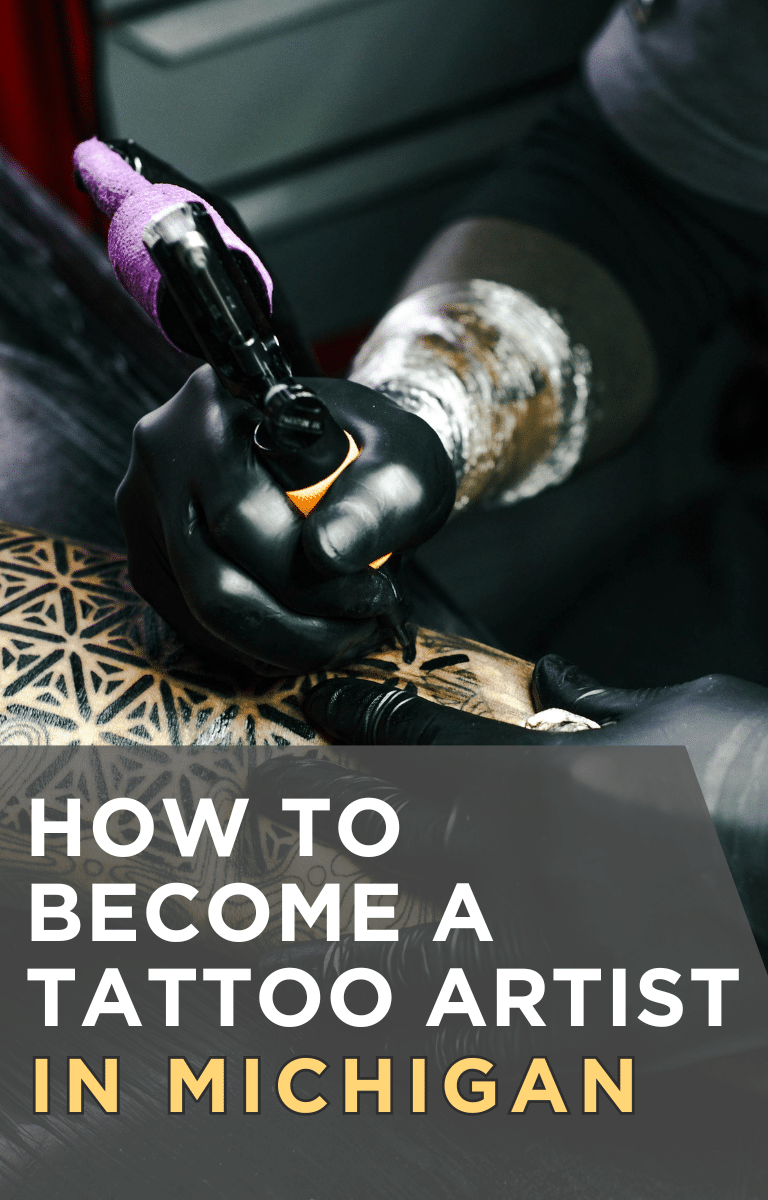
Becoming a professional Tattoo Artist in Michigan is less about chasing a personal license and more about learning your craft inside a properly licensed tattoo studio. A tattoo license in Michigan is a facility credential issued to the tattoo studio itself, not an individual card that each Tattoo Artist carries. That single fact shapes your entire path. Once you understand it, training and working legally in Michigan becomes straightforward.
This guide walks you through how Michigan regulates tattooing and what the shop-only model means for your career. You’ll also get the step-by-step path to working professionally and how a serious tattoo apprenticeship sets you up to earn a real living. A Professional Tattoo Artist can earn over $106,000 a year according to ZipRecruiter. It’s an AI-proof career built on human skill.
Key Takeaways
- Shop-only licensing: Michigan licenses the Tattoo Studio, not the individual artist, under state health law.
- Regulator: The Michigan Department of Health and Human Services (MDHHS) oversees body art facilities.
- BBP required: Artists need current bloodborne pathogens certification, renewed annually.
- No transfer: A tattoo license from another state cannot transfer into Michigan.
- Your leverage is skill: A strong tattoo apprenticeship, not paperwork, is what makes you employable.
Michigan Tattoo Licensing at a Glance
Michigan uses a shop-only licensing model, meaning the studio holds the license while individual Tattoo Artists work under it. Here are the core facts drawn directly from state requirements.
- Regulator: Michigan Department of Health and Human Services (MDHHS)
- Governing law: Mich. Comp. Laws §§ 333.13101 to 333.13112
- Licensing model: Shop-only, no individual artist license
- Key artist requirement: Current bloodborne pathogens (BBP) certification, renewed annually
- License transfer: Ineligible from other states
- Fees: Check the official MDHHS body art page for current amounts
For anything not listed above, including exact fee schedules, verify with the MDHHS Body Art Page before you rely on it.
How does Michigan regulate tattooing?
Michigan regulates tattooing through the Department of Health and Human Services, which licenses body art facilities under Mich. Comp. Laws §§ 333.13101 to 333.13112. The state treats tattooing as a public health matter, so the rules focus on the environment where tattooing happens rather than on certifying each person holding the Tattoo Machine.
Under this framework, a Tattoo Studio must be licensed before it can legally operate. Establishment owners use an online system to apply for facility licensure and to handle renewals, which keeps the paperwork centralized with the business rather than scattered across every artist.
The health-based approach explains why bloodborne pathogens certification matters so much. Anyone working with needles and skin needs current BBP certification, and that certification is renewed annually so your safety knowledge never goes stale.
Tip: Because the license lives with the shop, the reputation and compliance record of the studio you join directly affects the legality of your work. Choose your studio carefully.
What does the shop-only model mean for you?
In a shop-only state, you do not apply for a personal tattoo license in Michigan. Instead, you build the skills and safety credentials that let you work under a licensed studio. This is good news for anyone worried about a maze of individual exams and board applications.
There is no individual artist license in Michigan. The regulatory burden lives with the licensed shop, so your job is to make yourself the kind of artist a licensed studio wants on the floor. That means portfolio quality, technical control, and clean, professional practice.
Practically speaking, your two priorities are learning to tattoo at a high level and maintaining your BBP certification. Everything else on the compliance side flows through the studio that employs you.
Warning: Working without being connected to a properly licensed facility puts both you and the studio at legal risk. Do not tattoo the public outside a licensed establishment.
How do you become a Tattoo Artist in Michigan step by step?
To become a Tattoo Artist in Michigan, learn the craft through a structured tattoo apprenticeship, earn your bloodborne pathogens certification, and work inside a licensed tattoo studio. Here is the realistic sequence.
- Build a foundation in art and drawing. Strong fundamentals in composition, line, and shading are what separate a hobbyist from a Professional Tattoo Artist.
- Enroll in a serious tattoo apprenticeship. A structured tattoo apprenticeship with an experienced Mentor teaches machine control, sterilization, skin behavior, and studio workflow.
- Complete bloodborne pathogens training. Obtain current BBP certification and plan to renew it annually as Michigan requires.
- Develop a professional portfolio. Your portfolio is your credential in a shop-only state. It proves you can deliver clean, consistent work.
- Join a licensed Tattoo Studio. Because the facility holds the license, working under a licensed shop is what makes your practice legal.
- Confirm facility compliance. Verify with the studio owner that the establishment is licensed through the MDHHS online system and stays current on renewals.
Notice that nowhere in this path do you file for a personal license. Your effort goes into competence and safety, which is exactly where it belongs.
What does a tattoo license in Michigan cost?
Michigan facility license fees are set by the state and paid by the studio owner, so confirm current amounts directly on the MDHHS body art page rather than relying on any figure you find secondhand. We will not guess at a number, because fees change and only the official source is authoritative.
What you can plan for personally are the costs tied to your own development. These typically include your bloodborne pathogens training and its annual renewal, plus the investment you make in quality training through a structured tattoo apprenticeship.
If you eventually open your own studio, the facility licensure and renewal costs become yours, handled through the state’s online system. Until then, budget for your training, your BBP certification, and your equipment, and let the studio carry the facility fees.
Tip: Treat your training as a career investment. Compared to years of college tuition, a focused tattoo apprenticeship targets an AI-proof career where a Professional Tattoo Artist can earn over $106,000 a year.
Can you transfer a tattoo license from another state?
No, a tattoo license from another state is ineligible for transfer into Michigan because Michigan does not issue individual artist licenses in the first place. There is simply no personal credential to move over.
If you are relocating to Michigan as an experienced artist, the practical steps are straightforward. Make sure your bloodborne pathogens certification is current under Michigan’s annual renewal expectation, and secure a spot at a licensed Tattoo Studio in the state.
Your portfolio and reputation travel with you far better than any piece of paper would. In a shop-only state, demonstrated skill is your strongest asset when approaching a licensed studio.
What mistakes should you avoid?
The biggest mistake in Michigan is assuming you need a personal tattoo license and skipping the actual work of learning the craft inside a legitimate studio. Avoid the traps below.
- Chasing a nonexistent individual license. Michigan has no artist license, so do not waste time hunting for one.
- Letting BBP certification lapse. It must be renewed annually. An expired certification undermines both you and the studio.
- Tattooing outside a licensed facility. Kitchen and living-room work is unsafe and exposes everyone to legal risk.
- Skipping structured training. Self-teaching leaves dangerous gaps in sterilization and technique that a Mentor would catch.
- Assuming a tattoo apprenticeship and a classroom course are the same thing. True mastery comes from hands-on mentorship, not a shortcut.
- Trusting unverified fee figures. Always confirm costs on the official MDHHS page.
Learning to tattoo with Ink Different
Ink Different Tattoos is a college alternative that trains you through a Traditional Tattoo Apprenticeship built around a professional Mentor and hands-on client work. In a shop-only state like Michigan, this is exactly the kind of preparation that makes you employable at a licensed tattoo studio.
- Runs 18 to 24 months across four structured phases and welcomes beginners.
- Teaches machine control, needle theory, sterilization, and skin behavior.
- Covers design fundamentals and the professional habits that keep clients coming back.
- Builds the bloodborne pathogens safety knowledge and tattoo studio workflow a licensed shop expects.
Tattooing is a hands-on, human craft, which is why it remains work that machines cannot replace. A well-trained Tattoo Artist builds a career on expert skill, not shortcuts.
Michigan’s shop-only model means your credential is skill, not paperwork. Focus on training, certification, and a strong portfolio, and a licensed tattoo studio will take you seriously.
Ready to become a Tattoo Artist? Apply now to Ink Different’s Traditional Tattoo Apprenticeship and start building an AI-proof career, with licensing support along the way.
Frequently Asked Questions
Do I need a personal tattoo license in Michigan?
No. Michigan uses a shop-only model, so the tattoo studio holds the license and there is no individual Tattoo Artist license to apply for.
Who regulates tattooing in Michigan?
The Michigan Department of Health and Human Services (MDHHS) regulates body art facilities under Mich. Comp. Laws §§ 333.13101 to 333.13112.
What certification do I need as a Tattoo Artist in Michigan?
You need current bloodborne pathogens (BBP) certification, which must be renewed annually so your safety knowledge stays up to date.
Can I transfer my tattoo license from another state to Michigan?
No. Transfer is ineligible because Michigan does not issue individual Tattoo Artist licenses. You simply join a licensed Michigan tattoo studio with current BBP certification.
How much does a Michigan tattoo facility license cost?
Fees are set by the state and paid by the tattoo studio owner. Confirm the current amount on the official MDHHS body art page before relying on any figure.
How do I actually learn to tattoo in Michigan?
Complete a structured tattoo apprenticeship with an experienced Mentor, build a professional portfolio, earn your BBP certification, and work inside a licensed tattoo studio.