
How Hard Is It to Get a Tattoo License?
July 17, 2026
What a Tattoo License Costs: A Budget Guide for New Artists
July 21, 2026
In This Article
- Key Takeaways
- What is the difference between a tattoo license and a certification?
- Which one do you actually need to tattoo legally?
- Why do so many new Tattoo Artists get confused about this?
- How do you get a tattoo license step by step?
- Do certifications matter at all?
- Where do the rules change the most?
- How does Ink Different get you license-ready?
- What if you want to go even further?
- Ready to take the first step?
- FAQ
You are staring at forums, YouTube videos, and a hundred conflicting answers. And you just want one simple answer: what do you actually need to tattoo people legally and get paid for it?
That confusion is exhausting, and it is exactly what keeps talented people stuck in jobs that drain them. Here at Ink Different Tattoos, we clear the fog so you can stop researching and start building.
The short version: a tattoo license is a government-issued permit that lets you tattoo legally in your state or county. A certification is proof that you completed training in one specific skill, like bloodborne pathogen safety or CPR.
Key Takeaways
- License vs. certification: A tattoo license is legal permission from the government to tattoo; certification proves course completion.
- What you need: To tattoo legally, you need a state or county license, not just a certificate.
- Bloodborne pathogen: This certification is required nearly everywhere and is a licensing prerequisite.
- The true path: A structured tattoo apprenticeship builds skills and paperwork leading to licensing.
- Ink Different support: Our Traditional Tattoo Apprenticeship includes licensing guidance and job-ready training.
What is the difference between a tattoo license and a certification?
A tattoo license is legal government permission to tattoo in your area, while a certification is documented proof that you completed a specific training course, such as bloodborne pathogen safety or CPR.
Think of it like driving. A certificate is like the completion slip from driver’s ed: it shows you learned something. The license is what actually lets you drive on the road legally.
Certifications are usually issued by training providers or organizations. Licenses are issued by state health departments, county agencies, or city offices. They are not interchangeable, and confusing them is one of the most common early missteps we see.
Quick truth: Nobody hands you a license just for taking a weekend course. Licensing is a legal process, and certifications are pieces of that puzzle.
Which one do you actually need to tattoo legally?
To tattoo legally and earn an income, you need a tattoo license from your local government, and getting that license usually requires holding specific certifications first.
The license is the non-negotiable part. Without it, working in a professional tattoo studio is not an option, and tattooing without one can carry serious legal penalties depending on your state.
Certifications support the license. In most places, you cannot even apply for a license until you can prove you completed a bloodborne pathogen course that meets OSHA bloodborne pathogen standards. So the honest answer is: you need both, but the license is the destination, and the certification is a checkpoint along the way.

Why do so many new Tattoo Artists get confused about this?
Most new Tattoo Artists get confused because online sellers market cheap certifications as if they were a shortcut to a professional tattooing career. In reality, a certificate alone will not make you a licensed Tattoo Artist.
The internet is flooded with “tattoo certification courses” promising you can start tattooing after a quick online module. These prey on the same hope that pulls you toward this craft in the first place: the desire to escape a dead-end job and finally use your creative potential.
The problem is that no online certificate teaches you how to hold a tattoo machine, stretch skin, or heal a client’s ink properly.
Professional skill and legal standing come from hands-on training. A certificate without training is like owning a toolbox without knowing how to build anything.
How do you get a tattoo license step by step?
You get a tattoo license by completing required training and certifications, gaining supervised hands-on experience, then applying through your state or county health department. From there, you pass any required inspection or exam.
The exact order varies by location, but the general path looks like this:
- Step 1: Complete a bloodborne pathogen certification. Nearly every jurisdiction requires this before you touch a client.
- Step 2: Log supervised tattoo experience. Many states require a set number of hours or a formal tattoo apprenticeship under a licensed mentor.
- Step 3: Gather your paperwork. This may include certifications, proof of experience, identification, and application fees.
- Step 4: Apply through your local agency. Submit everything to your state or county health department.
- Step 5: Pass inspection or examination. Some areas require a written test or a tattoo studio inspection before issuing your license.
The specifics differ dramatically depending on where you live.
Do certifications matter at all?
Yes, certifications matter because they are often legal prerequisites for licensing, and they protect your clients. But they are supporting credentials, not a replacement for a license or real hands-on training.
The most important certification is bloodborne pathogen training. It teaches you how to prevent cross-contamination, handle needles safely, and protect both you and your clients from infection. Many studios and health departments will not let you work without it.
Aftercare knowledge matters, too. Understanding how skin heals, guided by resources like the American Academy of Dermatology tattoo care guidelines, keeps your work looking sharp and your clients coming back.
So, keep your certifications current. Just do not mistake them for the finish line. They are seeds you plant, but the tree only grows with real training and a license to back it up.
Where do the rules change the most?
Tattoo licensing rules change the most at the state and county level, meaning what qualifies you to tattoo in one state may not transfer directly to another without extra steps.
Some states require formal tattoo apprenticeship hours. Others focus on inspections and health certifications. A few counties add their own local requirements on top of state law. This patchwork is exactly why so many aspiring Tattoo Artists feel paralyzed before they even start.
According to the Bureau of Labor Statistics on craft and fine artists, skilled creative work continues to reward hands-on expertise, which is something artificial intelligence cannot replicate. If you want to understand why this career is built to last, read why Tattoo Artists are still essential.
The good news: you do not have to decode all of this alone. A structured tattoo apprenticeship program guides you through the exact requirements for your location.
How does Ink Different get you license-ready?
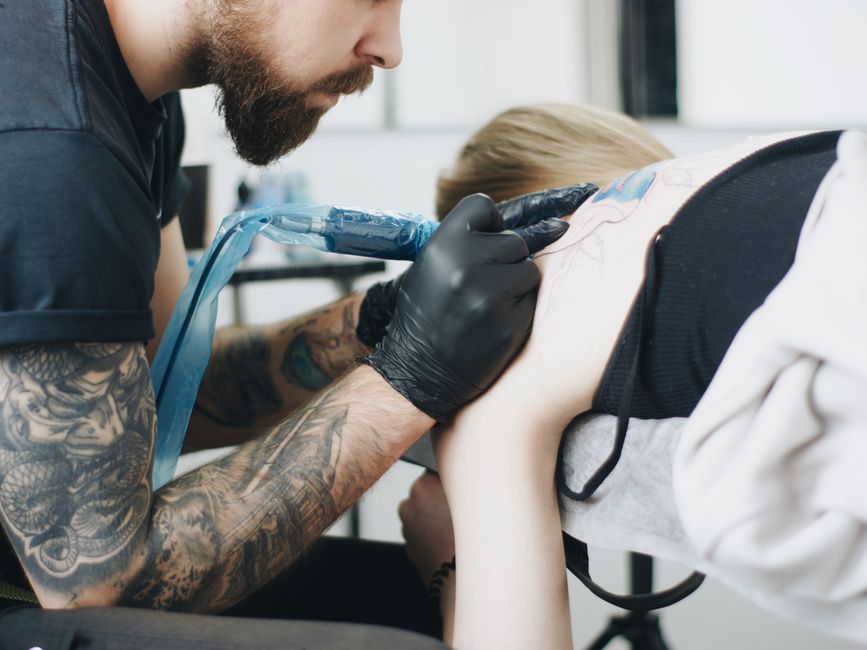
Ink Different Tattoos gets you license-ready through our Traditional Tattoo Apprenticeship, an 18-to-24-month training path with four phases that combine hands-on mentorship, licensing support, and job-ready skills.
This is where the confusion ends and the path begins. Instead of guessing which certificate to buy, you get a proven structure built over 15 years of training professional Tattoo Artists since 2011.
Here is what you can expect from our Traditional Tattoo Apprenticeship:
- Personalized hands-on training: You learn directly from experienced Mentors, not a pre-recorded video.
- Real studio experience: Train hands-on in professional tattoo studios alongside your Mentor.
- Built for beginners: No prior art experience required, so you can start from scratch.
- Licensing support: We help you navigate the certifications and paperwork your area demands.
- Job-ready with a guaranteed job offer: You graduate able to work professionally, backed by a guaranteed job offer.
This is a serious college alternative for people who are done wasting time and ready to invest in a hands-on craft. It is also grounded in our “Good Humans” culture, a family-like community where you are never left figuring things out alone.
Pro Tip: Live, in-person mentorship is the single biggest difference between Tattoo Artists who fizzle out and Tattoo Artists who build lasting careers. You cannot download muscle memory.
What if you want to go even further?
If you want to master a specific style, launch your brand, or explode an existing career, the Master Mentorship offers one year of in-person training alongside celebrity and award-winning mentors.
The Master Mentorship is for both beginners and experienced Tattoo Artists who want intensive skill development. You train with names like Al Fliction, Liz Cook, Kyle Dunbar, Boneface, and Jordi Pla. It is focused on style mastery, career growth, and business ownership.
Ready to take the first step?
A tattoo license is your legal permission to work, and certifications are the checkpoints that help you get there. You need both, but neither replaces the hands-on training that turns a hopeful beginner into a confident professional. The confusion that has been holding you back is not a sign that this is not for you: it is a sign you need the right guide.
Ready to become a Tattoo Artist? Apply now to Ink Different’s Traditional Tattoo Apprenticeship and start building a professional tattooing career with licensing support along the way. Not sure yet? Fill out our quick questionnaire to get personalized support and find out if our Tattoo Apprenticeship Program is right for you.
Frequently Asked Questions
Is a tattoo certification the same as a tattoo license?
No. A certification proves you completed a specific course, like bloodborne pathogen training. A tattoo license is legal government permission to tattoo. You typically need certifications to qualify for a license.
Can I tattoo legally with just an online certification?
No. An online certificate does not authorize you to tattoo legally. You need a license from your state or county, which usually requires supervised experience and safety certifications first.
Do I need experience to start a tattoo apprenticeship?
No. Ink Different’s Traditional Tattoo Apprenticeship is built for beginners with no prior art experience. You start with fundamentals and build skills through hands-on mentorship from day one.
How long does it take to become a licensed Tattoo Artist?
It typically takes 18 to 24 months through a structured tattoo apprenticeship. Timelines vary by state, program, and how quickly you master each training phase.
What makes Ink Different different from buying a certificate online?
Ink Different offers live, in-person mentorship, 15 years of experience since 2011, licensing support, and a family-like “Good Humans” culture. A certificate alone teaches none of that.
Are the licensing rules the same in every state?
No. Requirements vary significantly by state and county. Some require apprenticeship hours, others require inspections or exams. Ink Different helps you navigate the rules for your specific location.