Become a Tattoo Artist in Virginia Beach, Virginia
October 15, 2026
Become a Tattoo Artist in Kansas City, Missouri
October 15, 2026
In This Article
- Key Takeaways
- What is vocational rehabilitation and who qualifies?
- What careers will vocational rehab pay for?
- Can vocational rehab pay for tattoo artist training?
- How do you apply for vocational rehab funding?
- Why is tattooing a smart career to pursue?
- What does Ink Different’s apprenticeship offer?
- What is the Master Mentorship?
- Ready to take the first step?
- FAQ
There’s no fixed list of jobs that vocational rehab will pay for. Instead, you and your VR counselor choose a realistic career goal that fits your strengths, abilities, and interests, and VR can help fund the training to get there. That means skilled trades and hands-on careers, including tattooing, can qualify when they’re written into your approved plan.
This guide explains how VR decides which careers it supports, why skilled trades and apprenticeships make strong goals, and how to bring a tattoo career to your counselor.
Key Takeaways
- No fixed list: VR doesn’t work from a list of approved careers. Your goal is chosen with your counselor and built around you.
- Who qualifies: Generally, people whose disability creates a substantial barrier to employment and who need VR services to work.
- What it can fund: Training, books, tools, supplies, and occupational licenses tied to your goal.
- Tattooing: It can be a VR goal. Ink Different is an approved vocational rehab provider in Connecticut, Georgia and Pennsylvania.
- Next step: Contact your state VR agency and name your career goal clearly from day one.
What is vocational rehabilitation and who qualifies?
Vocational rehabilitation is a state-run service that helps people with disabilities prepare for, find, and keep work. The U.S. Department of Education’s Rehabilitation Services Administration funds each state’s VR agency through federal grants, and each state runs its own agency.
Under federal rules, you’re generally eligible if you have a physical or mental impairment, it creates a substantial barrier to employment, and you need VR services to get or keep a job. The full criteria are in 34 CFR 361.42, which also says people receiving SSI or SSDI are presumed eligible.
What careers will vocational rehab pay for?
Vocational rehab doesn’t pick careers from a list. Your Individualized Plan for Employment (IPE) has to be built around an employment goal you select, one that fits your strengths, abilities, interests, and informed choice.
What VR is ultimately working toward is competitive integrated employment, which in plain terms means a real job, in a regular workplace, paying at least what others doing that work earn. So the question your counselor is really asking is: will this goal realistically lead to steady work for you?
That opens the door wider than most people expect. A goal could be a trade like welding, a healthcare role, a tech certification, or a hands-on craft like tattooing. What matters is that the goal is realistic and the training gets you there.
Apprenticeships and hands-on training can count, too. Texas’s VR agency, for example, lists registered apprenticeships and on-the-job training among the training it supports. A tattoo apprenticeship isn’t a registered apprenticeship, and every state sets its own rules, but it shows that VR training isn’t limited to college classrooms.
Once your goal is set, federal rules let VR pay for the services you need to reach it, including vocational training, books, tools, training materials, occupational licenses, and equipment.

Can vocational rehab pay for tattoo artist training?
It can, but it’s never automatic. VR may help pay for Tattoo Artist training when becoming a Tattoo Artist is the goal in your approved IPE and your counselor approves the training provider.
Here’s the case for tattooing as a VR goal. No college trains Tattoo Artists. The craft is learned through a tattoo apprenticeship, because working safely on real skin takes long-term, hands-on mentorship from someone who’s done it for years. That gives your counselor a clear training route, a clear end point, and a path to licensing, since licensing rules for Tattoo Artists vary by state.
Here’s what’s confirmed for us: Ink Different is an approved vocational rehab provider in Connecticut, Georgia, and Pennsylvania. If you live anywhere else, we aren’t approved yet, but you can ask your counselor whether Ink Different can be approved as a vendor. Our team can support that request with paperwork and by talking with your counselor directly.
Pro Tip: Bring your counselor a written overview of the tattoo apprenticeship you want: how long it takes, how it’s structured, and how it leads to licensing and work. A specific plan is much easier to approve than a general idea.
How do you apply for vocational rehab funding?
You apply through your state’s VR agency. You’ll get an eligibility decision, then build an IPE with your counselor that names your career goal and the training to reach it.
Step one: Find your state agency. Use the Rehabilitation Services Administration’s directory of state VR agencies and request an intake appointment.
Step two: Gather your documentation. Pull together the medical or other records that show your disability and how it affects work.
Step three: Get your eligibility decision. Agencies generally have 60 days from your application to decide, unless you both agree to extend it.
Step four: Talk through career goals. Come prepared with the career you want and why it fits you. If that’s tattooing, say so.
Step five: Build your IPE. Your plan generally has to be finished within 90 days of your eligibility decision. It names your goal, your services, and who will provide them.
Step six: Wait for written approval. Once your plan is signed and the training is authorized, you can start. Don’t enroll or pay for anything you expect VR to cover before then.
Before your first appointment, read up on the mistakes aspiring tattoo apprentices should avoid to keep you from stumbling early in your journey.
Why is tattooing a smart career to pursue?
Tattooing is a skilled trade with a clear training path, real income potential, and work that can’t be automated. You learn it hands-on, you license it, and you build a client base that grows with your skills.
It’s also a trade you can take with you. Licensing rules vary by state, but once you’re trained and licensed, your skills go wherever you do. If you’re weighing a big change, our post on the career change tattoo apprenticeship path walks you through what the switch looks like.
And if you’re wondering how it compares to a four-year degree, our breakdown of tattoo apprenticeships as a college alternative lays out the differences.
What does Ink Different’s apprenticeship offer?
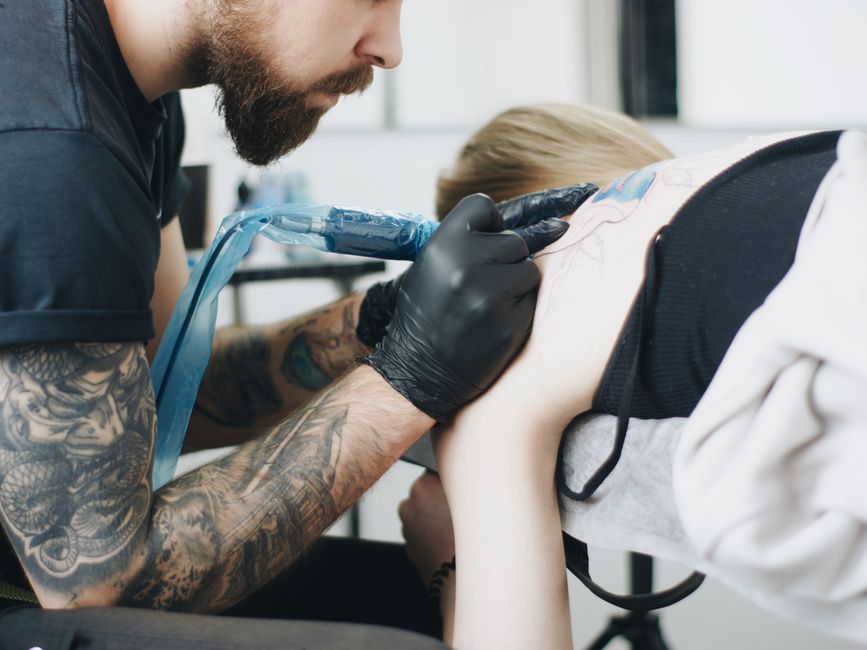
Ink Different’s Traditional Tattoo Apprenticeship takes 18 to 24 months across four phases. It trains beginners into working Tattoo Artists, with licensing support and a guaranteed job offer when you finish. No prior art experience is needed.
We’ve been training new Tattoo Artists since 2011, with 60+ locations nationwide. You learn from Mentors who are professional Tattoo Artists, working hands-on inside real tattoo studios.
Each phase builds on the last. You start with drawing and design fundamentals, move into machine handling and technique, and work your way up to supervised work on real clients. Safety training is part of it from the start, based on OSHA’s Bloodborne Pathogens standard, so you learn to work clean and safe before you ever touch a client.
You’ll also join our “Good Humans” community, a crew of Mentors and fellow tattoo apprentices who have your back the whole way.
What is the Master Mentorship?
The Master Mentorship is Ink Different’s one-year, in-person intensive for experienced Tattoo Artists who want to master a specific style, grow their career, and build a business.
You train directly with celebrity and award-winning Master Mentors, including Al Fliction, Liz Cook, Kyle Dunbar, Boneface, and Jordi Pla. It’s built for Tattoo Artists who want to level up, launch a brand, or open their own tattoo studio.
With 60+ locations nationwide, there’s a good chance you can train close to home. We also have Spanish-speaking locations in Denver, Orange County, NYC, Miami, San Antonio, and San Diego, so language doesn’t have to stand between you and a new career.
Ready to take the first step?
If you’ve been wondering whether VR could support a career you actually want, the answer starts with one conversation with your state agency. Bring a clear goal and a clear training path, and you’ll give your counselor what they need to say yes.
Want to talk through funding first? Call an advisor at 855 600 4465. Ready to go? Apply now to Ink Different’s Traditional Tattoo Apprenticeship, or fill out our quick questionnaire for personalized support.
Frequently Asked Questions
Is there a list of vocational rehab approved careers?
No. VR doesn’t use a fixed list of approved careers. You choose your employment goal with your counselor, and it has to fit your strengths, abilities, and interests and lead to real work.
What jobs will vocational rehab pay for?
Any realistic job goal that’s written into your approved IPE, from skilled trades to tech to hands-on crafts. VR then helps fund the training, tools, and licenses you need to reach it.
Does vocational rehab pay for tattoo training?
It can, if becoming a Tattoo Artist is the goal in your approved plan and your counselor approves the provider. Ink Different is an approved vocational rehab provider in Connecticut, Georgia and Pennsylvania.
Who qualifies for vocational rehabilitation services?
Generally, people with a physical or mental impairment that creates a substantial barrier to employment, who need VR services to work. Your state agency makes the final call.
Do I need prior art experience to start?
No. The Traditional Tattoo Apprenticeship is built for beginners and starts with drawing fundamentals.