Tattoo License Reciprocity, Explained for New Tattoo Artists
July 22, 2026
Where You Can Legally Learn to Tattoo: Licensing for Tattoo Apprentices
July 24, 2026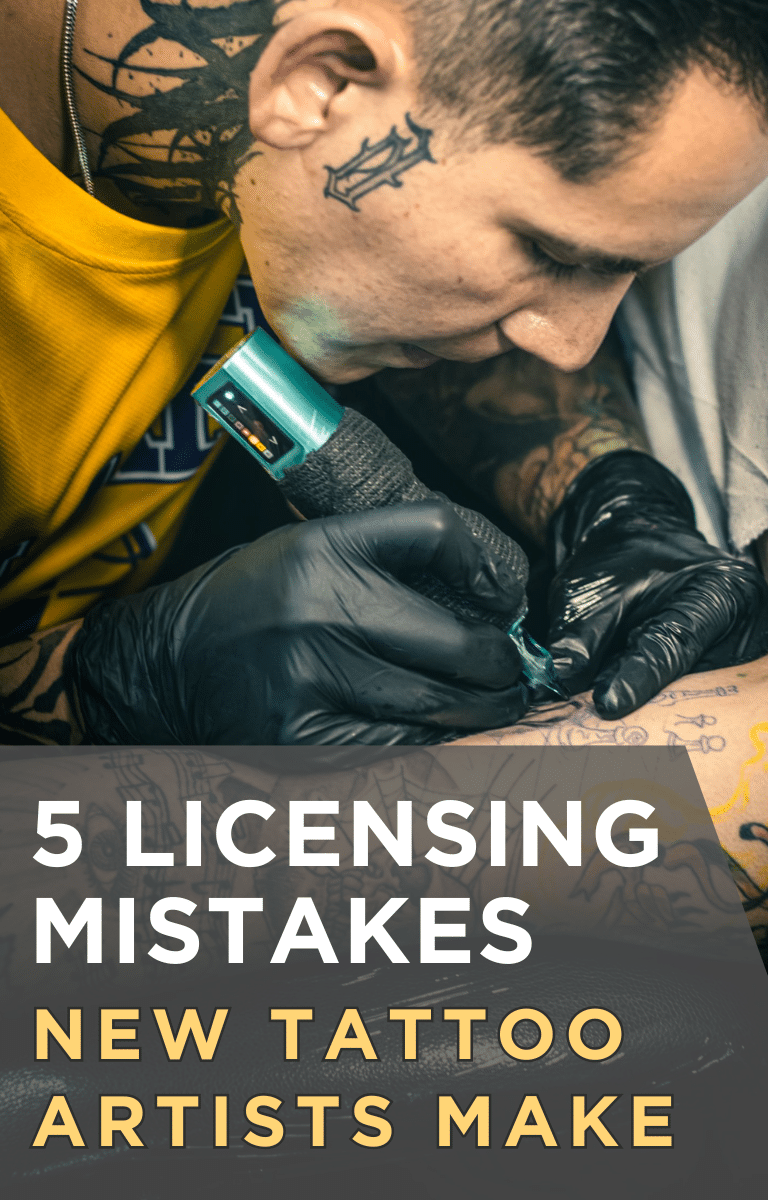
Tattoo license requirements vary wildly by state, and small paperwork mistakes can stall a promising Tattoo Artist before the first paying client. Some states issue an individual tattoo license. Others regulate only the shop, hand oversight to county health departments, or skip licensing almost entirely. Because the rules aren’t uniform, a credential that makes you legal in one state can leave you unlicensed in another.
Here are the five mistakes new Tattoo Artists make most often, based on how each state actually regulates the craft.
Key Takeaways
- No single national license exists: states use state-license, county-local, shop-only, permit, or no-license models, so your requirements depend on where you plan to work.
- County rules apply even in state-license states: California, Colorado, Kentucky, and others push registration and inspection down to local health departments.
- Transfers are rarely automatic: most incoming Tattoo Artists get guest or documentation status, though Vermont and Virginia offer clearer paths.
- Certifications differ by state: Iowa rejects standalone CPR, while Tennessee and Oregon require both CPR and First Aid, along with bloodborne pathogen training.
- Listed fees are rare: only a handful of states publish fees directly, so always confirm the amount on the official form.
Mistake 1: Do you assume every state issues an individual tattoo license?
Many states never issue an individual tattoo license at all. Instead, they regulate the tattoo shop and leave the Tattoo Artist tied to a licensed facility. This is the first, and most costly, assumption new Tattoo Artists make.
Several states use a shop-only model. In Illinois, the Illinois Department of Public Health registers Tattoo Artists within a registered facility instead of licensing them individually. Indiana works the same way through the Indiana Department of Health, where the shop operator ensures every Tattoo Artist completes annual OSHA-compliant bloodborne pathogen training. Louisiana, Michigan, North Dakota, and Ohio also place the licensing burden on the shop, not the individual Tattoo Artist.
Other states step back even further. Arizona has no state board and no centralized health regulation for tattoo shops. Its statute focuses only on protecting minors, and bloodborne pathogen certification is simply recommended for insurance purposes. Idaho and Maryland are similarly minimal, deferring to OSHA standards and local ordinances.
On the other end sit full state-license states like Connecticut. The Department of Public Health requires 2,000 hours of training under a licensed professional. You’ll also need a written exam and current Basic First Aid before you can legally tattoo.
Before anything else, identify which model your state uses. In a shop-only state, your first move is joining a licensed shop, not applying for a personal license that doesn’t exist.
Mistake 2: Are you ignoring county and local health departments?
Even in states with statewide frameworks, many delegate registration, inspection, and approved-trainer lists to counties. A state-level checklist alone won’t make you legal.
California is the clearest example of this hybrid model. State law sets the floor, but a Local Enforcement Agency in each county handles registration. In Los Angeles County, that means a $54 initial registration fee, annual renewal, a Hepatitis B vaccination or declination, and a county-approved bloodborne pathogen course. Colorado follows a similar pattern through local boards of health, where Denver requires demonstrated aseptic-technique knowledge.
Kentucky layers statewide rules on top of mandatory local registration and inspection. Nevada has no state board at all; Clark County issues a Body Art Card after a sanitation exam, and Washoe County runs a similar local permit. New York has no statewide license either. New York City’s Department of Consumer and Worker Protection runs the country’s most detailed tattoo licensing system through the NYC Health Academy Infection Control Course.
North Carolina shows why this matters long term. The Tattoo Permit from the county health department is tied to a specific Tattoo Artist and a specific shop. Moving studios or counties means starting the permit process over again.
Pennsylvania and Wyoming show the widest range. In Philadelphia, you need a tattoo apprenticeship letter from a certified Tattoo Artist plus a $40 fee, while other Pennsylvania counties impose no health oversight at all. Wyoming leaves eligibility, fees, and exams entirely to local departments.
Mistake 3: Do you expect your license to transfer automatically?
Most states don’t offer automatic reciprocity. Moving with an existing credential usually means guest status, a documentation review, or a fresh application.
Incoming Tattoo Artists tend to fall into a few transfer categories. A large group of state-license states, including Alaska, Arkansas, Connecticut, Hawaii, Iowa, Maine, Mississippi, Missouri, Oklahoma, Rhode Island, Tennessee, Washington, and Wisconsin, treat out-of-state Tattoo Artists under a guest framework rather than a clean transfer. Others, including Alabama, Kansas, Kentucky, Massachusetts, Minnesota, Nebraska, New Hampshire, New Mexico, and Nevada, require documentation review of your credentials.
Two states stand out as the friendliest for relocating Tattoo Artists. Vermont’s Office of Professional Regulation offers a Fast Track Endorsement for Tattoo Artists licensed in equivalent states, backed by a documented tattoo apprenticeship and a supervising statement. Virginia’s Department of Professional and Occupational Regulation publishes a clear licensure-by-endorsement path for qualified out-of-state Tattoo Artists, alongside its 1,500-hour training requirement and $120 fee.
Some states are effectively closed to transfer, simply because there’s no individual license to transfer into. Arizona, Delaware, Idaho, Illinois, Indiana, Louisiana, Maryland, Michigan, Montana, New Jersey, North Dakota, Ohio, Pennsylvania, South Carolina, Utah, and West Virginia fall into this group, so you re-enter through the shop or the local department instead.
Oregon and Florida take a more structured approach. Oregon’s Health Licensing Office accepts out-of-state education only if it’s substantially equivalent to its 360-hour state-approved curriculum. Florida publishes one of the most detailed reciprocity matrices in the country through its county-administered Department of Health.
Mistake 4: Are you confusing CPR, First Aid, and BBP certifications?
Bloodborne pathogen training, CPR, and First Aid are three separate certifications, and states are strict about which ones they accept and when they expire.
Bloodborne pathogen training is nearly universal, but timing rules vary. Alabama requires an approved BBP course completed within the prior 36 months. Georgia specifies that BBP, First Aid, and CPR certifications can’t expire within six months of a renewal. Illinois and Indiana require annual BBP training tied to the facility.
The certification trap that catches Tattoo Artists most often is scope. Iowa’s Department of Inspections, Appeals, and Licensing accepts Standard First Aid training but rejects a standalone CPR or AED-only certificate. That distinction alone has led to rejected license applications.
Some states require the full stack. Tennessee is one of roughly eleven states that require both CPR and First Aid for licensure, along with a state Tattoo Artist license and a local health certificate for the shop. Oregon similarly requires CPR and First Aid, BBP training, a high school diploma, graduation from a state-approved 360-hour curriculum, and a written exam. Connecticut and Maine require First Aid alongside their BBP training.
Hawaii adds a medical dimension that surprises newcomers. Its Department of Health Sanitation Branch requires Tuberculosis and Syphilis medical reports on top of BBP certification and a written exam.
Mistake 5: Are you guessing at fees and bonds?
Only a handful of states publish fees online, and guessing at the number, or mistaking a bond for a fee, leads to budgeting errors and missed payments.
Among the states that list a fee directly in their requirements, here is what the figures actually represent, ordered from lowest to highest listed Tattoo Artist-facing cost:
- California: $54 initial registration fee in Los Angeles County, with annual renewal.
- Florida: $60 application fee through the county-administered Department of Health.
- Wisconsin: $60 for the Practitioner’s License from the Department of Safety and Professional Services.
- Iowa: $75 Tattoo Artist permit and a separate $100 establishment permit, both annual.
- New Mexico: $100 initial licensure fee, plus a separate exam fee for the PCS national exam.
- Virginia: $120 licensure fee through the Board for Barbers and Cosmetology.
- Washington: $275 application fee plus a $330 shop license per location.
- Texas: $927 studio license fee, with Tattoo Artists registered to that studio.
Two figures in this list aren’t fees at all. Pennsylvania’s $40 is the Philadelphia application cost tied to a tattoo apprenticeship letter. Oklahoma’s $100,000 figure is a surety bond amount, and the Oklahoma State Department of Health recently removed that bond requirement to reduce barriers to opening a shop.
Every other state publishes its fees on official forms rather than listing them upfront. Don’t guess at the number. Pull the current fee schedule from your state board or local health department before you apply.
How do you learn to tattoo the right way with Ink Different?
Ink Different Tattoos is a college alternative for people who want a professional, hands-on career. Tattooing takes skill, trust, and a solid legal foundation, none of which you can shortcut. Most of the mistakes above happen because new Tattoo Artists learn the craft without learning the compliance side that keeps them working.
A Tattoo Artist can earn over $106,000 a year, according to ZipRecruiter. That income comes from mastering the craft and understanding the licensing rules for wherever you plan to work.
Our Traditional Tattoo Apprenticeship pairs you with a working Mentor who trains you on fundamentals while helping you navigate the licensing model, certifications, and local requirements for your state. Instead of guessing whether your state issues an individual license or defers to a county, you build your portfolio and your paperwork the right way from day one.
Ready to become a Tattoo Artist? Apply now to Ink Different’s Traditional Tattoo Apprenticeship and start building an AI-proof career, with licensing support along the way.
Frequently Asked Questions
Is there one national tattoo license in the United States?
No. There’s no national tattoo license. States use different models, ranging from full state licenses to county-local permits, shop-only registration, and minimal or no-license approaches. Your requirements depend on your exact location.
Which states make it easiest to transfer an existing tattoo license?
Vermont offers a Fast Track Endorsement for Tattoo Artists licensed in equivalent states, and Virginia publishes a clear licensure-by-endorsement path. Most other states use guest or documentation review instead of automatic reciprocity.
Do I need CPR and First Aid, or just bloodborne pathogen training?
It depends on the state. Tennessee and Oregon require CPR, First Aid, and BBP training, while Iowa accepts Standard First Aid but rejects standalone CPR. Always check your state’s exact certification wording.
Can I tattoo in a state that has no individual license?
Yes. In shop-only states like Illinois, Indiana, Louisiana, Michigan, North Dakota, and Ohio, you work under a licensed shop and complete facility-based BBP training instead of holding a personal license.
How much does a tattoo license cost?
Listed fees vary widely. Examples include a $54 registration fee in Los Angeles County, $60 in Florida and Wisconsin, $120 in Virginia, and a $927 studio license in Texas. Most states publish fees on official forms rather than listing them upfront.
Why do county health departments matter if my state has a license?
Because states like California, Colorado, Kentucky, and Nevada delegate registration, inspection, and approved-trainer lists to counties. A statewide credential alone won’t make you legal without meeting local requirements too.